Section 4.3Logarithmic Functions
Corequisite Skills review (optional warm-up)
Learning Objectives
- Convert between exponential and logarithmic form. (IA 10.3.1)
- Evaluate logarithmic functions. (IA 10.3.2)
Objective 1: Convert between exponential and logarithmic form. (IA 10.3.1)
Practice Makes Perfect
Graph the exponential function \(f(x)={2}^{x}\) by making a table.
| \(x\) | |||||
| \(y=f(x)\) |
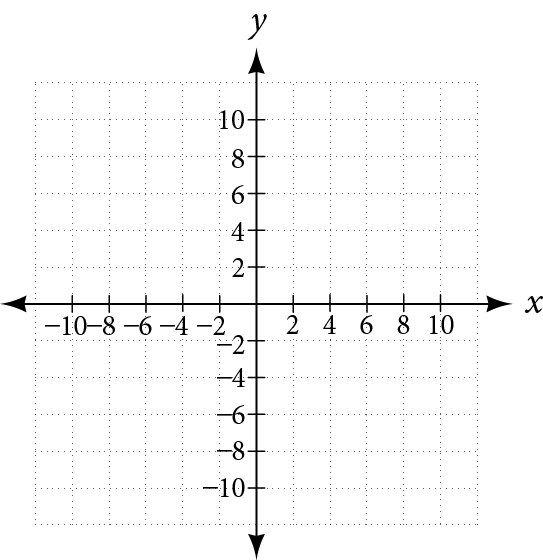
- ⓐ Is it one-to-one?
- ⓑ Domain?
- ⓒ Range?
- ⓓ Graph the inverse of \(f(x)={2}^{x}\) on the grid above by interchanging x and y coordinates in the table.
- ⓔ Is the inverse a one-to-one function?
- ⓕ Domain?
- ⓖ Range?
Find the inverse of \(f(x)={2}^{x}\)
- Rewrite with \(y=f(x)\): \(y={2}^{x}\)
- Interchange the variables \(x\) and \(y\): \(x={2}^{y}\)
- Solve for \(y\): Oops! We have no way to solve for \(y\).
We give y a new notation:
\[y=\log_2 x\]
"\(y=\log_2 x\)" read "the logarithm, base 2, of x," means "the power to which we raise 2 to get x."
The function \(y=\log_a x\) is equivalent to \(a^y=x\) is the logarithmic function with base \(a\), where \(a>0\), \(x>0\).
Since the equations \(y=\log_a x\) and \(x=a^y\) are equivalent, we can go back and forth between them. This will often be the method to solve some exponential and logarithmic equations. To help with converting back and forth, let's take a close look at the equations. Notice the positions of the exponent and base.
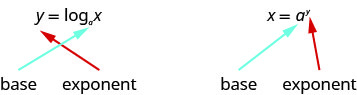
If we remember the logarithm is the exponent, it makes the conversion easier. You may want to repeat, "base to the exponent gives us the number."
Convert between exponential and logarithmic form.
ⓐ Convert to logarithmic form: \(2^3=8\)
Identify the base and the exponent: the base is 2 and the exponent is 3.
Then we have \(3=\log_2 8\).
ⓑ Convert to exponential form: \(\log_b m=a\)
Identify the base and the exponent: the base is b and the exponent is a.
Then we have \(b^a=m\).
Practice Makes Perfect
Convert between exponential and logarithmic form.
Remember these logarithmic notations to help complete the following:
Common Logarithm \(\log x=\log_{10} x\)
Natural Logarithm \(\ln x=\log_e x\)
Convert to logarithmic form.
- ⓐ \(8=2^x\)
- ⓑ \(10^{-2}=0.01\)
- ⓒ \(e^x=40\)
Convert to exponential form.
- ⓐ \(\log_{81} 3=4\)
- ⓑ \(\ln 1=0\)
- ⓒ \(\log 10000=4\)
Objective 2: Evaluate logarithmic functions (IA 10.3.2).
We can solve and evaluate logarithmic equations by using the technique of converting the equation to its equivalent exponential form.
Find the value of x: ⓐ \(\log_x 36=2\), ⓑ \(\log_4 x=3\), and ⓒ \(\log_{1/2} \frac{1}{8}=x.\)
ⓐ
\(\log_x 36=2\)
Convert to exponential form: \(x^2=36\)
Solve the quadratic: \(x=6,\ \cancel{x=-6}\)
The base of a logarithmic function must be positive, so we eliminate \(x=-6\). \(x=6\). Therefore, \(\log_6 36=2\).
ⓑ
\(\log_4 x=3\)
Convert to exponential form: \(4^3=x\)
Simplify: \(x=64\). Therefore, \(\log_4 64=3\).
ⓒ
\(\log_{1/2} \frac{1}{8}=x\)
Convert to exponential form: \(\left(\frac{1}{2}\right)^x=\frac{1}{8}\)
Rewrite \(\frac{1}{8}\) as \(\left(\frac{1}{2}\right)^3\): \(\left(\frac{1}{2}\right)^x=\left(\frac{1}{2}\right)^3\)
With the same base, the exponents must be equal: \(x=3\). Therefore, \(\log_{1/2} \frac{1}{8}=3\).
Practice Makes Perfect
Find the value of x.
- ⓐ \(\log_{25} x=2\)
- ⓑ \(\log_x 4=2\)
- ⓒ \(\log_x \frac{1}{3}=2\)
Evaluate each of the following.
- ⓐ \(\log_{100} 10\)
- ⓑ \(\log 0.1\)
- ⓒ \(\log_2 4\)
- ⓓ \(\log_1 20\)
- ⓔ \(\log_4 4\)
- ⓕ \(\log_{1/9} 3\)
- ⓖ \(\log_{\sqrt2} 2\)
- ⓗ \(\ln e^{-5}\)
In 2010, a major earthquake struck Haiti, destroying or damaging over 285,000 homes. One year later, another, stronger earthquake devastated Honshu, Japan, destroying or damaging over 332,000 buildings, like those shown in Figure 1. Even though both caused substantial damage, the earthquake in 2011 was 100 times stronger than the earthquake in Haiti. How do we know? The magnitudes of earthquakes are measured on a scale known as the Richter Scale. The Haitian earthquake registered a 7.0 on the Richter Scale whereas the Japanese earthquake registered a 9.0.

The Richter Scale is a base-ten logarithmic scale. In other words, an earthquake of magnitude 8 is not twice as great as an earthquake of magnitude 4. It is
\[10^{8-4}=10^4=10{,}000\]
times as great! In this lesson, we will investigate the nature of the Richter Scale and the base-ten function upon which it depends.
Converting from Logarithmic to Exponential Form
In order to analyze the magnitude of earthquakes or compare the magnitudes of two different earthquakes, we need to be able to convert between logarithmic and exponential form. For example, suppose the amount of energy released from one earthquake were 500 times greater than the amount of energy released from another. We want to calculate the difference in magnitude. The equation that represents this problem is \(10^x=500\), where \(x\) represents the difference in magnitudes on the Richter Scale. How would we solve for \(x\)?
We have not yet learned a method for solving exponential equations. None of the algebraic tools discussed so far is sufficient to solve \(10^x=500\). We know that \(10^2=100\) and \(10^3=1000\), so it is clear that \(x\) must be some value between 2 and 3, since \(y=10^x\) is increasing. We can examine a graph, as in Figure 2, to better estimate the solution.
Estimating from a graph, however, is imprecise. To find an algebraic solution, we must introduce a new function. Observe that the graph in Figure 2 passes the horizontal line test. The exponential function \(y=b^x\) is one-to-one, so its inverse, \(x=b^y\) is also a function. As is the case with all inverse functions, we simply interchange \(x\) and \(y\) and solve for \(y\) to find the inverse function. To represent \(y\) as a function of \(x\), we use a logarithmic function of the form \(y=\log_b(x)\). The base \(b\) logarithm of a number is the exponent by which we must raise \(b\) to get that number.
We read a logarithmic expression as, "The logarithm with base \(b\) of \(x\) is equal to \(y\)," or, simplified, "log base \(b\) of \(x\) is \(y\)." We can also say, "\(b\) raised to the power of \(y\) is \(x\)," because logs are exponents. For example, the base 2 logarithm of 32 is 5, because 5 is the exponent we must apply to 2 to get 32. Since \(2^5=32\), we can write \(\log_2 32=5\). We read this as "log base 2 of 32 is 5."
We can express the relationship between logarithmic form and its corresponding exponential form as follows:
\[\log_b(x)=y \Leftrightarrow b^y=x,\quad b>0,\ b\ne1\]
Note that the base \(b\) is always positive.
Because logarithm is a function, it is most correctly written as \(\log_b(x)\), using parentheses to denote function evaluation, just as we would with \(f(x)\). However, when the input is a single variable or number, it is common to see the parentheses dropped and the expression written without parentheses, as \(\log_b x\). Note that many calculators require parentheses around the \(x\).
We can illustrate the notation of logarithms as follows:

Notice that, comparing the logarithm function and the exponential function, the input and the output are switched. This means \(y=\log_b(x)\) and \(y=b^x\) are inverse functions.
A logarithm base \(b\) of a positive number \(x\) satisfies the following definition.
For \(x>0\), \(b>0\), \(b\ne1\),
\[y=\log_b(x) \text{ is equivalent to } b^y=x\]
where,
- we read \(\log_b(x)\) as, "the logarithm with base \(b\) of \(x\)" or the "log base \(b\) of \(x\)."
- the logarithm \(y\) is the exponent to which \(b\) must be raised to get \(x\).
Also, since the logarithmic and exponential functions switch the \(x\) and \(y\) values, the domain and range of the exponential function are interchanged for the logarithmic function. Therefore,
- the domain of the logarithm function with base \(b\) is \((0,\infty)\).
- the range of the logarithm function with base \(b\) is \(({-\infty},\infty)\).
Can we take the logarithm of a negative number?
No. Because the base of an exponential function is always positive, no power of that base can ever be negative. We can never take the logarithm of a negative number. Also, we cannot take the logarithm of zero. Calculators may output a log of a negative number when in complex mode, but the log of a negative number is not a real number.
Given an equation in logarithmic form \(\log_b(x)=y\), convert it to exponential form.
- Examine the equation \(y=\log_b x\) and identify \(b\), \(y\), and \(x\).
- Rewrite \(\log_b x=y\) as \(b^y=x\).
Write the following logarithmic equations in exponential form.
- ⓐ \(\log_6(\sqrt6)=\frac{1}{2}\)
- ⓑ \(\log_3(9)=2\)
Identify \(b\), \(y\), and \(x\) in each equation, then rewrite as \(b^y=x\).
First, identify the values of \(b\), \(y\), and \(x\). Then, write the equation in the form \(b^y=x\).
ⓐ \(\log_6(\sqrt6)=\frac{1}{2}\). Here, \(b=6\), \(y=\frac{1}{2}\), and \(x=\sqrt6\). Therefore, the equation \(\log_6(\sqrt6)=\frac{1}{2}\) is equivalent to \(6^{1/2}=\sqrt6\).
ⓑ \(\log_3(9)=2\). Here, \(b=3\), \(y=2\), and \(x=9\). Therefore, the equation \(\log_3(9)=2\) is equivalent to \(3^2=9\).
Write the following logarithmic equations in exponential form.
- ⓐ \(\log_{10}(1{,}000{,}000)=6\)
- ⓑ \(\log_5(25)=2\)
ⓐ \(\log_{10}(1{,}000{,}000)=6\) is equivalent to \(10^6=1{,}000{,}000\)
ⓑ \(\log_5(25)=2\) is equivalent to \(5^2=25\)
Converting from Exponential to Logarithmic Form
To convert from exponents to logarithms, we follow the same steps in reverse. We identify the base \(b\), exponent \(x\), and output \(y\). Then we write \(x=\log_b(y)\).
Write the following exponential equations in logarithmic form.
- ⓐ \(2^3=8\)
- ⓑ \(5^2=25\)
- ⓒ \(10^{-4}=\frac{1}{10{,}000}\)
Identify \(b\), \(x\), and \(y\) in each equation, then rewrite as \(x=\log_b(y)\).
First, identify the values of \(b\), \(y\), and \(x\). Then, write the equation in the form \(x=\log_b(y)\).
ⓐ \(2^3=8\). Here, \(b=2\), \(x=3\), and \(y=8\). Therefore, the equation \(2^3=8\) is equivalent to \(\log_2(8)=3\).
ⓑ \(5^2=25\). Here, \(b=5\), \(x=2\), and \(y=25\). Therefore, the equation \(5^2=25\) is equivalent to \(\log_5(25)=2\).
ⓒ \(10^{-4}=\frac{1}{10{,}000}\). Here, \(b=10\), \(x=-4\), and \(y=\frac{1}{10{,}000}\). Therefore, the equation \(10^{-4}=\frac{1}{10{,}000}\) is equivalent to \(\log_{10}\left(\frac{1}{10{,}000}\right)=-4\).
Write the following exponential equations in logarithmic form.
- ⓐ \(3^2=9\)
- ⓑ \(5^3=125\)
- ⓒ \(2^{-1}=\frac{1}{2}\)
ⓐ \(3^2=9\) is equivalent to \(\log_3(9)=2\)
ⓑ \(5^3=125\) is equivalent to \(\log_5(125)=3\)
ⓒ \(2^{-1}=\frac{1}{2}\) is equivalent to \(\log_2\left(\frac{1}{2}\right)=-1\)
Evaluating Logarithms
Knowing the squares, cubes, and roots of numbers allows us to evaluate many logarithms mentally. For example, consider \(\log_2 8\). We ask, "To what exponent must 2 be raised in order to get 8?" Because we already know \(2^3=8\), it follows that \(\log_2 8=3\).
Now consider solving \(\log_7 49\) and \(\log_3 27\) mentally.
- We ask, "To what exponent must 7 be raised in order to get 49?" We know \(7^2=49\). Therefore, \(\log_7 49=2\)
- We ask, "To what exponent must 3 be raised in order to get 27?" We know \(3^3=27\). Therefore, \(\log_3 27=3\)
Even some seemingly more complicated logarithms can be evaluated without a calculator. For example, let's evaluate \(\log_{2/3}\frac{4}{9}\) mentally.
- We ask, "To what exponent must \(\frac{2}{3}\) be raised in order to get \(\frac{4}{9}\)?" We know \(2^2=4\) and \(3^2=9\), so \(\left(\frac{2}{3}\right)^2=\frac{4}{9}\). Therefore, \(\log_{2/3}\left(\frac{4}{9}\right)=2\).
Given a logarithm of the form \(y=\log_b(x)\), evaluate it mentally.
- Rewrite the argument \(x\) as a power of \(b\): \(b^y=x\).
- Use previous knowledge of powers of \(b\) identify \(y\) by asking, "To what exponent should \(b\) be raised in order to get \(x\)?"
Solve \(y=\log_4(64)\) without using a calculator.
Rewrite as \(4^y=64\) and ask what power of 4 gives 64.
First we rewrite the logarithm in exponential form: \(4^y=64\). Next, we ask, "To what exponent must 4 be raised in order to get 64?"
We know \(4^3=64\)
Therefore, \(\log_4(64)=3\)
Solve \(y=\log_{121}(11)\) without using a calculator.
\(\log_{121}(11)=\frac{1}{2}\) (recalling that \(\sqrt{121}=(121)^{1/2}=11\))
Evaluate \(y=\log_3\left(\frac{1}{27}\right)\) without using a calculator.
Rewrite \(\frac{1}{27}\) as a negative power of 3.
First we rewrite the logarithm in exponential form: \(3^y=\frac{1}{27}\). Next, we ask, "To what exponent must 3 be raised in order to get \(\frac{1}{27}\)?"
We know \(3^3=27\), but what must we do to get the reciprocal, \(\frac{1}{27}\)? Recall from working with exponents that \(b^{-a}=\frac{1}{b^a}\). We use this information to write
\[3^{-3}=\frac{1}{3^3}=\frac{1}{27}\]
Therefore, \(\log_3\left(\frac{1}{27}\right)=-3\).
Evaluate \(y=\log_2\left(\frac{1}{32}\right)\) without using a calculator.
\(\log_2\left(\frac{1}{32}\right)=-5\)
Using Common Logarithms
Sometimes you may see a logarithm written without a base. When you see one written this way, you need to look at the expression before evaluating it. It may be that the base you use doesn't matter. If you find it in computer science, it often means \(\log_2(x)\). However, in mathematics it almost always means the common logarithm of 10. In other words, the expression \(\log(x)\) often means \(\log_{10}(x)\).
A common logarithm is a logarithm with base 10. We can also write \(\log_{10}(x)\) simply as \(\log(x)\). The common logarithm of a positive number \(x\) satisfies the following definition.
For \(x>0\),
\[y=\log(x) \text{ is equivalent to } 10^y=x\]
We read \(\log(x)\) as, "the logarithm with base 10 of \(x\)" or "log base 10 of \(x\)."
The logarithm \(y\) is the exponent to which 10 must be raised to get \(x\).
Currently, we use \(\log_b(x)\), \(\lg(x)\) as the common logarithm, \(\text{lb}(x)\) as the binary logarithm, and \(\ln(x)\) as the natural logarithm. Writing \(\lg(x)\) without specifying a base is now considered bad form, despite being frequently found in older materials.
Given a common logarithm of the form \(y=\log(x)\), evaluate it mentally.
- Rewrite the argument \(x\) as a power of 10: \(10^y=x\).
- Use previous knowledge of powers of 10 to identify \(y\) by asking, "To what exponent must 10 be raised in order to get \(x\)?"
Evaluate \(y=\log(1000)\) without using a calculator.
Rewrite as \(10^y=1000\) and ask what power of 10 gives 1000.
First we rewrite the logarithm in exponential form: \(10^y=1000\). Next, we ask, "To what exponent must 10 be raised in order to get 1000?" We know
\(10^3=1000\)
Therefore, \(\log(1000)=3\).
Evaluate \(y=\log(1{,}000{,}000)\).
\(\log(1{,}000{,}000)=6\)
Given a common logarithm with the form \(y=\log(x)\), evaluate it using a calculator.
- Press [LOG].
- Enter the value given for \(x\), followed by [ ) ].
- Press [ENTER].
Evaluate \(y=\log(321)\) to four decimal places using a calculator.
Just enter 321 after pressing the LOG key.
- Press [LOG].
- Enter 321, followed by [ ) ].
- Press [ENTER].
Rounding to four decimal places, \(\log(321)\approx2.5065\).
Note that \(10^2=100\) and that \(10^3=1000\). Since 321 is between 100 and 1000, we know that \(\log(321)\) must be between \(\log(100)\) and \(\log(1000)\). This gives us the following:
\(100<321<1000\)
\(2<2.5065<3\)
Evaluate \(y=\log(123)\) to four decimal places using a calculator.
\(\log(123)\approx2.0899\)
The amount of energy released from one earthquake was 500 times greater than the amount of energy released from another. The equation \(10^x=500\) represents this situation, where \(x\) is the difference in magnitudes on the Richter Scale. To the nearest thousandth, what was the difference in magnitudes?
Rewrite the exponential equation in logarithmic form, then evaluate with a calculator.
We begin by rewriting the exponential equation in logarithmic form.
\(10^x=500\)
\(\log(500)=x\) Use the definition of the common log.
Next we evaluate the logarithm using a calculator:
- Press [LOG].
- Enter 500, followed by [ ) ].
- Press [ENTER].
- To the nearest thousandth, \(\log(500)\approx2.699\).
The difference in magnitudes was about 2.699.
The amount of energy released from one earthquake was 8,500 times greater than the amount of energy released from another. The equation \(10^x=8500\) represents this situation, where \(x\) is the difference in magnitudes on the Richter Scale. To the nearest thousandth, what was the difference in magnitudes?
The difference in magnitudes was about 3.929.
Using Natural Logarithms
The most frequently used base for logarithms is \(e\), the value of which is approximately 2.71828. Base \(e\) logarithms are important in calculus and some scientific applications; they are called natural logarithms. The base \(e\) logarithm, \(\log_e(x)\), has its own notation, \(\ln(x)\).
Most values of \(\ln(x)\) can be found only using a calculator. The major exception is that, because the logarithm of 1 is always 0 in any base, \(\ln1=0\). For other natural logarithms, we can use the ln key that can be found on most scientific calculators. We can also find the natural logarithm of any power of \(e\) using the inverse property of logarithms.
A natural logarithm is a logarithm with base \(e\). We write \(\log_e(x)\) simply as \(\ln(x)\). The natural logarithm of a positive number \(x\) satisfies the following definition.
For \(x>0\),
\(y=\ln(x)\) is equivalent to \(e^y=x\)
We read \(\ln(x)\) as, "the logarithm with base \(e\) of \(x\)" or "the natural logarithm of \(x\)."
The logarithm \(y\) is the exponent to which \(e\) must be raised to get \(x\).
Since the functions \(y=e^x\) and \(y=\ln(x)\) are inverse functions, \(\ln(e^x)=x\) for all \(x\) and \(e^{\ln(x)}=x\) for \(x>0\).
Given a natural logarithm with the form \(y=\ln(x)\), evaluate it using a calculator.
- Press [LN].
- Enter the value given for \(x\), followed by [ ) ].
- Press [ENTER].
Evaluate \(y=\ln(500)\) to four decimal places using a calculator.
Just enter 500 after pressing the LN key.
- Press [LN].
- Enter 500, followed by [ ) ].
- Press [ENTER].
Rounding to four decimal places, \(\ln(500)\approx6.2146\)
Evaluate \(\ln(-500)\).
It is not possible to take the logarithm of a negative number in the set of real numbers.
Access this online resource for additional instruction and practice with logarithms.
Key Equations
| Definition of the logarithmic function | For \(x>0\), \(b>0\), \(b\ne1\), \(y=\log_b(x)\) if and only if \(b^y=x\). |
| Definition of the common logarithm | For \(x>0\), \(y=\log(x)\) if and only if \(10^y=x\). |
| Definition of the natural logarithm | For \(x>0\), \(y=\ln(x)\) if and only if \(e^y=x\). |
Key Concepts
- The inverse of an exponential function is a logarithmic function, and the inverse of a logarithmic function is an exponential function.
- Logarithmic equations can be written in an equivalent exponential form, using the definition of a logarithm. See Example 1.
- Exponential equations can be written in their equivalent logarithmic form using the definition of a logarithm. See Example 2.
- Logarithmic functions with base \(b\) can be evaluated mentally using previous knowledge of powers of \(b\). See Example 3 and Example 4.
- Common logarithms can be evaluated mentally using previous knowledge of powers of 10. See Example 5.
- When common logarithms cannot be evaluated mentally, a calculator can be used. See Example 6.
- Real-world exponential problems with base 10 can be rewritten as a common logarithm and then evaluated using a calculator. See Example 7.
- Natural logarithms can be evaluated using a calculator. See Example 8.
Section Exercises
Verbal
What is a base \(b\) logarithm? Discuss the meaning by interpreting each part of the equivalent equations \(b^y=x\) and \(\log_b x=y\) for \(b>0, b\ne1\).
A logarithm is an exponent. Specifically, it is the exponent to which a base \(b\) is raised to produce a given value. In the expressions given, the base \(b\) has the same value. The exponent, \(y\), in the expression \(b^y\) can also be written as the logarithm, \(\log_b x\), and the value of \(x\) is the result of raising \(b\) to the power of \(y\).
How is the logarithmic function \(f(x)=\log_b x\) related to the exponential function \(g(x)=b^x\)? What is the result of composing these two functions?
How can the logarithmic equation \(\log_b x=y\) be solved for \(x\) using the properties of exponents?
Since the equation of a logarithm is equivalent to an exponential equation, the logarithm can be converted to the exponential equation \(b^y=x\), and then properties of exponents can be applied to solve for \(x\).
Discuss the meaning of the common logarithm. What is its relationship to a logarithm with base \(b\), and how does the notation differ?
Discuss the meaning of the natural logarithm. What is its relationship to a logarithm with base \(b\), and how does the notation differ?
The natural logarithm is a special case of the logarithm with base \(b\) in that the natural log always has base \(e\). Rather than notating the natural logarithm as \(\log_e(x)\), the notation used is \(\ln(x)\).
Algebraic
For the following exercises, rewrite each equation in exponential form.
\(\log_4(q)=m\)
\(\log_a(b)=c\)
\(a^c=b\)
\(\log_{16}(y)=x\)
\(\log_x(64)=y\)
\(x^y=64\)
\(\log_y(x)=-11\)
\(\log_{15}(a)=b\)
\(15^b=a\)
\(\log_y(137)=x\)
\(\log_{13}(142)=a\)
\(13^a=142\)
\(\log(v)=t\)
\(\ln(w)=n\)
\(e^n=w\)
For the following exercises, rewrite each equation in logarithmic form.
\(4^x=y\)
\(c^d=k\)
\(\log_c(k)=d\)
\(m^{-7}=n\)
\(19^x=y\)
\(\log_{19}y=x\)
\(x^{-\frac{10}{13}}=y\)
\(n^4=103\)
\(\log_n(103)=4\)
\(\left(\dfrac{7}{5}\right)^m=n\)
\(y^x=\dfrac{39}{100}\)
\(\log_y\left(\dfrac{39}{100}\right)=x\)
\(10^a=b\)
\(e^k=h\)
\(\ln(h)=k\)
For the following exercises, solve for \(x\) by converting the logarithmic equation to exponential form.
\(\log_3(x)=2\)
\(\log_2(x)=-3\)
\(x=2^{-3}=\dfrac{1}{8}\)
\(\log_5(x)=2\)
\(\log_3(x)=3\)
\(x=3^3=27\)
\(\log_2(x)=6\)
\(\log_9(x)=\dfrac{1}{2}\)
\(x=9^{1/2}=3\)
\(\log_{18}(x)=2\)
\(\log_6(x)=-3\)
\(x=6^{-3}=\dfrac{1}{216}\)
\(\log(x)=3\)
\(\ln(x)=2\)
\(x=e^2\)
For the following exercises, use the definition of common and natural logarithms to simplify.
\(\log\!\left(100^8\right)\)
\(10^{\log(32)}\)
32
\(2\log(.0001)\)
\(e^{\ln(1.06)}\)
1.06
\(\ln\!\left(e^{-5.03}\right)\)
\(e^{\ln(10.125)}+4\)
14.125
Numeric
For the following exercises, evaluate the base \(b\) logarithmic expression without using a calculator.
\(\log_3\!\left(\dfrac{1}{27}\right)\)
\(\log_6\!\left(\sqrt6\right)\)
\(\dfrac{1}{2}\)
\(\log_2\!\left(\dfrac{1}{8}\right)+4\)
\(6\log_8(4)\)
4
For the following exercises, evaluate the common logarithmic expression without using a calculator.
\(\log(10{,}000)\)
\(\log(0.001)\)
\(-3\)
\(\log(1)+7\)
\(2\log\!\left(100^{-3}\right)\)
\(-12\)
For the following exercises, evaluate the natural logarithmic expression without using a calculator.
\(\ln\!\left(e^{\frac{1}{3}}\right)\)
\(\ln(1)\)
0
\(\ln\!\left(e^{-0.225}\right)-3\)
\(25\ln\!\left(e^{\frac{2}{5}}\right)\)
10
Technology
For the following exercises, evaluate each expression using a calculator. Round to the nearest thousandth.
\(\log(0.04)\)
\(\ln(15)\)
2.708
\(\ln\!\left(\dfrac{4}{5}\right)\)
\(\log\!\left(\sqrt2\right)\)
0.151
\(\ln\!\left(\sqrt2\right)\)
Extensions
Is \(x=0\) in the domain of the function \(f(x)=\log(x)\)? If so, what is the value of the function when \(x=0\)? Verify the result.
No, the function has no defined value for \(x=0\). To verify, suppose \(x=0\) is in the domain of the function \(f(x)=\log(x)\). Then there is some number \(n\) such that \(n=\log(0)\). Rewriting as an exponential equation gives: \(10^n=0\), which is impossible since no such real number \(n\) exists. Therefore, \(x=0\) is not in the domain of the function \(f(x)=\log(x)\).
Is \(f(x)=0\) in the range of the function \(f(x)=\log(x)\)? If so, for what value of \(x\)? Verify the result.
Is there a number \(x\) such that \(\ln x=2\)? If so, what is that number? Verify the result.
Yes. Suppose there exists a real number \(x\) such that \(\ln x=2\). Rewriting as an exponential equation gives \(x=e^2\), which is a real number. To verify, let \(x=e^2\). Then, by definition, \(\ln(x)=\ln(e^2)=2\).
Is the following true: \(\dfrac{\log_3(27)}{\log_4\left(\frac{1}{64}\right)}=-1\)? Verify the result.
Is the following true: \(\dfrac{\ln\!\left(e^{1.725}\right)}{\ln(1)}=1.725\)? Verify the result.
No; \(\ln(1)=0\), so \(\dfrac{\ln\!\left(e^{1.725}\right)}{\ln(1)}\) is undefined.
Real-World Applications
The exposure index \(EI\) for a camera is a measurement of the amount of light that hits the image receptor. It is determined by the equation \(EI=\log_2\!\left(\dfrac{f^2}{t}\right)\), where \(f\) is the "f-stop" setting on the camera, and \(t\) is the exposure time in seconds. Suppose the f-stop setting is 8 and the desired exposure time is 2 seconds. What will the resulting exposure index be?
Refer to the previous exercise. Suppose the light meter on a camera indicates an \(EI\) of \(-2\), and the desired exposure time is 16 seconds. What should the f-stop setting be?
2
The intensity levels \(I\) of two earthquakes measured on a seismograph can be compared by the formula \(\log\dfrac{I_1}{I_2}=M_1-M_2\) where \(M\) is the magnitude given by the Richter Scale. In August 2009, an earthquake of magnitude 6.1 hit Honshu, Japan. In March 2011, that same region experienced yet another, more devastating earthquake, this time with a magnitude of 9.0. How many times greater was the intensity of the 2011 earthquake? Round to the nearest whole number.