Section 9.4Solve Equations in Quadratic Form
Before you get started, take this readiness quiz.
Factor by substitution: \({y}^{4}-{y}^{2}-20.\)
If you missed this problem, review Example 13.
\(\left({y}^{2}+4\right)\left({y}^{2}-5\right)\)
Factor by substitution: \({(y-4)}^{2}+8(y-4)+15.\)
If you missed this problem, review Example 14.
\((y-1)(y+1)\)
Simplify: ⓐ \({x}^{\frac{1}{2}}·{x}^{\frac{1}{4}}\) ⓑ \({({x}^{\frac{1}{3}})}^{2}\) ⓒ \({({x}^{-1})}^{2}.\)
If you missed this problem, review Example 8.
ⓐ \({x}^{\frac{3}{4}}\) ; ⓑ \({x}^{\frac{2}{3}}\) ; ⓒ \({x}^{-2}\)
Solve Equations in Quadratic Form
Sometimes when we factored trinomials, the trinomial did not appear to be in the ax2 + bx + c form. So we factored by substitution allowing us to make it fit the ax2 + bx + c form. We used the standard \(u\) for the substitution.
To factor the expression x4 − 4x2 − 5, we noticed the variable part of the middle term is x2 and its square, x4, is the variable part of the first term. (We know \({({x}^{2})}^{2}={x}^{4}.\) ) So we let u = x2 and factored.

| |

| |
| Let \(u={x}^{2}\) and substitute. | 
|
| Factor the trinomial. | 
|
| Replace u with \({x}^{2}\) . | 
|
Similarly, sometimes an equation is not in the ax2 + bx + c = 0 form but looks much like a quadratic equation. Then, we can often make a thoughtful substitution that will allow us to make it fit the ax2 + bx + c = 0 form. If we can make it fit the form, we can then use all of our methods to solve quadratic equations.
Notice that in the quadratic equation ax2 + bx + c = 0, the middle term has a variable, x, and its square, x2, is the variable part of the first term. Look for this relationship as you try to find a substitution.
Again, we will use the standard u to make a substitution that will put the equation in quadratic form. If the substitution gives us an equation of the form ax2 + bx + c = 0, we say the original equation was of quadratic form.
The next example shows the steps for solving an equation in quadratic form.
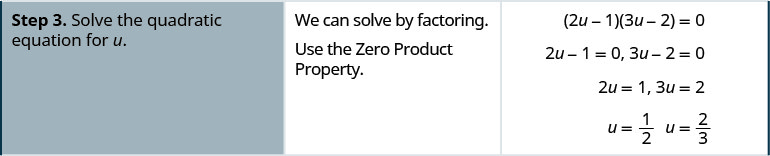
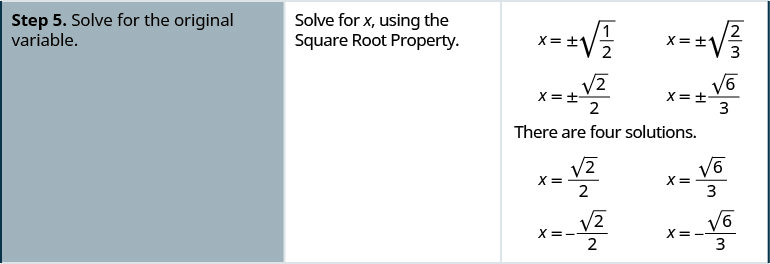
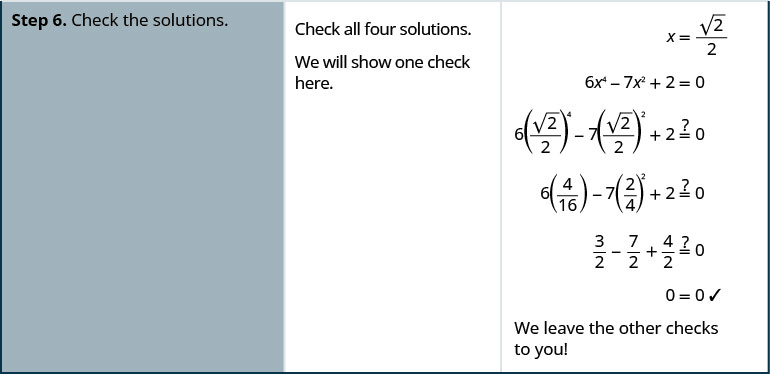
Solve: \(6{x}^{4}-7{x}^{2}+2=0\)
Notice \(({x}^{2})^{2}={x}^{4},\) so let \(u={x}^{2}\) to rewrite the equation as a quadratic in \(u.\)



Solve: \({x}^{4}-6{x}^{2}+8=0\) .
\(x=\sqrt{2},x=\text{-}\sqrt{2},x=2,x=-2\)
Solve: \({x}^{4}-11{x}^{2}+28=0\) .
\(x=\sqrt{7},x=\text{-}\sqrt{7},x=2,x=-2\)
We summarize the steps to solve an equation in quadratic form.
- Identify a substitution that will put the equation in quadratic form.
- Rewrite the equation with the substitution to put it in quadratic form.
- Solve the quadratic equation for u.
- Substitute the original variable back into the results, using the substitution.
- Solve for the original variable.
- Check the solutions.
In the next example, the binomial in the middle term, (x − 2) is squared in the first term. If we let u = x − 2 and substitute, our trinomial will be in ax2 + bx + c form.
Solve: \({(x-2)}^{2}+7(x-2)+12=0.\)
Let \(u=x-2\) so the equation becomes a quadratic in \(u.\)

| |
| Prepare for the substitution. | 
|
| Let \(u=x-2\) and substitute. | 
|
| Solve by factoring. | 


|
| Replace \(u\) with \(x-2.\) | 
|
| Solve for \(x.\) | 
|
Check: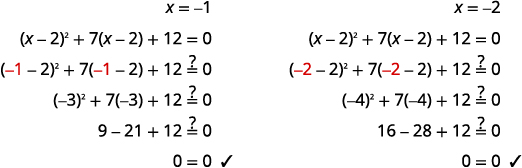
|
Solve: \({(x-5)}^{2}+6(x-5)+8=0.\)
\(x=3,x=1\)
Solve: \({(y-4)}^{2}+8(y-4)+15=0.\)
\(y=-1,y=1\)
In the next example, we notice that \({(\sqrt{x})}^{2}=x.\) Also, remember that when we square both sides of an equation, we may introduce extraneous roots. Be sure to check your answers!
Solve: \(x-3\sqrt{x}+2=0.\)
Since \({(\sqrt{x})}^{2}=x,\) let \(u=\sqrt{x}\) to rewrite the equation as a quadratic in \(u.\)
The \(\sqrt{x}\) in the middle term, is squared in the first term \({(\sqrt{x})}^{2}=x.\) If we let \(u=\sqrt{x}\) and substitute, our trinomial will be in ax2 + bx + c = 0 form.

| |
| Rewrite the trinomial to prepare for the substitution. | 
|
| Let \(u=\sqrt{x}\) and substitute. | 
|
| Solve by factoring. | 


|
| Replace u with \(\sqrt{x}.\) | 
|
| Solve for x, by squaring both sides. | 
|
Check: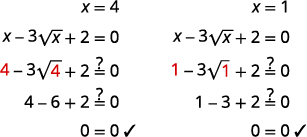
|
Solve: \(x-7\sqrt{x}+12=0.\)
\(x=9,x=16\)
Solve: \(x-6\sqrt{x}+8=0.\)
\(x=4,x=16\)
Substitutions for rational exponents can also help us solve an equation in quadratic form. Think of the properties of exponents as you begin the next example.
Solve: \({x}^{\frac{2}{3}}-2{x}^{\frac{1}{3}}-24=0.\)
Since \({({x}^{\frac{1}{3}})}^{2}={x}^{\frac{2}{3}},\) let \(u={x}^{\frac{1}{3}}\) to rewrite the equation as a quadratic in \(u.\)
The \({x}^{\frac{1}{3}}\) in the middle term is squared in the first term \({({x}^{\frac{1}{3}})}^{2}={x}^{\frac{2}{3}}.\) If we let \(u={x}^{\frac{1}{3}}\) and substitute, our trinomial will be in ax2 + bx + c = 0 form.

| |
| Rewrite the trinomial to prepare for the substitution. | 
|
| Let \(u={x}^{\frac{1}{3}}\) and substitute. | 
|
| Solve by factoring. | 


|
| Replace u with \({x}^{\frac{1}{3}}.\) | 
|
| Solve for \(x\) by cubing both sides. | 

|
Check: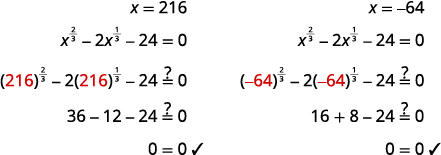
|
Solve: \({x}^{\frac{2}{3}}-5{x}^{\frac{1}{3}}-14=0.\)
\(x=-8,x=343\)
Solve: \({x}^{\frac{1}{2}}-8{x}^{\frac{1}{4}}+15=0.\)
\(x=81,x=625\)
In the next example, we need to keep in mind the definition of a negative exponent as well as the properties of exponents.
Solve: \(3{x}^{-2}-7{x}^{-1}+2=0.\)
Since \({({x}^{-1})}^{2}={x}^{-2},\) let \(u={x}^{-1}\) to rewrite the equation as a quadratic in \(u.\)
The \({x}^{-1}\) in the middle term is squared in the first term \({({x}^{-1})}^{2}={x}^{-2}.\) If we let \(u={x}^{-1}\) and substitute, our trinomial will be in ax2 + bx + c = 0 form.

| ||
| Rewrite the trinomial to prepare for the substitution. | 
| |
| Let \(u={x}^{-1}\) and substitute. | 
| |
| Solve by factoring. | 
| |

| ||

| ||
| Replace u with \({x}^{-1}.\) | 
| |
| Solve for \(x\) by taking the reciprocal since \({x}^{-1}=\frac{1}{x}.\) | 
| |
Check: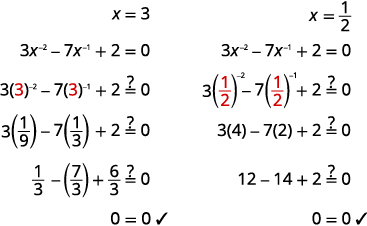
|
Solve: \(8{x}^{-2}-10{x}^{-1}+3=0.\)
\(x=\frac{4}{3}x=2\)
Solve: \(6{x}^{-2}-23{x}^{-1}+20=0.\)
\(x=\frac{2}{5},x=\frac{3}{4}\)
Access this online resource for additional instruction and practice with solving quadratic equations.
Key Concepts
- How to solve equations in quadratic form.
- Identify a substitution that will put the equation in quadratic form.
- Rewrite the equation with the substitution to put it in quadratic form.
- Solve the quadratic equation for u.
- Substitute the original variable back into the results, using the substitution.
- Solve for the original variable.
- Check the solutions.
Section Exercises
Practice Makes Perfect
Solve Equations in Quadratic Form
In the following exercises, solve.
\({x}^{4}-7{x}^{2}+12=0\)
\(x=\pm \sqrt{3},x=\pm 2\)
\({x}^{4}-9{x}^{2}+18=0\)
\({x}^{4}-13{x}^{2}-30=0\)
\(x=\pm \sqrt{15},x=\pm \sqrt{2}i\)
\({x}^{4}+5{x}^{2}-36=0\)
\(2{x}^{4}-5{x}^{2}+3=0\)
\(x=\pm 1,x=\frac{\pm \sqrt{6}}{2}\)
\(4{x}^{4}-5{x}^{2}+1=0\)
\(2{x}^{4}-7{x}^{2}+3=0\)
\(x=\pm \sqrt{3},x=\pm \frac{\sqrt{2}}{2}\)
\(3{x}^{4}-14{x}^{2}+8=0\)
\({(x-3)}^{2}-5(x-3)-36=0\)
\(x=-1,x=12\)
\({(x+2)}^{2}-3(x+2)-54=0\)
\({(3y+2)}^{2}+(3y+2)-6=0\)
\(x=-\frac{5}{3},x=0\)
\({(5y-1)}^{2}+3(5y-1)-28=0\)
\({({x}^{2}+1)}^{2}-5({x}^{2}+1)+4=0\)
\(x=0,x=\pm \sqrt{3}\)
\({({x}^{2}-4)}^{2}-4({x}^{2}-4)+3=0\)
\(2{({x}^{2}-5)}^{2}-5({x}^{2}-5)+2=0\)
\(x=\pm \frac{\sqrt{22}}{2},x=\pm \sqrt{7}\)
\(2{({x}^{2}-5)}^{2}-7({x}^{2}-5)+6=0\)
\(x-\sqrt{x}-20=0\)
\(x=25\)
\(x-8\sqrt{x}+15=0\)
\(x+6\sqrt{x}-16=0\)
\(x=4\)
\(x+4\sqrt{x}-21=0\)
\(6x+\sqrt{x}-2=0\)
\(x=\frac{1}{4}\)
\(6x+\sqrt{x}-1=0\)
\(10x-17\sqrt{x}+3=0\)
\(x=\frac{1}{25},x=\frac{9}{4}\)
\(12x+5\sqrt{x}-3=0\)
\({x}^{\frac{2}{3}}+9{x}^{\frac{1}{3}}+8=0\)
\(x=-1,x=-512\)
\({x}^{\frac{2}{3}}-3{x}^{\frac{1}{3}}=28\)
\({x}^{\frac{2}{3}}+4{x}^{\frac{1}{3}}=12\)
\(x=8,x=-216\)
\({x}^{\frac{2}{3}}-11{x}^{\frac{1}{3}}+30=0\)
\(6{x}^{\frac{2}{3}}-{x}^{\frac{1}{3}}=12\)
\(x=\frac{27}{8},x=-\frac{64}{27}\)
\(3{x}^{\frac{2}{3}}-10{x}^{\frac{1}{3}}=8\)
\(8{x}^{\frac{2}{3}}-43{x}^{\frac{1}{3}}+15=0\)
\(x=\frac{27}{512},x=125\)
\(20{x}^{\frac{2}{3}}-23{x}^{\frac{1}{3}}+6=0\)
\(x-8{x}^{\frac{1}{2}}+7=0\)
\(x=1,x=49\)
\(2x-7{x}^{\frac{1}{2}}=15\)
\(6{x}^{-2}+13{x}^{-1}+5=0\)
\(x=-2,x=-\frac{3}{5}\)
\(15{x}^{-2}-26{x}^{-1}+8=0\)
\(8{x}^{-2}-2{x}^{-1}-3=0\)
\(x=-2,x=\frac{4}{3}\)
\(15{x}^{-2}-4{x}^{-1}-4=0\)
Writing Exercises
Explain how to recognize an equation in quadratic form.
Answers will vary.
Explain the procedure for solving an equation in quadratic form.
Self Check
ⓐ After completing the exercises, use this checklist to evaluate your mastery of the objectives of this section.

ⓑ On a scale of 1-10, how would you rate your mastery of this section in light of your responses on the checklist? How can you improve this?