Section 9.1Solve Quadratic Equations Using the Square Root Property
Before you get started, take this readiness quiz.
Simplify: \(\sqrt{128}.\)
If you missed this problem, review Example 1.
\(8\sqrt{2}\)
Simplify: \(\sqrt{\frac{32}{5}}\) .
If you missed this problem, review Example 4.
\(\frac{4\sqrt{10}}{5}\)
Factor: \(9{x}^{2}-12x+4\) .
If you missed this problem, review Example 1.
\({\left(3x-2\right)}^{2}\)
A quadratic equation is an equation of the form ax2 + bx + c = 0, where \(a\ne 0\) . Quadratic equations differ from linear equations by including a quadratic term with the variable raised to the second power of the form ax2. We use different methods to solve quadratic equations than linear equations, because just adding, subtracting, multiplying, and dividing terms will not isolate the variable.
We have seen that some quadratic equations can be solved by factoring. In this chapter, we will learn three other methods to use in case a quadratic equation cannot be factored.
Solve Quadratic Equations of the form \(a{x}^{2}=k\) using the Square Root Property
We have already solved some quadratic equations by factoring. Let’s review how we used factoring to solve the quadratic equation x2 = 9.
| \({x}^{2}=9\,\) | |
| Put the equation in standard form. | \({x}^{2}-9=0\,\) |
| Factor the difference of squares. | \((x-3)(x+3)=0\,\) |
| Use the Zero Product Property. | \(x-3=0\,x-3=0\,\) |
| Solve each equation. | \(x=3\,x=-3\,\) |
We can easily use factoring to find the solutions of similar equations, like x2 = 16 and x2 = 25, because 16 and 25 are perfect squares. In each case, we would get two solutions, \(x=4,x=-4\) and \(x=5,x=-5.\)
But what happens when we have an equation like x2 = 7? Since 7 is not a perfect square, we cannot solve the equation by factoring.
Previously we learned that since 169 is the square of 13, we can also say that 13 is a square root of 169. Also, (−13)2 = 169, so −13 is also a square root of 169. Therefore, both 13 and −13 are square roots of 169. So, every positive number has two square roots—one positive and one negative. We earlier defined the square root of a number in this way:
\[\text{If}\,{n}^{2}=m,\,\text{then}\,n\,\text{is a square root of}\,m.\]
Since these equations are all of the form x2 = k, the square root definition tells us the solutions are the two square roots of k. This leads to the Square Root Property.
If x2 = k, then
\[x=\sqrt{k}\,\text{or}\,x=\text{-}\sqrt{k}\,\text{or}\,x=\pm \sqrt{k}.\]
Notice that the Square Root Property gives two solutions to an equation of the form x2 = k, the principal square root of \(k\) and its opposite. We could also write the solution as \(x=\pm \sqrt{k}.\) We read this as x equals positive or negative the square root of k.
Now we will solve the equation x2 = 9 again, this time using the Square Root Property.
| \(\,{x}^{2}=9\) | |
| Use the Square Root Property. | \(\,x=\pm \sqrt{9}\) |
| \(\,x=\pm 3\) | |
| \(\text{So}\,x=3\,\text{or}\,x=-3.\) |
What happens when the constant is not a perfect square? Let’s use the Square Root Property to solve the equation x2 = 7.
| \({x}^{2}=7\) | |
| Use the Square Root Property. | \(x=\sqrt{7},\,x=\text{-}\sqrt{7}\) |
We cannot simplify \(\sqrt{7}\) , so we leave the answer as a radical.
Solve: \({x}^{2}-50=0.\)



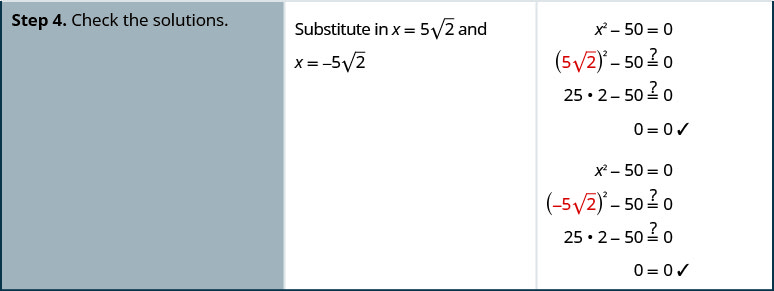
Isolate the quadratic term, then apply the Square Root Property.
Solve: \({x}^{2}-48=0.\)
\(x=4\sqrt{3},x=-4\sqrt{3}\)
Solve: \({y}^{2}-27=0.\)
\(y=3\sqrt{3},y=-3\sqrt{3}\)
The steps to take to use the Square Root Property to solve a quadratic equation are listed here.
- Isolate the quadratic term and make its coefficient one.
- Use Square Root Property.
- Simplify the radical.
- Check the solutions.
In order to use the Square Root Property, the coefficient of the variable term must equal one. In the next example, we must divide both sides of the equation by the coefficient 3 before using the Square Root Property.
Solve: \(3{z}^{2}=108.\)
Divide both sides by 3 to make the coefficient of z² equal to one before applying the property.
| \(3{z}^{2}=108\) | |
| The quadratic term is isolated. Divide by 3 to make its coefficient 1. | \(\frac{3{z}^{2}}{3}=\frac{108}{3}\) |
| Simplify. | \({z}^{2}=36\) |
| Use the Square Root Property. | \(\,z=\pm \sqrt{36}\) |
| Simplify the radical. | \(\,z=\pm 6\) |
| Rewrite to show two solutions. | \(z=6,\,z=-6\) |
Check the solutions: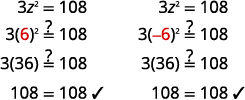
|
Solve: \(2{x}^{2}=98.\)
\(x=7,x=-7\)
Solve: \(5{m}^{2}=80.\)
\(m=4,m=-4\)
The Square Root Property states ‘If \({x}^{2}=k\) ,’ What will happen if \(k<0?\) This will be the case in the next example.
Solve: \({x}^{2}+72=0\) .
Isolate the quadratic term first and notice what sign the isolated value has.
| \({x}^{2}+72=0\) | |
| Isolate the quadratic term. | \(\,{x}^{2}=-72\) |
| Use the Square Root Property. | \(\,x=\pm \sqrt{-72}\) |
| Simplify using complex numbers. | \(\,x=\pm \sqrt{72}\,i\) |
| Simplify the radical. | \(\,x=\pm 6\sqrt{2}\,i\) |
| Rewrite to show two solutions. | \(x=6\sqrt{2}\,i,\,x=-6\sqrt{2}\,i\) |
Check the solutions: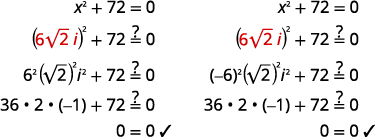
|
Solve: \({c}^{2}+12=0.\)
\(c=2\sqrt{3}i,\,\,\,c=-2\sqrt{3}i\)
Solve: \({q}^{2}+24=0.\)
\(c=2\sqrt{6}i,\,\,\,c=-2\sqrt{6}i\)
Our method also works when fractions occur in the equation; we solve as any equation with fractions. In the next example, we first isolate the quadratic term, and then make the coefficient equal to one.
Solve: \(\frac{2}{3}{u}^{2}+5=17.\)
Subtract 5 to isolate the quadratic term, then multiply by the reciprocal of its coefficient.
| \(\frac{2}{3}{u}^{2}+5=17\) | |
| Isolate the quadratic term. | 
|
| Multiply by \(\frac{3}{2}\) to make the coefficient 1. | 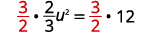
|
| Simplify. | 
|
| Use the Square Root Property. | 
|
| Simplify the radical. | 
|
| Simplify. | 
|
| Rewrite to show two solutions. | 
|
Check: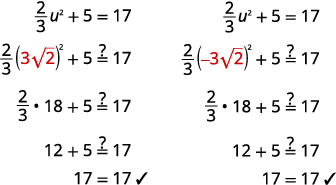
|
Solve: \(\frac{1}{2}{x}^{2}+4=24.\)
\(x=2\sqrt{10},\,x=-2\sqrt{10}\)
Solve: \(\frac{3}{4}{y}^{2}-3=18.\)
\(y=2\sqrt{7},\,y=-2\sqrt{7}\)
The solutions to some equations may have fractions inside the radicals. When this happens, we must rationalize the denominator.
Solve: \(2{x}^{2}-8=41.\)
Isolate x² and divide by its coefficient; expect a fraction under the radical that will need rationalizing.

| |
| Isolate the quadratic term. | 
|
| Divide by \(2\) to make the coefficient 1. | 
|
| Simplify. | 
|
| Use the Square Root Property. | 
|
| Rewrite the radical as a fraction of square roots. | 
|
| Rationalize the denominator. | 
|
| Simplify. | 
|
| Rewrite to show two solutions. | 
|
| Check: We leave the check for you. |
Solve: \(5{r}^{2}-2=34.\)
\(r=\frac{6\sqrt{5}}{5},\,r=-\frac{6\sqrt{5}}{5}\)
Solve: \(3{t}^{2}+6=70.\)
\(t=\frac{8\sqrt{3}}{3},\,t=-\frac{8\sqrt{3}}{3}\)
Solve Quadratic Equations of the Form a(x − h)2 = k Using the Square Root Property
We can use the Square Root Property to solve an equation of the form a(x − h)2 = k as well. Notice that the quadratic term, x, in the original form ax2 = k is replaced with (x − h).

The first step, like before, is to isolate the term that has the variable squared. In this case, a binomial is being squared. Once the binomial is isolated, by dividing each side by the coefficient of a, then the Square Root Property can be used on (x − h)2.
Solve: \(4{(y-7)}^{2}=48.\)
Divide both sides by 4 to isolate the squared binomial before using the Square Root Property.
| \(4{(y-7)}^{2}=48\) | |
| Divide both sides by the coefficient 4. | \(\,{(y-7)}^{2}=12\) |
| Use the Square Root Property on the binomial | \(\,y-7=\pm \sqrt{12}\) |
| Simplify the radical. | \(\,y-7=\pm 2\sqrt{3}\) |
| Solve for \(y.\) | \(\,y=7\pm 2\sqrt{3}\) |
| Rewrite to show two solutions. | \(y=7+2\sqrt{3},\) \(y=7-2\sqrt{3}\) |
Check: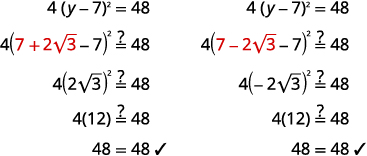
|
Solve: \(3{(a-3)}^{2}=54.\)
\(a=3+3\sqrt{2},\,a=3-3\sqrt{2}\)
Solve: \(2{(b+2)}^{2}=80.\)
\(b=-2+2\sqrt{10},\,b=-2-2\sqrt{10}\)
Remember when we take the square root of a fraction, we can take the square root of the numerator and denominator separately.
Solve: \({(x-\frac{1}{3})}^{2}=\frac{5}{9}.\)
Apply the Square Root Property directly to the binomial, then simplify the radical of the fraction.
| \(\,{(x-\frac{1}{3})}^{2}=\frac{5}{9}\) | |
| Use the Square Root Property. | \(\,x-\frac{1}{3}=\pm \sqrt{\frac{5}{9}}\) |
| Rewrite the radical as a fraction of square roots. | \(\,x-\frac{1}{3}=\pm \frac{\sqrt{5}}{\sqrt{9}}\) |
| Simplify the radical. | \(\,x-\frac{1}{3}=\pm \frac{\sqrt{5}}{3}\) |
| Solve for \(x\) . | \(\,x=\frac{1}{3}\pm \frac{\sqrt{5}}{3}\) |
| Rewrite to show two solutions. | \(x=\frac{1}{3}+\frac{\sqrt{5}}{3},\,x=\frac{1}{3}-\frac{\sqrt{5}}{3}\) |
| Check: We leave the check for you. |
Solve: \({(x-\frac{1}{2})}^{2}=\frac{5}{4}.\)
\(x=\frac{1}{2}+\frac{\sqrt{5}}{2}\) , \(x=\frac{1}{2}-\frac{\sqrt{5}}{2}\)
Solve: \({(y+\frac{3}{4})}^{2}=\frac{7}{16}.\)
\(y=-\frac{3}{4}+\frac{\sqrt{7}}{4},\,y=-\frac{3}{4}-\frac{\sqrt{7}}{4}\)
We will start the solution to the next example by isolating the binomial term.
Solve: \(2{(x-2)}^{2}+3=57.\)
Subtract 3 from both sides, then divide by 2 to isolate the squared binomial.
| \(2{(x-2)}^{2}+3=57\,\) | |
| Subtract 3 from both sides to isolate the binomial term. | \(2{(x-2)}^{2}=54\,\) |
| Divide both sides by 2. | \({(x-2)}^{2}=27\,\) |
| Use the Square Root Property. | \(x-2=\pm \sqrt{27}\,\) |
| Simplify the radical. | \(x-2=\pm 3\sqrt{3}\,\) |
| Solve for \(x\) . | \(x=2\pm 3\sqrt{3}\,\) |
| Rewrite to show two solutions. | \(x=2+3\sqrt{3},\,x=2-3\sqrt{3}\) |
| Check: We leave the check for you. |
Solve: \(5{(a-5)}^{2}+4=104.\)
\(a=5+2\sqrt{5},\,a=5-2\sqrt{5}\)
Solve: \(3{(b+3)}^{2}-8=88.\)
\(b=-3+4\sqrt{2},\,b=-3-4\sqrt{2}\)
Sometimes the solutions are complex numbers.
Solve: \({(2x-3)}^{2}=-12.\)
Apply the Square Root Property; since the right side is negative, expect an imaginary result.
| \(\,{(2x-3)}^{2}=-12\) | |
| Use the Square Root Property. | \(\,2x-3=\pm \sqrt{-12}\) |
| Simplify the radical. | \(\,2x-3=\pm 2\sqrt{3}\,i\) |
| Add 3 to both sides. | \(\,2x=3\pm 2\sqrt{3}\,i\) |
| Divide both sides by 2. | \(\,x=\frac{3\pm 2\sqrt{3}\,i}{2}\) |
| Rewrite in standard form. | \(\,x=\frac{3}{2}\pm \frac{2\sqrt{3}\,i}{2}\) |
| Simplify. | \(\,x=\frac{3}{2}\pm \sqrt{3}\,i\) |
| Rewrite to show two solutions. | \(x=\frac{3}{2}+\sqrt{3}\,i,\,x=\frac{3}{2}-\sqrt{3}\,i\) |
| Check: We leave the check for you. |
Solve: \({(3r+4)}^{2}=-8.\)
\(r=-\frac{4}{3}+\frac{2\sqrt{2}i}{3},\,\text{r}=-\frac{4}{3}-\frac{2\sqrt{2}i}{3}\)
Solve: \({(2t-8)}^{2}=-10.\)
\(t=4+\frac{\sqrt{10}i}{2},\,\text{t}=4-\frac{\sqrt{10}i}{2}\)
The left sides of the equations in the next two examples do not seem to be of the form a(x − h)2. But they are perfect square trinomials, so we will factor to put them in the form we need.
Solve: \(4{n}^{2}+4n+1=16.\)
Recognize the left side as a perfect square trinomial and factor it before applying the property.
We notice the left side of the equation is a perfect square trinomial. We will factor it first.
| \(\,4{n}^{2}+4n+1=16\) | |
| Factor the perfect square trinomial. | \(\,{(2n+1)}^{2}=16\) |
| Use the Square Root Property. | \(\,2n+1=\pm \sqrt{16}\) |
| Simplify the radical. | \(\,2n+1=\pm 4\) |
| Solve for \(n\) . | \(\,2n=-1\pm 4\) |
| Divide each side by 2. | \(\,\frac{2n}{2}=\frac{-1\pm 4}{2}\) \(\,n=\frac{-1\pm 4}{2}\) |
| Rewrite to show two solutions. | \(n=\frac{-1+4}{2}\) , \(n=\frac{-1-4}{2}\) |
| Simplify each equation. | \(n=\frac{3}{2}\) , \(\,n=-\frac{5}{2}\) |
Check: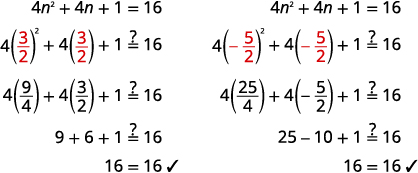
|
Solve: \(9{m}^{2}-12m+4=25.\)
\(m=\frac{7}{3},\,m=-1\)
Solve: \(16{n}^{2}+40n+25=4.\)
\(n=-\frac{3}{4},\,n=-\frac{7}{4}\)
Access this online resource for additional instruction and practice with using the Square Root Property to solve quadratic equations.
Key Concepts
- Square Root Property
How to solve a quadratic equation using the square root property.- If \({x}^{2}=k\) , then \(x=\sqrt{k}\,\text{or}\,x=\text{-}\sqrt{k}\) or \(x=\pm \sqrt{k}\)
- Isolate the quadratic term and make its coefficient one.
- Use Square Root Property.
- Simplify the radical.
- Check the solutions.
- When the isolated quadratic term is negative or the binomial squared equals a negative number, the Square Root Property produces complex solutions. (See Example 3 and Example 9.)
- A perfect square trinomial can be factored into a squared binomial before applying the Square Root Property. (See Example 10.)
Section Exercises
Practice Makes Perfect
Solve Quadratic Equations of the Form ax2 = k Using the Square Root Property
In the following exercises, solve each equation.
\({a}^{2}=49\)
\(a=\pm 7\)
\({b}^{2}=144\)
\({r}^{2}-24=0\)
\(r=\pm 2\sqrt{6}\)
\({t}^{2}-75=0\)
\({u}^{2}-300=0\)
\(u=\pm 10\sqrt{3}\)
\({v}^{2}-80=0\)
\(4{m}^{2}=36\)
\(m=\pm 3\)
\(3{n}^{2}=48\)
\(\frac{4}{3}{x}^{2}=48\)
\(x=\pm 6\)
\(\frac{5}{3}{y}^{2}=60\)
\({x}^{2}+25=0\)
\(x=\pm 5i\)
\({y}^{2}+64=0\)
\({x}^{2}+63=0\)
\(x=\pm 3\sqrt{7}i\)
\({y}^{2}+45=0\)
\(\frac{4}{3}{x}^{2}+2=110\)
\(x=\pm 9\)
\(\frac{2}{3}{y}^{2}-8=-2\)
\(\frac{2}{5}{a}^{2}+3=11\)
\(a=\pm 2\sqrt{5}\)
\(\frac{3}{2}{b}^{2}-7=41\)
\(7{p}^{2}+10=26\)
\(p=\pm \frac{4\sqrt{7}}{7}\)
\(2{q}^{2}+5=30\)
\(5{y}^{2}-7=25\)
\(y=\pm \frac{4\sqrt{10}}{5}\)
\(3{x}^{2}-8=46\)
Solve Quadratic Equations of the Form a(x − h)2 = k Using the Square Root Property
In the following exercises, solve each equation.
\({(u-6)}^{2}=64\)
\(u=14,u=-2\)
\({(v+10)}^{2}=121\)
\({(m-6)}^{2}=20\)
\(m=6\pm 2\sqrt{5}\)
\({(n+5)}^{2}=32\)
\({(r-\frac{1}{2})}^{2}=\frac{3}{4}\)
\(r=\frac{1}{2}\pm \frac{\sqrt{3}}{2}\)
\({(x+\frac{1}{5})}^{2}=\frac{7}{25}\)
\({(y+\frac{2}{3})}^{2}=\frac{8}{81}\)
\(y=-\frac{2}{3}\pm \frac{2\sqrt{2}}{9}\)
\({(t-\frac{5}{6})}^{2}=\frac{11}{25}\)
\({(a-7)}^{2}+5=55\)
\(a=7\pm 5\sqrt{2}\)
\({(b-1)}^{2}-9=39\)
\(4{(x+3)}^{2}-5=27\)
\(x=-3\pm 2\sqrt{2}\)
\(5{(x+3)}^{2}-7=68\)
\({(5c+1)}^{2}=-27\)
\(c=-\frac{1}{5}\pm \frac{3\sqrt{3}}{5}i\)
\({(8d-6)}^{2}=-24\)
\({(4x-3)}^{2}+11=-17\)
\(x=\frac{3}{4}\pm \frac{\sqrt{7}}{2}i\)
\({(2y+1)}^{2}-5=-23\)
\({m}^{2}-4m+4=8\)
\(m=2\pm 2\sqrt{2}\)
\({n}^{2}+8n+16=27\)
\({x}^{2}-6x+9=12\)
\(x=3\pm 2\sqrt{3}\)
\({y}^{2}+12y+36=32\)
\(25{x}^{2}-30x+9=36\)
\(x=-\frac{3}{5},x=\frac{9}{5}\)
\(9{y}^{2}+12y+4=9\)
\(36{x}^{2}-24x+4=81\)
\(x=-\frac{7}{6},x=\frac{11}{6}\)
\(64{x}^{2}+144x+81=25\)
Mixed Practice
In the following exercises, solve using the Square Root Property.
\(2{r}^{2}=32\)
\(r=\pm 4\)
\(4{t}^{2}=16\)
\({(a-4)}^{2}=28\)
\(a=4\pm 2\sqrt{7}\)
\({(b+7)}^{2}=8\)
\(9{w}^{2}-24w+16=1\)
\(w=1,w=\frac{5}{3}\)
\(4{z}^{2}+4z+1=49\)
\({a}^{2}-18=0\)
\(a=\pm 3\sqrt{2}\)
\({b}^{2}-108=0\)
\({(p-\frac{1}{3})}^{2}=\frac{7}{9}\)
\(p=\frac{1}{3}\pm \frac{\sqrt{7}}{3}\)
\({(q-\frac{3}{5})}^{2}=\frac{3}{4}\)
\({m}^{2}+12=0\)
\(m=\pm 2\sqrt{3}i\)
\({n}^{2}+48=0.\)
\({u}^{2}-14u+49=72\)
\(u=7\pm 6\sqrt{2}\)
\({v}^{2}+18v+81=50\)
\({(m-4)}^{2}+3=15\)
\(m=4\pm 2\sqrt{3}\)
\({(n-7)}^{2}-8=64\)
\({(x+5)}^{2}=4\)
\(x=-3,x=-7\)
\({(y-4)}^{2}=64\)
\(6{c}^{2}+4=29\)
\(c=\pm \frac{5\sqrt{6}}{6}\)
\(2{d}^{2}-4=77\)
\({(x-6)}^{2}+7=3\)
\(x=6\pm 2i\)
\({(y-4)}^{2}+10=9\)
Writing Exercises
In your own words, explain the Square Root Property.
Answers will vary.
In your own words, explain how to use the Square Root Property to solve the quadratic equation \({(x+2)}^{2}=16\) .
Self Check
ⓐ After completing the exercises, use this checklist to evaluate your mastery of the objectives of this section.
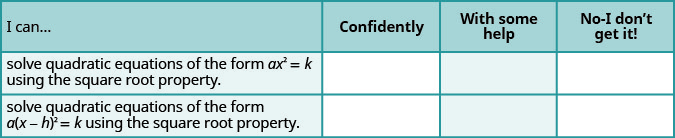
Choose how would you respond to the statement “I can solve quadratic equations of the form a times the square of x minus h equals k using the Square Root Property.” “Confidently,” “with some help,” or “No, I don’t get it.”
ⓑ If most of your checks were:
…confidently. Congratulations! You have achieved the objectives in this section. Reflect on the study skills you used so that you can continue to use them. What did you do to become confident of your ability to do these things? Be specific.
…with some help. This must be addressed quickly because topics you do not master become potholes in your road to success. In math every topic builds upon previous work. It is important to make sure you have a strong foundation before you move on. Whom can you ask for help?Your fellow classmates and instructor are good resources. Is there a place on campus where math tutors are available? Can your study skills be improved?
…no - I don’t get it! This is a warning sign and you must not ignore it. You should get help right away or you will quickly be overwhelmed. See your instructor as soon as you can to discuss your situation. Together you can come up with a plan to get you the help you need.