Section 7.4Solve Rational Equations
Before you get started, take this readiness quiz.
Solve: \(\frac{1}{6}x+\frac{1}{2}=\frac{1}{3}.\)
If you missed this problem, review Example 9.
\(x=-1\)
Solve: \({n}^{2}-5n-36=0.\)
If you missed this problem, review Example 2.
\(n=9,\,n=-4\)
Solve the formula \(5x+2y=10\) for \(y.\)
If you missed this problem, review Example 4.
\(y=\frac{10-5x}{2}\)
After defining the terms ‘expression’ and ‘equation’ earlier, we have used them throughout this book. We have simplified many kinds of expressions and solved many kinds of equations. We have simplified many rational expressions so far in this chapter. Now we will solve a rational equation.
A rational equation is an equation that contains a rational expression.
You must make sure to know the difference between rational expressions and rational equations. The equation contains an equal sign.
\[\begin{array}{llll}\text{Rational Expression} & & & \text{Rational Equation} \\ \begin{array}{l}\frac{1}{8}x+\frac{1}{2} \\ \frac{y+6}{{y}^{2}-36} \\ \frac{1}{n-3}+\frac{1}{n+4}\end{array} & & & \begin{array}{lll}\frac{1}{8}x+\frac{1}{2} & = & \frac{1}{4} \\ \frac{y+6}{{y}^{2}-36} & = & y+1 \\ \frac{1}{n-3}+\frac{1}{n+4} & = & \frac{15}{{n}^{2}+n-12}\end{array}\end{array}\]
Solve Rational Equations
We have already solved linear equations that contained fractions. We found the LCD of all the fractions in the equation and then multiplied both sides of the equation by the LCD to “clear” the fractions.
We will use the same strategy to solve rational equations. We will multiply both sides of the equation by the LCD. Then, we will have an equation that does not contain rational expressions and thus is much easier for us to solve. But because the original equation may have a variable in a denominator, we must be careful that we don’t end up with a solution that would make a denominator equal to zero.
So before we begin solving a rational equation, we examine it first to find the values that would make any denominators zero. That way, when we solve a rational equation we will know if there are any algebraic solutions we must discard.
An algebraic solution to a rational equation that would cause any of the rational expressions to be undefined is called an extraneous solution to a rational equation.
An extraneous solution to a rational equation is an algebraic solution that would cause any of the expressions in the original equation to be undefined.
We note any possible extraneous solutions, c, by writing \(x\ne c\) next to the equation.
Solve: \(\frac{1}{x}+\frac{1}{3}=\frac{5}{6}.\)
Note the value that would make the denominator zero, then clear the fractions by multiplying every term by the LCD.


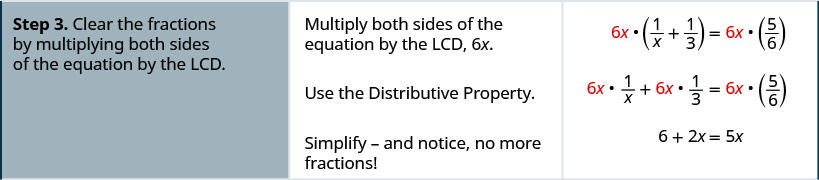

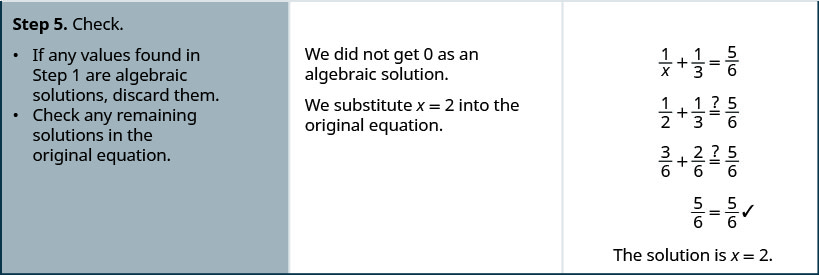
Solve: \(\frac{1}{y}+\frac{2}{3}=\frac{1}{5}.\)
\(y=-\frac{15}{7}\)
Solve: \(\frac{2}{3}+\frac{1}{5}=\frac{1}{x}.\)
\(x=\frac{15}{13}\)
The steps of this method are shown.
- Note any value of the variable that would make any denominator zero.
- Find the least common denominator of all denominators in the equation.
- Clear the fractions by multiplying both sides of the equation by the LCD.
- Solve the resulting equation.
- Check:
- If any values found in Step 1 are algebraic solutions, discard them.
- Check any remaining solutions in the original equation.
We always start by noting the values that would cause any denominators to be zero.
Solve: \(1-\frac{5}{y}=-\frac{6}{{y}^{2}}.\)
Note that y cannot be zero, then multiply every term by the LCD, y², to clear the fractions and get a quadratic equation.

| |
| Note any value of the variable that would make any denominator zero. | 
|
| Find the least common denominator of all denominators in the equation. The LCD is y2. | |
| Clear the fractions by multiplying both sides of the equation by the LCD. | 
|
| Distribute. | 
|
| Multiply. | 
|
| Solve the resulting equation. First write the quadratic equation in standard form. | 
|
| Factor. | 
|
| Use the Zero Product Property. | 
|
| Solve. | 
|
| Check. We did not get 0 as an algebraic solution. 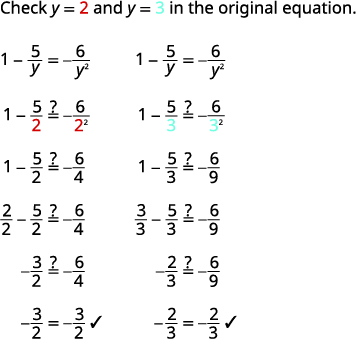
| |
| The solution is \(y=2,\) \(y=3.\) |
Solve: \(1-\frac{2}{x}=\frac{15}{{x}^{2}}.\)
\(x=-3,x=5\)
Solve: \(1-\frac{4}{y}=\frac{12}{{y}^{2}}.\)
\(y=-2,y=6\)
In the next example, the last denominators is a difference of squares. Remember to factor it first to find the LCD.
Solve: \(\frac{2}{x+2}+\frac{4}{x-2}=\frac{x-1}{{x}^{2}-4}.\)
Factor the last denominator as a difference of squares to see the LCD and the values that must be excluded.

| |
| Note any value of the variable that would make any denominator zero. | 
|
| Find the least common denominator of all denominators in the equation. The LCD is \((x+2)(x-2).\) | |
| Clear the fractions by multiplying both sides of the equation by the LCD. | 
|
| Distribute. | 
|
| Remove common factors. | 
|
| Simplify. | 
|
| Distribute. | 
|
| Solve. | 


|
| Check: We did not get 2 or −2 as algebraic solutions. 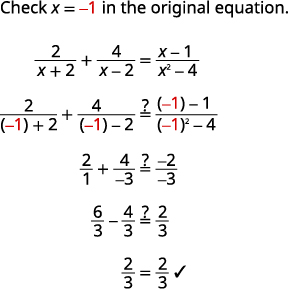
| |
| The solution is \(x=-1.\) |
Solve: \(\frac{2}{x+1}+\frac{1}{x-1}=\frac{1}{{x}^{2}-1}.\)
\(x=\frac{2}{3}\)
Solve: \(\frac{5}{y+3}+\frac{2}{y-3}=\frac{5}{{y}^{2}-9}.\)
\(y=2\)
In the next example, the first denominator is a trinomial. Remember to factor it first to find the LCD.
Solve: \(\frac{m+11}{{m}^{2}-5m+4}=\frac{5}{m-4}-\frac{3}{m-1}.\)
Factor the trinomial denominator first — it reveals both the LCD and the values of m to exclude.

| |
| Note any value of the variable that would make any denominator zero. Use the factored form of the quadratic denominator. | 
|
| Find the least common denominator of all denominators in the equation. The LCD is \((m-4)(m-1).\) | |
| Clear the fractions by multiplying both sides of the equation by the LCD. | 
|
| Distribute. | 
|
| Remove common factors. | 
|
| Simplify. | 
|
| Solve the resulting equation. | 

|
| Check. The only algebraic solution was 4, but we said that 4 would make a denominator equal to zero. The algebraic solution is an extraneous solution. | |
| There is no solution to this equation. |
Solve: \(\frac{x+13}{{x}^{2}-7x+10}=\frac{6}{x-5}-\frac{4}{x-2}.\)
There is no solution.
Solve: \(\frac{y-6}{{y}^{2}+3y-4}=\frac{2}{y+4}+\frac{7}{y-1}.\)
There is no solution.
The equation we solved in the previous example had only one algebraic solution, but it was an extraneous solution. That left us with no solution to the equation. In the next example we get two algebraic solutions. Here one or both could be extraneous solutions.
Solve: \(\frac{y}{y+6}=\frac{72}{{y}^{2}-36}+4.\)
Factor y² − 36 to find the LCD and the excluded values, then clear the fractions — the result is a quadratic.

| |
| Factor all the denominators, so we can note any value of the variable that would make any denominator zero. | 
|
| Find the least common denominator. The LCD is \((y-6)(y+6).\) | |
| Clear the fractions. | 
|
| Simplify. | 
|
| Simplify. | 
|
| Solve the resulting equation. | 




|
Check.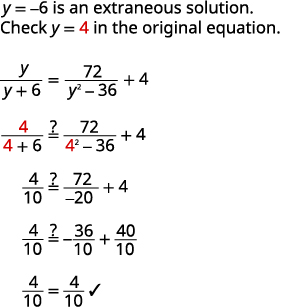
| |
| The solution is \(y=4.\) |
Solve: \(\frac{x}{x+4}=\frac{32}{{x}^{2}-16}+5.\)
\(x=3\)
Solve: \(\frac{y}{y+8}=\frac{128}{{y}^{2}-64}+9.\)
\(y=7\)
In some cases, all the algebraic solutions are extraneous.
Solve: \(\frac{x}{2x-2}-\frac{2}{3x+3}=\frac{5{x}^{2}-2x+9}{12{x}^{2}-12}.\)
Factor every denominator completely first — that's the only way to spot the true LCD and the excluded values here.

| |
| We will start by factoring all denominators, to make it easier to identify extraneous solutions and the LCD. | 
|
| Note any value of the variable that would make any denominator zero. | 
|
| Find the least common denominator. The LCD is \(12(x-1)(x+1).\) | |
| Clear the fractions. | 
|
| Simplify. | 
|
| Simplify. | 
|
| Solve the resulting equation. | 



|
| Check. \(x=1\) and \(x=-1\) are extraneous solutions. | |
| The equation has no solution. |
Solve: \(\frac{y}{5y-10}-\frac{5}{3y+6}=\frac{2{y}^{2}-19y+54}{15{y}^{2}-60}.\)
There is no solution.
Solve: \(\frac{z}{2z+8}-\frac{3}{4z-8}=\frac{3{z}^{2}-16z-16}{8{z}^{2}+16z-64}.\)
There is no solution.
Solve: \(\frac{4}{3{x}^{2}-10x+3}+\frac{3}{3{x}^{2}+2x-1}=\frac{2}{{x}^{2}-2x-3}.\)
Factor each quadratic denominator to find the LCD and the values of x that must be excluded.

| |
| Factor all the denominators, so we can note any value of the variable that would make any denominator zero. | \(x\ne \text{-}1,x\ne \frac{1}{3},x\ne 3\) 
|
| Find the least common denominator. The LCD is \((3x-1)(x+1)(x-3).\) | |
| Clear the fractions. | |

| |
| Simplify. | 
|
| Distribute. | 
|
| Simplify. | 
|

| |
| The only algebraic solution was \(x=3,\) but we said that \(x=3\) would make a denominator equal to zero. The algebraic solution is an extraneous solution. | |
| There is no solution to this equation. |
Solve: \(\frac{15}{{x}^{2}+x-6}-\frac{3}{x-2}=\frac{2}{x+3}.\)
There is no solution.
Solve: \(\frac{5}{{x}^{2}+2x-3}-\frac{3}{{x}^{2}+x-2}=\frac{1}{{x}^{2}+5x+6}.\)
There is no solution.
Use Rational Functions
Working with functions that are defined by rational expressions often lead to rational equations. Again, we use the same techniques to solve them.
For rational function, \(f(x)=\frac{2x-6}{{x}^{2}-8x+15},\) ⓐ find the domain of the function, ⓑ solve \(f(x)=1,\) and ⓒ find the points on the graph at this function value.
Start by setting the denominator equal to zero — that finds the domain restrictions you'll also need when solving f(x)=1.
ⓐ The domain of a rational function is all real numbers except those that make the rational expression undefined. So to find them, we will set the denominator equal to zero and solve.
| \({x}^{2}-8x+15=0\) | |
| Factor the trinomial. | \((x-3)(x-5)=0\) |
| Use the Zero Product Property. | \(x-3=0\,x-5=0\) |
| Solve. | \(x=3\,x=5\) |
| The domain is all real numbers except \(x\ne 3,x\ne 5\text{.}\) |
ⓑ
However, \(x=3\) is outside the domain of this function, so we discard that root as extraneous.

| |
| Substitute in the rational expression. | 
|
| Factor the denominator. | 
|
| Multiply both sides by the LCD, \((x-3)(x-5).\) | 
|
| Simplify. | 
|
| Solve. | 
|
| Factor. | 
|
| Use the Zero Product Property. | 
|
| Solve. | 
|
ⓒ The value of the function is 1 when \(x=7.\) So the points on the graph of this function when \(f(x)=1\) is \((7,1))\)
For rational function, \(f(x)=\frac{8-x}{{x}^{2}-7x+12},\) ⓐ find the domain of the function ⓑ solve \(f(x)=3\) ⓒ find the points on the graph at this function value.
ⓐ The domain is all real numbers except \(x\ne 3\) and \(x\ne 4.\) ⓑ \(x=2,x=\frac{14}{3}\)
ⓒ \((2,3),(\frac{14}{3},3)\)
For rational function, \(f(x)=\frac{x-1}{{x}^{2}-6x+5},\) ⓐ find the domain of the function ⓑ solve \(f(x)=4\) ⓒ find the points on the graph at this function value.
ⓐ The domain is all real numbers except \(x\ne 1\) and \(x\ne 5.\) ⓑ \(x=\frac{21}{4}\) ⓒ \((\frac{21}{4},4)\)
Solve a Rational Equation for a Specific Variable
When we solved linear equations, we learned how to solve a formula for a specific variable. Many formulas used in business, science, economics, and other fields use rational equations to model the relation between two or more variables. We will now see how to solve a rational equation for a specific variable.
When we developed the point-slope formula from our slope formula, we cleared the fractions by multiplying by the LCD.
\(\begin{array}{llllll} & & & m & = & \frac{y-{y}_{1}}{x-{x}_{1}} \\ \text{Multiply both sides of the equation by}\,x-{x}_{1}. & & & m(x-{x}_{1}) & = & (\frac{y-{y}_{1}}{x-{x}_{1}})(x-{x}_{1}) \\ \text{Simplify.} & & & m(x-{x}_{1}) & = & y-{y}_{1} \\ \text{Rewrite the equation with the}\,y\,\text{terms on the left.} & & & y-{y}_{1} & = & m(x-{x}_{1})\end{array}\)
In the next example, we will use the same technique with the formula for slope that we used to get the point-slope form of an equation of a line through a point in Chapter 3. We will add one more step to solve for y.
Solve: \(m=\frac{y-2}{x-3}\) for \(y.\)
Multiply both sides by the LCD, x − 3, to clear the fraction, then isolate y.

| |
| Note any value of the variable that would make any denominator zero. | 
|
| Clear the fractions by multiplying both sides of the equation by the LCD, \(x-3.\) | 
|
| Simplify. | 
|
| Isolate the term with y. | 
|
Solve: \(m=\frac{y-5}{x-4}\) for \(y.\)
\(y=mx-4m+5\)
Solve: \(m=\frac{y-1}{x+5}\) for \(y.\)
\(y=mx+5m+1\)
Remember to multiply both sides by the LCD in the next example.
Solve: \(\frac{1}{c}+\frac{1}{m}=1\) for c.
Multiply both sides by the LCD, cm, then collect all the terms with c on one side so you can factor it out.

| |
| Note any value of the variable that would make any denominator zero. | 
|
| Clear the fractions by multiplying both sides of the equations by the LCD, cm. | 
|
| Distribute. | 
|
| Simplify. | 
|
| Collect the terms with c to the right. | 
|
| Factor the expression on the right. | 
|
| To isolate c, divide both sides by \(m-1.\) | 
|
| Simplify by removing common factors. | 
|
| Notice that even though we excluded \(c=0,m=0\) from the original equation, we must also now state that \(m\ne 1.\) |
Solve: \(\frac{1}{a}+\frac{1}{b}=c\) for a.
\(a=\frac{b}{cb-1}\)
Solve: \(\frac{2}{x}+\frac{1}{3}=\frac{1}{y}\) for y.
\(y=\frac{3x}{x+6}\)
Access this online resource for additional instruction and practice with equations with rational expressions.
Key Concepts
- How to solve equations with rational expressions.
- Note any value of the variable that would make any denominator zero.
- Find the least common denominator of all denominators in the equation.
- Clear the fractions by multiplying both sides of the equation by the LCD.
- Solve the resulting equation.
- Check:
- If any values found in Step 1 are algebraic solutions, discard them.
- Check any remaining solutions in the original equation.
Section Exercises
Practice Makes Perfect
Solve Rational Equations
In the following exercises, solve each rational equation.
\(\frac{1}{a}+\frac{2}{5}=\frac{1}{2}\)
\(a=10\)
\(\frac{6}{3}-\frac{2}{d}=\frac{4}{9}\)
\(\frac{4}{5}+\frac{1}{4}=\frac{2}{v}\)
\(v=\frac{40}{21}\)
\(\frac{3}{8}+\frac{2}{y}=\frac{1}{4}\)
\(1-\frac{2}{m}=\frac{8}{{m}^{2}}\)
\(m=-2,m=4\)
\(1+\frac{4}{n}=\frac{21}{{n}^{2}}\)
\(1+\frac{9}{p}=\frac{-20}{{p}^{2}}\)
\(p=-5,p=-4\)
\(1-\frac{7}{q}=\frac{-6}{{q}^{2}}\)
\(\frac{5}{3v-2}=\frac{7}{4v}\)
\(v=14\)
\(\frac{8}{2w+1}=\frac{3}{w}\)
\(\frac{3}{x+4}+\frac{7}{x-4}=\frac{8}{{x}^{2}-16}\)
\(x=-\frac{4}{5}\)
\(\frac{5}{y-9}+\frac{1}{y+9}=\frac{18}{{y}^{2}-81}\)
\(\frac{8}{z-10}-\frac{7}{z+10}=\frac{5}{{z}^{2}-100}\)
\(z=-145\)
\(\frac{9}{a+11}-\frac{6}{a-11}=\frac{6}{{a}^{2}-121}\)
\(\frac{-10}{q-2}-\frac{7}{q+4}=1\)
\(q=-18,q=-1\)
\(\frac{2}{s+7}-\frac{3}{s-3}=1\)
\(\frac{v-10}{{v}^{2}-5v+4}=\frac{3}{v-1}-\frac{6}{v-4}\)
\(\text{no solution}\)
\(\frac{w+8}{{w}^{2}-11w+28}=\frac{5}{w-7}+\frac{2}{w-4}\)
\(\frac{x-10}{{x}^{2}+8x+12}=\frac{3}{x+2}+\frac{4}{x+6}\)
\(\text{no solution}\)
\(\frac{y-5}{{y}^{2}-4y-5}=\frac{1}{y+1}+\frac{1}{y-5}\)
\(\frac{b+3}{3b}+\frac{b}{24}=\frac{1}{b}\)
\(b=-8\)
\(\frac{c+3}{12c}+\frac{c}{36}=\frac{1}{4c}\)
\(\frac{d}{d+3}=\frac{18}{{d}^{2}-9}+4\)
\(d=2\)
\(\frac{m}{m+5}=\frac{50}{{m}^{2}-25}+6\)
\(\frac{n}{n+2}-3=\frac{8}{{n}^{2}-4}\)
\(n=1\)
\(\frac{p}{p+7}-8=\frac{98}{{p}^{2}-49}\)
\(\frac{q}{3q-9}-\frac{3}{4q+12}=\frac{7{q}^{2}+6q+63}{24{q}^{2}-216}\)
\(\text{no solution}\)
\(\frac{r}{3r-15}-\frac{1}{4r+20}=\frac{3{r}^{2}+17r+40}{12{r}^{2}-300}\)
\(\frac{s}{2s+6}-\frac{2}{5s+5}=\frac{5{s}^{2}-3s-7}{10{s}^{2}+40s+30}\)
\(s=\frac{5}{4}\)
\(\frac{t}{6t-12}-\frac{5}{2t+10}=\frac{{t}^{2}-23t+70}{12{t}^{2}+36t-120}\)
\(\frac{2}{{x}^{2}+2x-8}-\frac{1}{{x}^{2}+9x+20}=\frac{4}{{x}^{2}+3x-10}\)
\(x=-\frac{4}{3}\)
\(\frac{5}{{x}^{2}+4x+3}+\frac{2}{{x}^{2}+x-6}=\frac{3}{{x}^{2}-x-2}\)
\(\frac{3}{{x}^{2}-5x-6}+\frac{3}{{x}^{2}-7x+6}=\frac{6}{{x}^{2}-1}\)
no solution
\(\frac{2}{{x}^{2}+2x-3}+\frac{3}{{x}^{2}+4x+3}=\frac{6}{{x}^{2}-1}\)
Solve Rational Equations that Involve Functions
For rational function, \(f(x)=\frac{x-2}{{x}^{2}+6x+8},\) ⓐ find the domain of the function ⓑ solve \(f(x)=5\) ⓒ find the points on the graph at this function value.
ⓐ The domain is all real numbers except \(x\ne \text{-}2\) and \(x\ne \text{-}4.\) ⓑ \(x=-3,x=-\frac{14}{5}\) ⓒ \((-3,5),(-\frac{14}{5},5)\)
For rational function, \(f(x)=\frac{x+1}{{x}^{2}-2x-3},\) ⓐ find the domain of the function ⓑ solve \(f(x)=1\) ⓒ find the points on the graph at this function value.
For rational function, \(f(x)=\frac{2-x}{{x}^{2}-7x+10},\) ⓐ find the domain of the function ⓑ solve \(f(x)=2\) ⓒ find the points on the graph at this function value.
ⓐ The domain is all real numbers except \(x\ne 2\) and \(x\ne 5.\) ⓑ \(x=\frac{9}{2},\) ⓒ \((\frac{9}{2},2)\)
For rational function, \(f(x)=\frac{5-x}{{x}^{2}+5x+6},\)
ⓐ find the domain of the function
ⓑ solve \(f(x)=3\)
ⓒ the points on the graph at this function value.
Solve a Rational Equation for a Specific Variable
In the following exercises, solve.
\(\frac{C}{r}=2\pi\) for \(r.\)
\(r=\frac{C}{2\pi }\)
\(\frac{I}{r}=P\) for \(r.\)
\(\frac{v+3}{w-1}=\frac{1}{2}\) for \(w.\)
\(w=2v+7\)
\(\frac{x+5}{2-y}=\frac{4}{3}\) for \(y.\)
\(a=\frac{b+3}{c-2}\) for \(c.\)
\(c=\frac{b+3+2a}{a}\)
\(m=\frac{n}{2-n}\) for \(n.\)
\(\frac{1}{p}+\frac{2}{q}=4\) for \(p.\)
\(p=\frac{q}{4q-2}\)
\(\frac{3}{s}+\frac{1}{t}=2\) for \(s.\)
\(\frac{2}{v}+\frac{1}{5}=\frac{3}{w}\) for \(w.\)
\(w=\frac{15v}{10+v}\)
\(\frac{6}{x}+\frac{2}{3}=\frac{1}{y}\) for \(y.\)
\(\frac{m+3}{n-2}=\frac{4}{5}\) for \(n.\)
\(n=\frac{5m+23}{4}\)
\(r=\frac{s}{3-t}\) for \(t.\)
\(\frac{E}{c}={m}^{2}\) for \(c.\)
\(c=\frac{E}{{m}^{2}}\)
\(\frac{R}{T}=W\) for \(T.\)
\(\frac{3}{x}-\frac{5}{y}=\frac{1}{4}\) for \(y.\)
\(y=\frac{20x}{12-x}\)
\(c=\frac{2}{a}\,+\frac{b}{5}\) for \(a.\)
Writing Exercises
Your class mate is having trouble in this section. Write down the steps you would use to explain how to solve a rational equation.
Answers will vary.
Alek thinks the equation \(\frac{y}{y+6}=\frac{72}{{y}^{2}-36}+4\) has two solutions, \(y=-6\) and \(y=4.\) Explain why Alek is wrong.
Self Check
ⓐ After completing the exercises, use this checklist to evaluate your mastery of the objectives of this section.
ⓑ On a scale of \(1-10,\) how would you rate your mastery of this section in light of your responses on the checklist? How can you improve this?
Glossary
- extraneous solution to a rational equation
- An extraneous solution to a rational equation is an algebraic solution that would cause any of the expressions in the original equation to be undefined.
- rational equation
- A rational equation is an equation that contains a rational expression.