Section 6.4General Strategy for Factoring Polynomials
Recognize and Use the Appropriate Method to Factor a Polynomial Completely
You have now become acquainted with all the methods of factoring that you will need in this course. The following chart summarizes all the factoring methods we have covered, and outlines a strategy you should use when factoring polynomials.
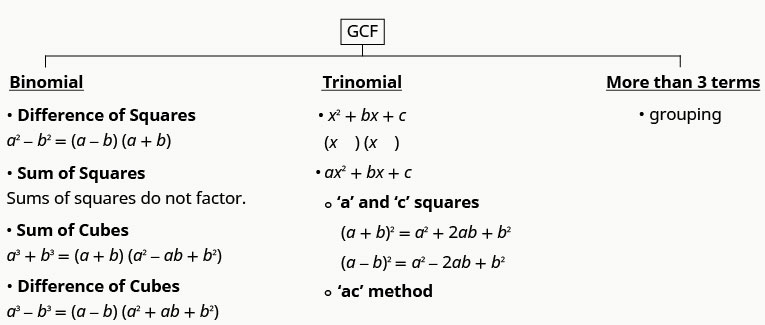
- Is there a greatest common factor?
Factor it out. - Is the polynomial a binomial, trinomial, or are there more than three terms?
If it is a binomial: If it is a trinomial: If it has more than three terms:- Is it a sum?
Of squares? Sums of squares do not factor.
Of cubes? Use the sum of cubes pattern. - Is it a difference?
Of squares? Factor as the product of conjugates.
Of cubes? Use the difference of cubes pattern.
- Is it of the form \({x}^{2}+bx+c?\) Undo FOIL.
- Is it of the form \(a{x}^{2}+bx+c?\)
If a and c are squares, check if it fits the trinomial square pattern.
Use the trial and error or “ac” method.
- Use the grouping method.
- Is it a sum?
- Check.
Is it factored completely?
Do the factors multiply back to the original polynomial?
Remember, a polynomial is completely factored if, other than monomials, its factors are prime!
Factor completely: \(7{x}^{3}-21{x}^{2}-70x.\)
Factor out the GCF, \(7x,\) first, then identify what kind of expression remains inside the parentheses.
| \(7{x}^{3}-21{x}^{2}-70x\) | |
| Is there a GCF? Yes, \(7x\) . | |
| Factor out the GCF. | \(7x({x}^{2}-3x-10)\) |
| In the parentheses, is it a binomial, trinomial, or are there more terms? | |
| Trinomial with leading coefficient 1. | |
| “Undo” FOIL. | \(7x(x\,)(x\,)\) |
| \(7x(x+2)(x-5)\) | |
| Is the expression factored completely? Yes. | |
| Neither binomial can be factored. | |
| Check your answer. | |
| Multiply. | |
| \(7x(x+2)(x-5)\) | |
| \(7x({x}^{2}-5x+2x-10)\) | |
| \(7x({x}^{2}-3x-10)\) | |
| \(7{x}^{3}-21{x}^{2}-70x✓\) |
Factor completely: \(8{y}^{3}+16{y}^{2}-24y.\)
\(8y(y-1)(y+3)\)
Factor completely: \(5{y}^{3}-15{y}^{2}-270y.\)
\(5y(y-9)(y+6)\)
Be careful when you are asked to factor a binomial as there are several options!
Factor completely: \(24{y}^{2}-150.\)
Factor out the GCF, 6, then check whether the remaining binomial is a difference of squares.
| \(24{y}^{2}-150\) | |
| Is there a GCF? Yes, 6. | |
| Factor out the GCF. | \(6(4{y}^{2}-25)\) |
| In the parentheses, is it a binomial, trinomial or are there more than three terms? Binomial. | |
| Is it a sum? No. | |
| Is it a difference? Of squares or cubes? Yes, squares. | \(6({(2y)}^{2}-{(5)}^{2})\) |
| Write as a product of conjugates. | \(6(2y-5)(2y+5)\) |
| \(\,\text{Is the expression factored completely?}\) | |
| \(\,\text{Neither binomial can be factored.}\) | |
| Check: | |
| \(\,\text{Multiply.}\) | |
| \(6(2y-5)(2y+5)\) | |
| \(6(4{y}^{2}-25)\) | |
| \(24{y}^{2}-150✓\) |
Factor completely: \(16{x}^{3}-36x.\)
\(4x(2x-3)(2x+3)\)
Factor completely: \(27{y}^{2}-48.\)
\(3(3y-4)(3y+4)\)
The next example can be factored using several methods. Recognizing the trinomial squares pattern will make your work easier.
Factor completely: \(4{a}^{2}-12ab+9{b}^{2}.\)
Check whether the first and last terms are perfect squares and whether the middle term fits the \({a}^{2}-2ab+{b}^{2}\) pattern.
| \(4{a}^{2}-12ab+9{b}^{2}\) | |
| Is there a GCF? No. | |
| Is it a binomial, trinomial, or are there more terms? | |
| Trinomial with \(a\ne 1\) . But the first term is a perfect square. | |
| Is the last term a perfect square? Yes. | \({(2a)}^{2}-12ab+{(3b)}^{2}\) |
| Does it fit the pattern, \({a}^{2}-2ab+{b}^{2}\) ? Yes. | \({(2a)}^{2}{}_{\text{↘}}\underset{-2(2a)(3b)}{-12ab+}{}_{\text{↙}}{(3b)}^{2}\) |
| Write it as a square. | \({(2a-3b)}^{2}\) |
| \(\,\text{Is the expression factored completely? Yes.}\) | |
| \(\,\text{The binomial cannot be factored.}\) | |
| Check your answer. | |
| \(\,\text{Multiply.}\) | |
| \({(2a-3b)}^{2}\) | |
| \({(2a)}^{2}-2·2a·3b+{(3b)}^{2}\) | |
| \(4{a}^{2}-12ab+9{b}^{2}✓\) |
Factor completely: \(4{x}^{2}+20xy+25{y}^{2}.\)
\({(2x+5y)}^{2}\)
Factor completely: \(9{x}^{2}-24xy+16{y}^{2}.\)
\({(3x-4y)}^{2}\)
Remember, sums of squares do not factor, but sums of cubes do!
Factor completely \(12{x}^{3}{y}^{2}+75x{y}^{2}.\)
Factor out the GCF, \(3x{y}^{2},\) then check whether the remaining binomial is a sum of squares.
| \(12{x}^{3}{y}^{2}+75x{y}^{2}\) | |
| Is there a GCF? Yes, \(3x{y}^{2}\) . | |
| Factor out the GCF. | \(3x{y}^{2}(4{x}^{2}+25)\) |
| In the parentheses, is it a binomial, trinomial, or are there more than three terms? Binomial. | |
| Is it a sum? Of squares? Yes. | Sums of squares are prime. |
| \(\,\text{Is the expression factored completely? Yes.}\) | |
| Check: | |
| \(\,\text{Multiply.}\) | |
| \(3x{y}^{2}(4{x}^{2}+25)\) | |
| \(12{x}^{3}{y}^{2}+75x{y}^{2}✓\) |
Factor completely: \(50{x}^{3}y+72xy.\)
\(2xy(25{x}^{2}+36)\)
Factor completely: \(27x{y}^{3}+48xy.\)
\(3xy(9{y}^{2}+16)\)
When using the sum or difference of cubes pattern, being careful with the signs.
Factor completely: \(24{x}^{3}+81{y}^{3}.\)
Factor out the GCF, 3, then recognize the remaining binomial as a sum of cubes.
| Is there a GCF? Yes, 3. | 
|
| Factor it out. | 
|
| In the parentheses, is it a binomial, trinomial, of are there more than three terms? Binomial. | |
| Is it a sum or difference? Sum. | |
| Of squares or cubes? Sum of cubes. | 
|
| Write it using the sum of cubes pattern. | 
|
| Is the expression factored completely? Yes. | 
|
| Check by multiplying. |
Factor completely: \(250{m}^{3}+432{n}^{3}.\)
\(2(5m+6n)(25{m}^{2}-30mn+36{n}^{2})\)
Factor completely: \(2{p}^{3}+54{q}^{3}.\)
\(2(p+3q)({p}^{2}-3pq+9{q}^{2})\)
Factor completely: \(3{x}^{5}y-48xy.\)
Factor out the GCF, \(3xy,\) then recognize the remaining binomial as a difference of squares.
| \(3{x}^{5}y-48xy\) | |
| Is there a GCF? Factor out \(3xy\) | \(3xy({x}^{4}-16)\) |
| Is the binomial a sum or difference? Of squares or cubes? Write it as a difference of squares. | \(3xy({({x}^{2})}^{2}-{(4)}^{2})\) |
| Factor it as a product of conjugates | \(3xy({x}^{2}-4)({x}^{2}+4)\) |
| The first binomial is again a difference of squares. | \(3xy({(x)}^{2}-{(2)}^{2})({x}^{2}+4)\) |
| Factor it as a product of conjugates. | \(3xy(x-2)(x+2)({x}^{2}+4)\) |
| Is the expression factored completely? Yes. | |
| Check your answer. | |
| Multiply. | |
| \(3xy(x-2)(x+2)({x}^{2}+4)\) | |
| \(3xy({x}^{2}-4)({x}^{2}+4)\) | |
| \(3xy({x}^{4}-16)\) | |
| \(3{x}^{5}y-48xy✓\) |
Factor completely: \(4{a}^{5}b-64ab.\)
\(4ab({a}^{2}+4)(a-2)(a+2)\)
Factor completely: \(7x{y}^{5}-7xy.\)
\(7xy({y}^{2}+1)(y-1)(y+1)\)
Factor completely: \(4{x}^{2}+8bx-4ax-8ab.\)
Factor out the GCF, 4, then use grouping on the remaining four terms.
| \(4{x}^{2}+8bx-4ax-8ab\) | |
| Is there a GCF? Factor out the GCF, 4. | \(4({x}^{2}+2bx-ax-2ab)\) |
| There are four terms. Use grouping. | \(\begin{array}{l} \\ 4[x(x+2b)-a(x+2b)] \\ 4(x+2b)(x-a)\end{array}\) |
| Is the expression factored completely? Yes. | |
| Check your answer. Multiply. \(\,\begin{array}{l} \\ \\ 4(x+2b)(x-a) \\ 4({x}^{2}-ax+2bx-2ab) \\ 4{x}^{2}+8bx-4ax-8ab✓\end{array}\) |
Factor completely: \(6{x}^{2}-12xc+6bx-12bc.\)
\(6(x+b)(x-2c)\)
Factor completely: \(16{x}^{2}+24xy-4x-6y.\)
\(2(4x-1)(2x+3y)\)
Taking out the complete GCF in the first step will always make your work easier.
Factor completely: \(40{x}^{2}y+44xy-24y.\)
Factor out the GCF, \(4y,\) first — it makes the remaining trinomial much easier to factor.
| \(40{x}^{2}y+44xy-24y\) | |
| Is there a GCF? Factor out the GCF, \(4y\) . | \(4y(10{x}^{2}+11x-6)\) |
| Factor the trinomial with \(a\ne 1\) . | \(4y(10{x}^{2}+11x-6)\) |
| \(4y(5x-2)(2x+3)\) | |
| Is the expression factored completely? Yes. | |
| Check your answer. | |
| Multiply. | |
| \(4y(5x-2)(2x+3)\) | |
| \(4y(10{x}^{2}+11x-6)\) | |
| \(40{x}^{2}y+44xy-24y✓\) |
Factor completely: \(4{p}^{2}q-16pq+12q.\)
\(4q(p-3)(p-1)\)
Factor completely: \(6p{q}^{2}-9pq-6p.\)
\(3p(2q+1)(q-2)\)
When we have factored a polynomial with four terms, most often we separated it into two groups of two terms. Remember that we can also separate it into a trinomial and then one term.
Factor completely: \(9{x}^{2}-12xy+4{y}^{2}-49.\)
Group the first three terms — they form a perfect square trinomial that leaves a difference of squares.
| \(9{x}^{2}-12xy+4{y}^{2}-49\) | |
| Is there a GCF? No. | |
| With more than 3 terms, use grouping. Last 2 terms have no GCF. Try grouping first 3 terms. | \(9{x}^{2}-12xy+4{y}^{2}-49\) |
| Factor the trinomial with \(a\ne 1\) . But the first term is a perfect square. | |
| Is the last term of the trinomial a perfect square? Yes. | \({(3x)}^{2}-12xy+{(2y)}^{2}-49\) |
| Does the trinomial fit the pattern, \({a}^{2}-2ab+{b}^{2}\) ? Yes. | \({(3x)}^{2}{}_{\text{↘}}\underset{-2(3x)(2y)}{-12xy+}{}_{\text{↙}}{(2y)}^{2}-49\) |
| Write the trinomial as a square. | \({(3x-2y)}^{2}-49\) |
| Is this binomial a sum or difference? Of squares or cubes? Write it as a difference of squares. | \({(3x-2y)}^{2}-{7}^{2}\) |
| Write it as a product of conjugates. | \(((3x-2y)-7)((3x-2y)+7)\) |
| \((3x-2y-7)(3x-2y+7)\) | |
| Is the expression factored completely? Yes. | |
| Check your answer. | |
| Multiply. | |
| \((3x-2y-7)(3x-2y+7)\) | |
| \(9{x}^{2}-6xy-21x-6xy+4{y}^{2}+14y+21x-14y-49\) | |
| \(9{x}^{2}-12xy+4{y}^{2}-49✓\) |
Factor completely: \(4{x}^{2}-12xy+9{y}^{2}-25.\)
\((2x-3y-5)(2x-3y+5)\)
Factor completely: \(16{x}^{2}-24xy+9{y}^{2}-64.\)
\((4x-3y-8)(4x-3y+8)\)
Key Concepts
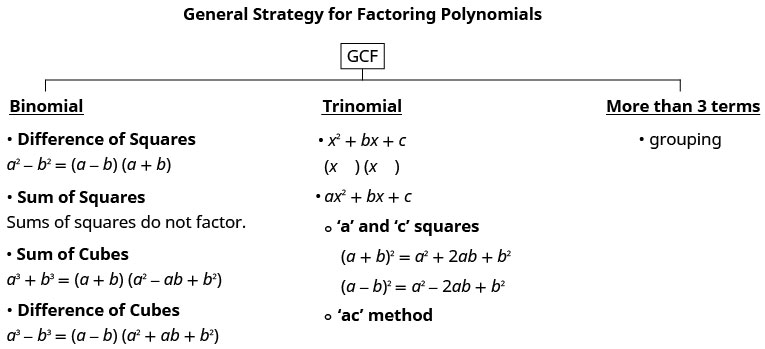
- How to use a general strategy for factoring polynomials.
- Is there a greatest common factor?
Factor it out. - Is the polynomial a binomial, trinomial, or are there more than three terms?
If it is a binomial:
Is it a sum?
Of squares? Sums of squares do not factor.
Of cubes? Use the sum of cubes pattern.
Is it a difference?
Of squares? Factor as the product of conjugates.
Of cubes? Use the difference of cubes pattern.
If it is a trinomial:
Is it of the form \({x}^{2}+bx+c?\) Undo FOIL.
Is it of the form \(a{x}^{2}+bx+c?\)
If a and c are squares, check if it fits the trinomial square pattern.
Use the trial and error or “ac” method.
If it has more than three terms:
Use the grouping method. - Check.
Is it factored completely?
Do the factors multiply back to the original polynomial?
- Is there a greatest common factor?
Section Exercises
Practice Makes Perfect
Recognize and Use the Appropriate Method to Factor a Polynomial Completely
In the following exercises, factor completely.
\(2{n}^{2}+13n-7\)
\((2n-1)(n+7)\)
\(8{x}^{2}-9x-3\)
\({a}^{5}+9{a}^{3}\)
\({a}^{3}({a}^{2}+9)\)
\(75{m}^{3}+12m\)
\(121{r}^{2}-{s}^{2}\)
\((11r-s)(11r+s)\)
\(49{b}^{2}-36{a}^{2}\)
\(8{m}^{2}-32\)
\(8(m-2)(m+2)\)
\(36{q}^{2}-100\)
\(25{w}^{2}-60w+36\)
\({(5w-6)}^{2}\)
\(49{b}^{2}-112b+64\)
\({m}^{2}+14mn+49{n}^{2}\)
\({(m+7n)}^{2}\)
\(64{x}^{2}+16xy+{y}^{2}\)
\(7{b}^{2}+7b-42\)
\(7(b+3)(b-2)\)
\(30{n}^{2}+30n+72\)
\(3{x}^{4}y-81xy\)
\(3xy(x-3)({x}^{2}+3x+9)\)
\(4{x}^{5}y-32{x}^{2}y\)
\({k}^{4}-16\)
\((k-2)(k+2)({k}^{2}+4)\)
\({m}^{4}-81\)
\(5{x}^{5}{y}^{2}-80x{y}^{2}\)
\(5x{y}^{2}({x}^{2}+4)(x+2)(x-2)\)
\(48{x}^{5}{y}^{2}-243x{y}^{2}\)
\(15pq-15p+12q-12\)
\(3(5p+4)(q-1)\)
\(12ab-6a+10b-5\)
\(4{x}^{2}+40x+84\)
\(4(x+3)(x+7)\)
\(5{q}^{2}-15q-90\)
\(4{u}^{5}+4{u}^{2}{v}^{3}\)
\(4{u}^{2}(u+v)({u}^{2}-uv+{v}^{2})\)
\(5{m}^{4}n+320m{n}^{4}\)
\(4{c}^{2}+20cd+81{d}^{2}\)
prime
\(25{x}^{2}+35xy+49{y}^{2}\)
\(10{m}^{4}-6250\)
\(10(m-5)(m+5)({m}^{2}+25)\)
\(3{v}^{4}-768\)
\(36{x}^{2}y+15xy-6y\)
\(3y(3x+2)(4x-1)\)
\(60{x}^{2}y-75xy+30y\)
\(8{x}^{3}-27{y}^{3}\)
\((2x-3y)(4{x}^{2}+6xy+9{y}^{2})\)
\(64{x}^{3}+125{y}^{3}\)
\({y}^{6}-1\)
\((y+1)(y-1)({y}^{2}-y+1)({y}^{2}+y+1)\)
\({y}^{6}+1\)
\(9{x}^{2}-6xy+{y}^{2}-49\)
\((3x-y+7)(3x-y-7)\)
\(16{x}^{2}-24xy+9{y}^{2}-64\)
\({(3x+1)}^{2}-6(3x+1)+9\)
\((3x-2{)}^{2}\)
\({(4x-5)}^{2}-7(4x-5)+12\)
Writing Exercises
Explain what it mean to factor a polynomial completely.
Answers will vary.
The difference of squares \({y}^{4}-625\) can be factored as \(({y}^{2}-25)({y}^{2}+25).\) But it is not completely factored. What more must be done to completely factor.
Of all the factoring methods covered in this chapter (GCF, grouping, undo FOIL, ‘ac’ method, special products) which is the easiest for you? Which is the hardest? Explain your answers.
Answers will vary.
Create three factoring problems that would be good test questions to measure your knowledge of factoring. Show the solutions.
Self Check
ⓐ After completing the exercises, use this checklist to evaluate your mastery of the objectives of this section.

ⓑ On a scale of 1-10, how would you rate your mastery of this section in light of your responses on the checklist? How can you improve this?