Section 1.5Properties of Real Numbers
A more thorough introduction to the topics covered in this section can be found in the Elementary Algebra 2e chapter, Foundations.
Use the Commutative and Associative Properties
The order we add two numbers doesn’t affect the result. If we add \(8+9\) or \(9+8,\) the results are the same—they both equal 17. So, \(8+9=9+8.\) The order in which we add does not matter!
Similarly, when multiplying two numbers, the order does not affect the result. If we multiply \(9·8\) or \(8·9\) the results are the same—they both equal 72. So, \(9·8=8·9.\) The order in which we multiply does not matter!
These examples illustrate the Commutative Property.
\[\begin{array}{lllllll}\text{of Addition} & & & \text{If}\,a\,\text{and}\,b\,\text{are real numbers, then} & & & a+b=b+a. \\ \text{of Multiplication} & & & \text{If}\,a\,\text{and}\,b\,\text{are real numbers, then} & & & a·b=b·a.\end{array}\]
When adding or multiplying, changing the order gives the same result.
The Commutative Property has to do with order. We subtract \(9-8\) and \(8-9\) , and see that \(9-8\ne 8-9.\) Since changing the order of the subtraction does not give the same result, we know that subtraction is not commutative.
Division is not commutative either. Since \(12÷3\ne 3÷12,\) changing the order of the division did not give the same result. The commutative properties apply only to addition and multiplication!
Addition and multiplication are commutative.
Subtraction and division are not commutative.
When adding three numbers, changing the grouping of the numbers gives the same result. For example, \((7+8)+2=7+(8+2),\) since each side of the equation equals 17.
This is true for multiplication, too. For example, \((5·\frac{1}{3})·3=5·(\frac{1}{3}·3),\) since each side of the equation equals 5.
These examples illustrate the Associative Property.
\[\begin{array}{lllllll}\text{of Addition} & & & \text{If}\,a,b,\text{and}\,c\,\text{are real numbers, then} & & & (a+b)+c=a+(b+c). \\ \text{of Multiplication} & & & \text{If}\,\text{a},b,\text{and}\,c\,\text{are real numbers, then} & & & (a·b)·c=a·(b·c).\end{array}\]
When adding or multiplying, changing the grouping gives the same result.
The Associative Property has to do with grouping. If we change how the numbers are grouped, the result will be the same. Notice it is the same three numbers in the same order—the only difference is the grouping.
We saw that subtraction and division were not commutative. They are not associative either.
\[\begin{array}{llll}(10-3)-2\ne 10-(3-2) & & & (24÷4)÷2\ne 24÷(4÷2) \\ \,7-2\ne 10-1 & & & \,6÷2\ne 24÷2 \\ \,5\ne 9 & & & \,3\ne 12\end{array}\]
When simplifying an expression, it is always a good idea to plan what the steps will be. In order to combine like terms in the next example, we will use the Commutative Property of addition to write the like terms together.
Simplify: \(18p+6q+15p+5q.\)
Reorder the terms so the p-terms and the q-terms are next to each other before combining.
| \(18p+6q+15p+5q\) | |
| Use the Commutative Property of addition to reorder so that like terms are together. | \(18p+15p+6q+5q\) |
| Add like terms. | \(33p+11q\) |
Simplify: \(23r+14s+9r+15s.\)
\(32r+29s\)
Simplify: \(37m+21n+4m-15n.\)
\(41m+6n\)
When we have to simplify algebraic expressions, we can often make the work easier by applying the Commutative Property or Associative Property first.
Simplify: \((\frac{5}{13}+\frac{3}{4})+\frac{1}{4}.\)
Notice the last two fractions share a denominator — regroup them together using the Associative Property before adding.
| \((\frac{5}{13}+\frac{3}{4})+\frac{1}{4}\) | |
| Notice that the last 2 terms have a common denominator, so change the grouping. | \(\frac{5}{13}+(\frac{3}{4}+\frac{1}{4})\) |
| Add in parentheses first. | \(\frac{5}{13}+(\frac{4}{4})\) |
| Simplify the fraction. | \(\frac{5}{13}+1\) |
| Add. | \(1\frac{5}{13}\) |
| Convert to an improper fraction. | \(\frac{18}{13}\) |
Simplify: \((\frac{7}{15}+\frac{5}{8})+\frac{3}{8}.\)
\(1\frac{7}{15}\)
Simplify: \((\frac{2}{9}+\frac{7}{12})+\frac{5}{12}.\)
\(1\frac{2}{9}\)
Use the Properties of Identity, Inverse, and Zero
What happens when we add 0 to any number? Adding 0 doesn’t change the value. For this reason, we call 0 the additive identity. The Identity Property of Addition that states that for any real number \(a,a+0=a\) and \(0+a=a.\)
What happens when we multiply any number by one? Multiplying by 1 doesn’t change the value. So we call 1 the multiplicative identity. The Identity Property of Multiplication that states that for any real number \(a,a·1=a\) and \(1·a=a.\)
We summarize the Identity Properties here.
\[\begin{array}{llll}\text{of Addition}\,\text{For any real number}\,a:\,a+0=a & & & 0+a=a \\ \,0\,\text{is the}\,\text{additive identity} & & & \\ \text{of Multiplication}\,\text{For any real number}\,a:\,a·1=a & & & 1·a=a \\ \,1\,\text{is the}\,\text{multiplicative identity}\end{array}\]
What number added to 5 gives the additive identity, 0? We know

The missing number was the opposite of the number!
We call \(\text{-}a\) the additive inverse of \(a.\) The opposite of a number is its additive inverse. A number and its opposite add to zero, which is the additive identity. This leads to the Inverse Property of Addition that states for any real number \(a,a+(\text{-}a)=0.\)
What number multiplied by \(\frac{2}{3}\) gives the multiplicative identity, 1? In other words, \(\frac{2}{3}\) times what results in 1? We know

The missing number was the reciprocal of the number!
We call \(\frac{1}{a}\) the multiplicative inverseof a. The reciprocal of a number is its multiplicative inverse. This leads to the Inverse Property of Multiplication that states that for any real number \(a,a\ne 0,a·\frac{1}{a}=1.\)
We’ll formally state the inverse properties here.
\[\begin{array}{llll}\text{of Addition} & & & \text{For any real number}\,a,\,a+(\text{-}a)=0 \\ & & & \text{-}a\,\text{is the}\,\text{additive inverse}\,\text{of}\,a \\ & & & \text{A number and its}\,opposite\,\text{add to zero.} \\ \\ \\ \\ \\ \text{of Multiplication} & & & \text{For any real number}\,a,\,a\ne 0,\,a·\frac{1}{a}=1. \\ & & & \frac{1}{a}\,\text{is the}\,\text{multiplicative inverse}\,\text{of}\,a. \\ & & & \text{A number and its}\,reciprocal\,\text{multiply to one.}\end{array}\]
The Identity Property of addition says that when we add 0 to any number, the result is that same number. What happens when we multiply a number by 0? Multiplying by 0 makes the product equal zero.
What about division involving zero? What is \(0÷3?\) Think about a real example: If there are no cookies in the cookie jar and 3 people are to share them, how many cookies does each person get? There are no cookies to share, so each person gets 0 cookies. So, \(0÷3=0.\)
We can check division with the related multiplication fact. So we know \(0÷3=0\) because \(0·3=0.\)
Now think about dividing by zero. What is the result of dividing 4 by \(0?\) Think about the related multiplication fact:

Is there a number that multiplied by 0 gives \(4?\) Since any real number multiplied by 0 gives 0, there is no real number that can be multiplied by 0 to obtain 4. We conclude that there is no answer to \(4÷0\) and so we say that division by 0 is undefined.
We summarize the properties of zero here.
Multiplication by Zero: For any real number a,
\(\,a·0=0\,0·a=0\,\text{The product of any number and 0 is 0.}\)
Division by Zero: For any real number a, \(a\ne 0\)
\[\begin{array}{llll}\frac{0}{a}=0 & & & \,\text{Zero divided by any real number, except itself, is zero.} \\ \frac{a}{0}\,\text{is undefined} & & & \,\text{Division by zero is undefined.}\end{array}\]
We will now practice using the properties of identities, inverses, and zero to simplify expressions.
Simplify: \(-84n+(-73n)+84n.\)
Spot the two terms that are opposites of each other and reorder the expression so they're next to each other.
| \(-84n+(-73n)+84n\) | |
| Notice that the first and third terms are opposites; use the Commutative Property of addition to re-order the terms. | \(-84n+84n+(-73n)\) |
| Add left to right. | \(0+(-73n)\) |
| Add. | \(-73n\) |
Simplify: \(-27a+(-48a)+27a.\)
\(-48a\)
Simplify: \(39x+(-92x)+(-39x).\)
\(-92x\)
Now we will see how recognizing reciprocals is helpful. Before multiplying left to right, look for reciprocals—their product is 1.
Simplify: \(\frac{7}{15}·\frac{8}{23}·\frac{15}{7}.\)
Look for two factors that are reciprocals of each other and group them together first.
| \(\frac{7}{15}·\frac{8}{23}·\frac{15}{7}\) | |
| Notice the first and third terms are reciprocals, so use the Commutative Property of multiplication to re-order the factors. | \(\frac{7}{15}·\frac{15}{7}·\frac{8}{23}\) |
| Multiply left to right. | \(1·\frac{8}{23}\) |
| Multiply. | \(\frac{8}{23}\) |
Simplify: \(\frac{9}{16}·\frac{5}{49}·\frac{16}{9}.\)
\(\frac{5}{49}\)
Simplify: \(\frac{6}{17}·\frac{11}{25}·\frac{17}{6}.\)
\(\frac{11}{25}\)
The next example makes us aware of the distinction between dividing 0 by some number or some number being divided by 0.
Simplify: ⓐ \(\frac{0}{n+5},\) where \(n\ne \text{-}5\) ⓑ \(\frac{10-3p}{0},\) where \(10-3p\ne 0.\)
Decide which expression has 0 in the numerator and which has 0 in the denominator — they behave very differently.
ⓐ
\(\begin{array}{llll} & & & \,\frac{0}{n+5} \\ \text{Zero divided by any real number except itself is 0.} & & & \,0\end{array}\)
ⓑ
\(\begin{array}{llll} & & & \,\frac{10-3p}{0} \\ \text{Division by 0 is undefined.} & & & \,\text{undefined}\end{array}\)
Simplify: ⓐ \(\frac{0}{m+7},\) where \(m\ne \text{-}7\) ⓑ \(\frac{18-6c}{0},\) where \(18-6c\ne 0.\)
ⓐ 0 ⓑ undefined
Simplify: ⓐ \(\frac{0}{d-4},\) where \(d\ne 4\) ⓑ \(\frac{15-4q}{0},\) where \(15-4q\ne 0.\)
ⓐ 0 ⓑ undefined
Simplify Expressions Using the Distributive Property
Suppose that three friends are going to the movies. They each need $9.25—that’s 9 dollars and 1 quarter—to pay for their tickets. How much money do they need all together?
You can think about the dollars separately from the quarters. They need 3 times $9 so $27 and 3 times 1 quarter, so 75 cents. In total, they need $27.75. If you think about doing the math in this way, you are using the Distributive Property.
\(\begin{array}{llll}\text{If}\,a,b,\text{and}\,c\,\text{are real numbers, then} & & & a(b+c)=ab+ac \\ & & & (b+c)a=ba+ca \\ & & & a(b-c)=ab-ac \\ & & & (b-c)a=ba-ca\end{array}\)
In algebra, we use the Distributive Property to remove parentheses as we simplify expressions.
Simplify: \(3(x+4).\)
Multiply the 3 by each term inside the parentheses separately.
| \(3(x+4)\) | |
| Distribute. | \(3·x+3·4\) |
| Multiply. | \(3x+12\) |
Simplify: \(4(x+2).\)
\(4x+8\)
Simplify: \(6(x+7).\)
\(6x+42\)
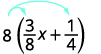
Some students find it helpful to draw in arrows to remind them how to use the Distributive Property. Then the first step in Example 6 would look like this:

Simplify: \(8(\frac{3}{8}x+\frac{1}{4}).\)
Distribute the 8 to each fraction inside the parentheses before multiplying.
| |
| Distribute. | 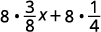
|
| Multiply. | 
|
Simplify: \(6(\frac{5}{6}y+\frac{1}{2}).\)
\(5y+3\)
Simplify: \(12(\frac{1}{3}n+\frac{3}{4}).\)
\(4n+9\)
Using the Distributive Property as shown in the next example will be very useful when we solve money applications in later chapters.
Simplify: \(100(0.3+0.25q).\)
Distribute the 100 to both the decimal term and the term with q.

| |
| Distribute. | 
|
| Multiply. | 
|
Simplify: \(100(0.7+0.15p).\)
\(70+15p\)
Simplify: \(100(0.04+0.35d).\)
\(4+35d\)
When we distribute a negative number, we need to be extra careful to get the signs correct!
Simplify: \(-11(4-3a).\)
Distribute \(-11\) to each term, keeping careful track of the signs.
| \(-11(4-3a)\) | |
| Distribute. | \(-11·4-(-11)·3a\) |
| Multiply. | \(-44-(-33a)\) |
| Simplify. | \(-44+33a\) |
Notice that you could also write the result as \(33a-44.\) Do you know why?
Simplify: \(-5(2-3a).\)
\(-10+15a\)
Simplify: \(-7(8-15y).\)
\(-56+105y\)
In the next example, we will show how to use the Distributive Property to find the opposite of an expression.
Simplify: \(\text{-}(y+5).\)
Rewrite the leading negative sign as multiplying by \(-1,\) then distribute.
| \(\text{-}(y+5)\) | |
| Multiplying by \(-1\) results in the opposite. | \(-1(y+5)\) |
| Distribute. | \(-1·y+(-1)·5\) |
| Simplify. | \(-y+(-5)\) |
| Simplify. | \(-y-5\) |
Simplify: \(\text{-}(z-11).\)
\(\text{-}z+11\)
Simplify: \(\text{-}(x-4).\)
\(\text{-}x+4\)
There will be times when we’ll need to use the Distributive Property as part of the order of operations. Start by looking at the parentheses. If the expression inside the parentheses cannot be simplified, the next step would be multiply using the Distributive Property, which removes the parentheses. The next two examples will illustrate this.
Simplify: \(8-2(x+3)\)
Follow the order of operations: distribute the \(-2\) into the parentheses before combining with the 8.
We follow the order of operations. Multiplication comes before subtraction, so we will distribute the 2 first and then subtract.
| \(8-2(x+3)\) | |
| Distribute. | \(8-2·x-2·3\) |
| Multiply. | \(8-2x-6\) |
| Combine like terms. | \(-2x+2\) |
Simplify: \(9-3(x+2).\)
\(3-3x\)
Simplify: \(7x-5(x+4).\)
\(2x-20\)
Simplify: \(4(x-8)-(x+3).\)
Distribute both the 4 and the implied \(-1\) across their own parentheses before combining like terms.
| \(4(x-8)-(x+3)\) | |
| Distribute. | \(4x-32-x-3\) |
| Combine like terms. | \(3x-35\) |
Simplify: \(6(x-9)-(x+12).\)
\(5x-66\)
Simplify: \(8(x-1)-(x+5).\)
\(7x-13\)
All the properties of real numbers we have used in this chapter are summarized here.
| Commutative Property When adding or multiplying, changing the order gives the same result \(\begin{array}{llllll}\,\text{of addition}\,\text{If}\,a,b\,\text{are real numbers, then} & & & \,a+b & = & b+a \\ \,\text{of multiplication}\,\text{If}\,a,b\,\text{are real numbers, then} & & & \,a·b & = & b·a\end{array}\) |
| Associative Property When adding or multiplying, changing the grouping gives the same result. \(\begin{array}{llllll}\,\text{of addition}\,\text{If}\,a,b,\,\text{and}\,c\,\text{are real numbers, then} & & & \,(a+b)+c & = & a+(b+c) \\ \,\text{of multiplication}\,\text{If}\,a,b,\,\text{and}\,c\,\text{are real numbers, then} & & & \,(a·b)·c & = & a·(b·c)\end{array}\) |
| Distributive Property \(\begin{array}{llllll}\,\text{If}\,a,b,\,\text{and}\,c\,\text{are real numbers, then} & & & \,a(b+c) & = & ab+ac \\ \\ & & & \,(b+c)a & = & ba+ca \\ \\ & & & \,a(b-c) & = & ab-ac \\ \\ & & & \,(b-c)a & = & ba-ca\end{array}\) |
| Identity Property \(\begin{array}{llll}\,\text{of addition}\,\text{For any real number}\,a\text{:} & & & \,a+0=a \\ \,0\,\text{is the}\,\text{additive identity} & & & \,0+a=a \\ \,\text{of multiplication}\,\text{For any real number}\,a\text{:} & & & \,a·1=a \\ \,1\,\text{is the}\,\text{multiplicative identity} & & & \,1·a=a\end{array}\) |
| Inverse Property \(\begin{array}{llll}\,\text{of addition}\,\text{For any real number}\,a, & & & \,a+(\text{-}a)=0 \\ \,\text{-}a\,\text{is the}\,\text{additive inverse}\,\text{of}\,a & & & \\ \,\text{A number and its}\,opposite\,\text{add to zero.} & & & \\ \,\text{of multiplication}\,\text{For any real number}\,a,a\ne 0 & & & \,a·\frac{1}{a}=1 \\ \\ \,\frac{1}{a}\,\text{is the}\,\text{multiplicative inverse}\,\text{of}\,a & & & \\ \,\text{A number and its}\,reciprocal\,\text{multiply to one.} & & & \end{array}\) |
| Properties of Zero \(\begin{array}{llll}\,\text{For any real number}\,a, & & & \,a·0=0 \\ & & & \,0·a=0 \\ \,\text{For any real number}\,a,a\ne 0, & & & \,\frac{0}{a}=0 \\ \,\text{For any real number}\,a, & & & \,\frac{a}{0}\,\text{is undefined}\end{array}\) |
Key Concepts
- Commutative Property
When adding or multiplying, changing the order gives the same result.
\(\begin{array}{llllll}\,\text{of addition}\,\text{If}\,a,b\,\text{are real numbers, then} & & & \,a+b & = & b+a \\ \,\text{of multiplication}\,\text{If}\,a,b\,\text{are real numbers, then} & & & \,a·b & = & b·a\end{array}\) (See Example 1.) - Associative Property
When adding or multiplying, changing the grouping gives the same result.
\(\begin{array}{llllll}\,\text{of addition}\,\text{If}\,a,b,\,\text{and}\,c\,\text{are real numbers, then} & & & \,(a+b)+c & = & a+(b+c) \\ \,\text{of multiplication}\,\text{If}\,a,b,\,\text{and}\,c\,\text{are real numbers, then} & & & \,(a·b)·c & = & a·(b·c)\end{array}\) (See Example 2.) - Distributive Property
\(\begin{array}{llllll}\,\text{If}\,a,b,\,\text{and}\,c\,\text{are real numbers, then} & & & \,a(b+c) & = & ab+ac \\ \\ & & & \,(b+c)a & = & ba+ca \\ \\ & & & \,a(b-c) & = & ab-ac \\ \\ & & & \,(b-c)a & = & ba-ca\end{array}\) (See Example 6, Example 7, Example 8, Example 9, Example 10, Example 11, and Example 12.) - Identity Property
\(\begin{array}{llll}\,\text{of addition}\,\text{For any real number}\,a\text{:} & & & \,a+0=a \\ \,0\,\text{is the}\,\text{additive identity} & & & \,0+a=a \\ \,\text{of multiplication}\,\text{For any real number}\,a\text{:} & & & \,a·1=a \\ \,1\,\text{is the}\,\text{multiplicative identity} & & & \,1·a=a\end{array}\) - Inverse Property
\(\begin{array}{llll}\,\text{of addition}\,\text{For any real number}\,a, & & & \,a+(\text{-}a)=0 \\ \,\text{-}a\,\text{is the}\,\text{additive inverse}\,\text{of}\,a & & & \\ \,\text{A number and its}\,opposite\,\text{add to zero.} & & & \\ \,\text{of multiplication}\,\text{For any real number}\,a,a\ne 0 & & & \,a·\frac{1}{a}=1 \\ \\ \,\frac{1}{a}\,\text{is the}\,\text{multiplicative inverse}\,\text{of}\,a & & & \\ \,\text{A number and its}\,reciprocal\,\text{multiply to one.} & & & \end{array}\) (See Example 3 and Example 4.) - Properties of Zero
\(\begin{array}{llll}\,\text{For any real number}\,a, & & & \,a·0=0 \\ & & & \,0·a=0 \\ \,\text{For any real number}\,a,a\ne 0, & & & \,\frac{0}{a}=0 \\ \,\text{For any real number}\,a, & & & \,\frac{a}{0}\,\text{is undefined}\end{array}\) (See Example 5.)
Section Exercises
Practice Makes Perfect
Use the Commutative and Associative Properties
In the following exercises, simplify.
\(43m+(-12n)+(-16m)+(-9n)\)
\(27m+(-21n)\)
\(-22p+17q+(-35p)+(-27q)\)
\(\frac{3}{8}g+\frac{1}{12}h+\frac{7}{8}g+\frac{5}{12}h\)
\(\frac{5}{4}g+\frac{1}{2}h\)
\(\frac{5}{6}a+\frac{3}{10}b+\frac{1}{6}a+\frac{9}{10}b\)
\(6.8p+9.14q+(-4.37p)+(-0.88q)\)
\(2.43p+8.26q\)
\(9.6m+7.22n+(-2.19m)+(-0.65n)\)
\(-24·7·\frac{3}{8}\)
\(-63\)
\(-36·11·\frac{4}{9}\)
\((\frac{5}{6}+\frac{8}{15})+\frac{7}{15}\)
\(1\frac{5}{6}\)
\((\frac{11}{12}+\frac{4}{9})+\frac{5}{9}\)
\(17(0.25)(4)\)
\(17\)
\(36(0.2)(5)\)
\([2.48(12)](0.5)\)
\(14.88\)
\([9.731(4)](0.75)\)
\(12(\frac{5}{6}p)\)
\(10p\)
\(20(\frac{3}{5}q)\)
Use the Properties of Identity, Inverse and Zero
In the following exercises, simplify.
\(19a+44-19a\)
\(44\)
\(27c+16-27c\)
\(\frac{1}{2}+\frac{7}{8}+(-\frac{1}{2})\)
\(\frac{7}{8}\)
\(\frac{2}{5}+\frac{5}{12}+(-\frac{2}{5})\)
\(10(0.1d)\)
\(d\)
\(100(0.01p)\)
\(\frac{3}{20}·\frac{49}{11}·\frac{20}{3}\)
\(\frac{49}{11}\)
\(\frac{13}{18}·\frac{25}{7}·\frac{18}{13}\)
\(\frac{0}{u-4.99},\) where \(u\ne 4.99\)
0
\(0÷(y-\frac{1}{6}),\) where \(x\ne \frac{1}{6}\)
\(\frac{32-5a}{0},\) where \(32-5a\ne 0\)
undefined
\(\frac{28-9b}{0},\) where \(28-9b\ne 0\)
\((\frac{3}{4}+\frac{9}{10}m)÷0,\) where \(\frac{3}{4}+\frac{9}{10}m\ne 0\)
undefined
\((\frac{5}{16}n-\frac{3}{7})÷0,\) where \(\frac{5}{16}n-\frac{3}{7}\ne 0\)
Simplify Expressions Using the Distributive Property
In the following exercises, simplify using the Distributive Property.
\(8(4y+9)\)
\(32y+72\)
\(9(3w+7)\)
\(6(c-13)\)
\(6c-78\)
\(7(y-13)\)
\(\frac{1}{4}(3q+12)\)
\(\frac{3}{4}q+3\)
\(\frac{1}{5}(4m+20)\)
\(9(\frac{5}{9}y-\frac{1}{3})\)
\(5y-3\)
\(10(\frac{3}{10}x-\frac{2}{5})\)
\(12(\frac{1}{4}+\frac{2}{3}r)\)
\(3+8r\)
\(12(\frac{1}{6}+\frac{3}{4}s)\)
\(15·\frac{3}{5}(4d+10)\)
\(36d+90\)
\(18·\frac{5}{6}(15h+24)\)
\(r(s-18)\)
\(rs-18r\)
\(u(v-10)\)
\((y+4)p\)
\(yp+4p\)
\((a+7)x\)
\(-7(4p+1)\)
\(-28p-7\)
\(-9(9a+4)\)
\(-3(x-6)\)
\(-3x+18\)
\(-4(q-7)\)
\(\text{-}(3x-7)\)
\(-3x+7\)
\(\text{-}(5p-4)\)
\(16-3(y+8)\)
\(-3y-8\)
\(18-4(x+2)\)
\(4-11(3c-2)\)
\(-33c+26\)
\(9-6(7n-5)\)
\(22-(a+3)\)
\(\text{-}a+19\)
\(8-(r-7)\)
\((5m-3)-(m+7)\)
\(4m-10\)
\((4y-1)-(y-2)\)
\(9(8x-3)-(-2)\)
\(72x-25\)
\(4(6x-1)-(-8)\)
\(5(2n+9)+12(n-3)\)
\(22n+9\)
\(9(5u+8)+2(u-6)\)
\(14(c-1)-8(c-6)\)
\(6c+34\)
\(11(n-7)-5(n-1)\)
\(6(7y+8)-(30y-15)\)
\(12y+63\)
\(7(3n+9)-(4n-13)\)
Writing Exercises
In your own words, state the Associative Property of addition.
Answers will vary.
What is the difference between the additive inverse and the multiplicative inverse of a number?
Simplify \(8(x-\frac{1}{4})\) using the Distributive Property and explain each step.
Answers will vary.
Explain how you can multiply \(4(\text{\$}5.97)\) without paper or calculator by thinking of \(\text{\$}5.97\) as \(6-0.03\) and then using the Distributive Property.
Self Check
ⓐ After completing the exercises, use this checklist to evaluate your mastery of the objectives of this section.
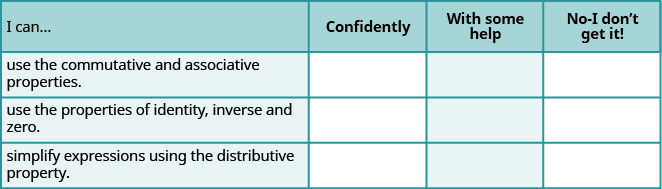
ⓑ After reviewing this checklist, what will you do to become confident for all objectives?
Chapter Review Exercises
Use the Language of Algebra
Identify Multiples and Factors
Use the divisibility tests to determine whether 180 is divisible by 2, by 3, by 5, by 6, and by 10.
Divisible by \(2,3,5,6,10\)
Find the prime factorization of 252.
Find the least common multiple of 24 and 40.
120
In the following exercises, simplify each expression.
\(24÷3+4(5-2)\)
\(7+3[6-4(5-4)]-{3}^{2}\)
4
Evaluate an Expression
In the following exercises, evaluate the following expressions.
When \(x=4,\) ⓐ \({x}^{3}\) ⓑ \({5}^{x}\) ⓒ \(2{x}^{2}-5x+3\)
\(2{x}^{2}-4xy-3{y}^{2}\) when \(x=3,\) \(y=1\)
3
Simplify Expressions by Combining Like Terms
In the following exercises, simplify the following expressions by combining like terms.
\(12y+7+2y-5\)
\(14{x}^{2}-9x+11-8{x}^{2}+8x-6\)
\(6{x}^{2}-x+5\)
Translate an English Phrase to an Algebraic Expression
In the following exercises, translate the phrases into algebraic expressions.
ⓐ the sum of \(4a{b}^{2}\) and \(7{a}^{3}{b}^{2}\)
ⓑ the product of \(6{y}^{2}\) and \(3y\)
ⓒ twelve more than \(5x\)
ⓓ \(5y\) less than \(8{y}^{2}\)
ⓐ eleven times the difference of \(y\) and two
ⓑ the difference of eleven times \(y\) and two
ⓐ \(11(y-2)\) ⓑ \(11y-2\)
Dushko has nickels and pennies in his pocket. The number of pennies is four less than five times the number of nickels. Let \(n\) represent the number of nickels. Write an expression for the number of pennies.
Integers
Simplify Expressions with Absolute Value
In the following exercise, fill in \(<,>,\) or \(=\) for each of the following pairs of numbers.
ⓐ \(\text{-}\text{|}7\text{|}\_\_\_-\text{|}-7\text{|}\)
ⓑ \(-8\_\_\_-\text{|}-8\text{|}\)
ⓒ \(\text{|}-13\text{|}\_\_\_-13\)
ⓓ \(\text{|}-12\text{|}\_\_\_-(-12)\)
ⓐ \(=\) ⓑ \(=\) ⓒ \(>\) ⓓ \(=\)
In the following exercises, simplify.
\(9-\text{|}3(4-8)\text{|}\)
\(12-3\text{|}1-4(4-2)\text{|}\)
\(-9\)
Add and Subtract Integers
In the following exercises, simplify each expression.
\(-12+(-8)+7\)
ⓐ \(15-7\)
ⓑ \(-15-(-7)\)
ⓒ \(-15-7\)
ⓓ \(15-(-7)\)
ⓐ 8 ⓑ \(-8\) ⓒ \(-22\) ⓓ 22
\(-11-(-12)+5\)
ⓐ \(23-(-17)\) ⓑ \(23+17\)
ⓐ 40 ⓑ 40
\(\text{-}(7-11)-(3-5)\)
Multiply and Divide Integers
In the following exercise, multiply or divide.
ⓐ \(-27÷9\) ⓑ \(120÷(-8)\) ⓒ \(4(-14)\) ⓓ \(-1(-17)\)
ⓐ \(-3\) ⓑ \(-15\) ⓒ \(-56\) ⓓ 17
Simplify and Evaluate Expressions with Integers
In the following exercises, simplify each expression.
ⓐ \({(-7)}^{3}\) ⓑ \(\text{-}{7}^{3}\)
\((7-11)(6-13)\)
28
\(63÷(-9)+(-36)÷(-4)\)
\(6-3\text{|}4(1-2)-(7-5)\text{|}\)
\(-12\)
\({(-2)}^{4}-24÷(13-5)\)
For the following exercises, evaluate each expression.
\({(y+z)}^{2}\) when
\(y=-4,z=7\)
9
\(3{x}^{2}-2xy+4{y}^{2}\) when
\(x=-2,y=-3\)
Translate English Phrases to Algebraic Expressions
In the following exercises, translate to an algebraic expression and simplify if possible.
the sum of \(-4\) and \(-9,\) increased by 23
\((-4+(-9))+23;10\)
ⓐ the difference of 17 and \(-8\) ⓑ subtract 17 from \(-25\)
Use Integers in Applications
In the following exercise, solve.
Temperature On July 10, the high temperature in Phoenix, Arizona, was 109°, and the high temperature in Juneau, Alaska, was 63°. What was the difference between the temperature in Phoenix and the temperature in Juneau?
\({46}^{\text{°}}\)
Fractions
Simplify Fractions
In the following exercises, simplify.
\(\frac{204}{228}\)
\(-\frac{270{x}^{3}}{198{y}^{2}}\)
\(-\frac{15{x}^{3}}{11{y}^{2}}\)
Multiply and Divide Fractions
In the following exercises, perform the indicated operation.
\((-\frac{14}{15})(\frac{10}{21})\)
\(\frac{6x}{25}÷\frac{9y}{20}\)
\(\frac{8x}{15y}\)
\(\frac{-\frac{4}{9}}{\frac{8}{21}}\)
Add and Subtract Fractions
In the following exercises, perform the indicated operation.
\(\frac{5}{18}+\frac{7}{12}\)
\(\frac{31}{36}\)
\(\frac{11}{36}-\frac{15}{48}\)
ⓐ \(\frac{5}{8}+\frac{3}{4}\) ⓑ \(\frac{5}{8}÷\frac{3}{4}\)
ⓐ \(\frac{11}{8}\) ⓑ \(\frac{5}{6}\)
ⓐ \(-\frac{3y}{10}-\frac{5}{6}\) ⓑ \(-\frac{3y}{10}·\frac{5}{6}\)
Use the Order of Operations to Simplify Fractions
In the following exercises, simplify.
\(\frac{4·3-2·5}{-6·3+2·3}\)
\(-\frac{1}{6}\)
\(\frac{4(7-3)-2(4-9)}{-3(4+2)+7(3-6)}\)
\(\frac{{4}^{3}-{4}^{2}}{{(\frac{4}{5})}^{2}}\)
75
Evaluate Variable Expressions with Fractions
In the following exercises, evaluate.
\(4{x}^{2}{y}^{2}\) when
\(x=\frac{2}{3}\) and \(y=-\frac{3}{4}\)
\(\frac{a+b}{a-b}\) when
\(a=-4,\) \(b=6\)
\(-\frac{1}{5}\)
Decimals
Round Decimals
Round \(6.738\) to the nearest ⓐ hundredth ⓑ tenth ⓒ whole number.
Add and Subtract Decimals
In the following exercises, perform the indicated operation.
\(-23.67+29.84\)
\(6.17\)
\(54.3-100\)
\(79.38-(-17.598)\)
\(96.978\)
Multiply and Divide Decimals
In the following exercises, perform the indicated operation.
\((-2.8)(3.97)\)
\((-8.43)(-57.91)\)
488.1813
\((53.48)(10)\)
\((0.563)(100)\)
\(56.3\)
\(\text{\$}118.35÷2.6\)
\(1.84÷(-0.8)\)
\(-2.3\)
Convert Decimals, Fractions and Percents
In the following exercises, convert each decimal to a fraction.
\(0.65\)
\(-9.6\)
\(-\frac{48}{5}\)
In the following exercises, convert each fraction to a decimal.
\(-\frac{5}{8}\)
\(\frac{14}{11}\)
\(1.\overset{¯}{27}\)
In the following exercises, convert each decimal to a percent.
\(2.43\)
\(0.0475\)
\(4.75\%\)
Simplify Expressions with Square Roots
In the following exercises, simplify.
\(\sqrt{289}\)
\(\sqrt{-121}\)
no real number
Identify Integers, Rational Numbers, Irrational Numbers, and Real Numbers
In the following exercise, list the ⓐ whole numbers ⓑ integers ⓒ rational numbers ⓓ irrational numbers ⓔ real numbers for each set of numbers
\(-8,0,1.95286...,\frac{12}{5},\sqrt{36},9\)
Locate Fractions and Decimals on the Number Line
In the following exercises, locate the numbers on a number line.
\(\frac{3}{4},-\frac{3}{4},1\frac{1}{3},-1\frac{2}{3},\frac{7}{2},-\frac{5}{2}\)
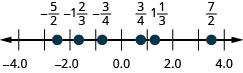
ⓐ \(3.2\) ⓑ \(-1.35\)
Properties of Real Numbers
Use the Commutative and Associative Properties
In the following exercises, simplify.
\(\frac{5}{8}x+\frac{5}{12}y+\frac{1}{8}x+\frac{7}{12}y\)
\(\frac{3}{4}x+y\)
\(-32·9·\frac{5}{8}\)
\((\frac{11}{15}+\frac{3}{8})+\frac{5}{8}\)
\(1\frac{11}{15}\)
Use the Properties of Identity, Inverse and Zero
In the following exercises, simplify.
\(\frac{4}{7}+\frac{8}{15}+(-\frac{4}{7})\)
\(\frac{13}{15}·\frac{9}{17}·\frac{15}{13}\)
\(\frac{9}{17}\)
\(\frac{0}{x-3},x\ne 3\)
\(\frac{5x-7}{0},5x-7\ne 0\)
undefined
Simplify Expressions Using the Distributive Property
In the following exercises, simplify using the Distributive Property.
\(8(a-4)\)
\(12(\frac{2}{3}b+\frac{5}{6})\)
\(8b+10\)
\(18·\frac{5}{6}(2x-5)\)
\((x-5)p\)
\(xp-5p\)
\(-4(y-3)\)
\(12-6(x+3)\)
\(-6x-6\)
\(6(3x-4)-(-5)\)
\(5(2y+3)-(4y-1)\)
\(6y+16\)
Practice Test
Find the prime factorization of \(756.\)
Combine like terms: \(5n+8+2n-1\)
\(7n+7\)
Evaluate when \(x=-2\) and \(y=3:\) \(\frac{\text{|}3x-4y\text{|}}{6}\)
Translate to an algebraic expression and simplify:
ⓐ eleven less than negative eight
ⓑ the difference of \(-8\) and \(-3\) , increased by 5
\(-8-11;-19\)
\((-8-(-3))+5;0\)
Dushko has nickels and pennies in his pocket. The number of pennies is seven less than four times the number of nickels. Let \(n\) represent the number of nickels. Write an expression for the number of pennies.
Round \(28.1458\) to the nearest
ⓐ hundredth ⓑ thousandth
ⓐ \(28.15\) ⓑ \(28.146\)
Convert
ⓐ \(\frac{5}{11}\) to a decimal ⓑ \(1.15\) to a percent
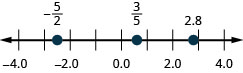
Locate \(\frac{3}{5},2.8,\text{and}-\frac{5}{2}\) on a number line.
In the following exercises, simplify each expression.
\(8+3[6-3(5-2)]-{4}^{2}\)
\(\text{-}(4-9)-(9-5)\)
1
\(56÷(-8)+(-27)÷(-3)\)
\(16-2\text{|}3(1-4)-(8-5)\text{|}\)
\(-8\)
\(-5+2{(-3)}^{2}-9\)
\(\frac{180}{204}\)
\(\frac{15}{17}\)
\(-\frac{7}{18}+\frac{5}{12}\)
\(\frac{4}{5}÷(-\frac{12}{25})\)
\(-\frac{5}{3}\)
\(\frac{9-3·9}{15-9}\)
\(\frac{4(-3+2(3-6))}{3(11-3(2+3))}\)
\(3\)
\(\frac{5}{13}·47·\frac{13}{5}\)
\(\frac{-\frac{5}{9}}{\frac{10}{21}}\)
\(-\frac{7}{6}\)
\(-4.8+(-6.7)\)
\(34.6-100\)
\(-65.4\)
\(-12.04·(4.2)\)
\(-8÷0.05\)
−160
\(\sqrt{-121}\)
\((\frac{8}{13}+\frac{5}{7})+\frac{2}{7}\)
\(1\frac{8}{13}\)
\(5x+(-8y)-6x+3y\)
ⓐ \(\frac{0}{9}\) ⓑ \(\frac{11}{0}\)
ⓐ 0 ⓑ undefined
\(-3(8x-5)\)
\(6(3y-1)-(5y-3)\)
\(13y-3\)
Glossary
- additive identity
- The number 0 is the additive identity because adding 0 to any number does not change its value.
- additive inverse
- The opposite of a number is its additive inverse.
- multiplicative identity
- The number 1 is the multiplicative identity because multiplying 1 by any number does not change its value.
- multiplicative inverse
- The reciprocal of a number is its multiplicative inverse.