Section 1.3Fractions
A more thorough introduction to the topics covered in this section can be found in the Elementary Algebra 2e chapter, Foundations.
Simplify Fractions
A fraction is a way to represent parts of a whole. The fraction \(\frac{2}{3}\) represents two of three equal parts. See Figure 1. In the fraction \(\frac{2}{3},\) the 2 is called the numerator and the 3 is called the denominator. The line is called the fraction bar.
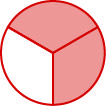
A fraction is written \(\frac{a}{b},\) where \(b\ne 0\) and
a is the numerator and b is the denominator.
A fraction represents parts of a whole. The denominator \(b\) is the number of equal parts the whole has been divided into, and the numerator \(a\) indicates how many parts are included.
Fractions that have the same value are equivalent fractions. The Equivalent Fractions
Property allows us to find equivalent fractions and also simplify fractions.
If a, b, and c are numbers where \(b\ne 0,c\ne 0,\)
then \(\frac{a}{b}=\frac{a·c}{b·c}\) and \(\frac{a·c}{b·c}=\frac{a}{b}.\)
A fraction is considered simplified if there are no common factors, other than 1, in its numerator and denominator.
For example,
\(\frac{2}{3}\) is simplified because there are no common factors of 2 and \(3.\)
\(\frac{10}{15}\) is not simplified because 5 is a common factor of 10 and \(15.\)
We simplify, or reduce, a fraction by removing the common factors of the numerator and denominator. A fraction is not simplified until all common factors have been removed. If an expression has fractions, it is not completely simplified until the fractions are simplified.
Sometimes it may not be easy to find common factors of the numerator and denominator. When this happens, a good idea is to factor the numerator and the denominator into prime numbers. Then divide out the common factors using the Equivalent Fractions Property.
Simplify: \(-\frac{315}{770}.\)
Rewrite the numerator and denominator as products of primes to spot common factors.



Simplify: \(-\frac{69}{120}.\)
\(-\frac{23}{40}\)
Simplify: \(-\frac{120}{192}.\)
\(-\frac{5}{8}\)
We now summarize the steps you should follow to simplify fractions.
- Rewrite the numerator and denominator to show the common factors.
If needed, factor the numerator and denominator into prime numbers first. - Simplify using the Equivalent Fractions Property by dividing out common factors.
- Multiply any remaining factors.
Multiply and Divide Fractions
Many people find multiplying and dividing fractions easier than adding and subtracting fractions.
To multiply fractions, we multiply the numerators and multiply the denominators.
If a, b, c, and d are numbers where \(b\ne 0,\) and \(d\ne 0,\) then
\[\frac{a}{b}·\frac{c}{d}=\frac{ac}{bd}\]
To multiply fractions, multiply the numerators and multiply the denominators.
When multiplying fractions, the properties of positive and negative numbers still apply, of course. It is a good idea to determine the sign of the product as the first step. In Example 2, we will multiply a negative by a negative, so the product will be positive.
When multiplying a fraction by an integer, it may be helpful to write the integer as a fraction. Any integer, a, can be written as \(\frac{a}{1}.\) So, for example, \(3=\frac{3}{1}.\)
Multiply: \(-\frac{12}{5}(-20x).\)
Determine the sign of the product first, then write 20x as a fraction over 1.
The first step is to find the sign of the product. Since the signs are the same, the product is positive.

| |
| Determine the sign of the product. The signs are the same, so the product is positive. | 
|
| Write 20x as a fraction. | 
|
| Multiply. | 
|
| Rewrite 20 to show the common factor 5 and divide it out. | 
|
| Simplify. | 
|
Multiply: \(\frac{11}{3}(-9a).\)
\(-33a\)
Multiply: \(\frac{13}{7}(-14b).\)
\(-26b\)
Now that we know how to multiply fractions, we are almost ready to divide. Before we can do that, we need some vocabulary. The reciprocal of a fraction is found by inverting the fraction, placing the numerator in the denominator and the denominator in the numerator. The reciprocal of \(\frac{2}{3}\) is \(\frac{3}{2}.\) Since 4 is written in fraction form as \(\frac{4}{1},\) the reciprocal of 4 is \(\frac{1}{4}.\)
To divide fractions, we multiply the first fraction by the reciprocal of the second.
If a, b, c, and d are numbers where \(b\ne 0,c\ne 0,\) and \(d\ne 0,\) then
\[\frac{a}{b}÷\frac{c}{d}=\frac{a}{b}·\frac{d}{c}\]
To divide fractions, we multiply the first fraction by the reciprocal of the second.
We need to say \(b\ne 0,\) \(c\ne 0,\) and \(d\ne 0,\) to be sure we don’t divide by zero!
Find the quotient: \(-\frac{7}{18}÷(-\frac{14}{27}).\)
Multiply the first fraction by the reciprocal of the second.

| |
| To divide, multiply the first fraction by the reciprocal of the second. | 
|
| Determine the sign of the product, and then multiply. | 
|
| Rewrite showing common factors. | 
|
| Remove common factors. | 
|
| Simplify. | 
|
Divide: \(-\frac{7}{27}÷(-\frac{35}{36}).\)
\(\frac{4}{15}\)
Divide: \(-\frac{5}{14}÷(-\frac{15}{28}).\)
\(\frac{2}{3}\)
The numerators or denominators of some fractions contain fractions themselves. A fraction in which the numerator or the denominator is a fraction is called a complex fraction.
A complex fraction is a fraction in which the numerator or the denominator contains a fraction.
Some examples of complex fractions are:
\[\frac{\frac{6}{7}}{3}\,\frac{\frac{3}{4}}{\frac{5}{8}}\,\frac{\frac{x}{2}}{\frac{5}{6}}\]
To simplify a complex fraction, remember that the fraction bar means division. For example, the complex fraction \(\frac{\frac{3}{4}}{\frac{5}{8}}\) means \(\frac{3}{4}÷\frac{5}{8}.\)
Simplify: \(\frac{\frac{x}{2}}{\frac{xy}{6}}.\)
Rewrite the complex fraction as division, then multiply by the reciprocal of the second fraction.
| \(\frac{\frac{x}{2}}{\frac{xy}{6}}\) | |
| Rewrite as division. | \(\frac{x}{2}÷\frac{xy}{6}\) |
| Multiply the first fraction by the reciprocal of the second. | \(\frac{x}{2}·\frac{6}{xy}\) |
| Multiply. | \(\frac{x·6}{2·xy}\) |
| Look for common factors. | \(\frac{x·3·2}{2·x·y}\) |
| Divide common factors and simplify. | \(\frac{3}{y}\) |
Simplify: \(\frac{\frac{a}{8}}{\frac{ab}{6}}.\)
\(\frac{3}{4b}\)
Simplify: \(\frac{\frac{p}{2}}{\frac{pq}{8}}.\)
\(\frac{4}{q}\)
Add and Subtract Fractions
When we multiplied fractions, we just multiplied the numerators and multiplied the denominators right straight across. To add or subtract fractions, they must have a common denominator.
If a, b, and c are numbers where \(c\ne 0,\) then
\[\frac{a}{c}+\frac{b}{c}=\frac{a+b}{c}\,\text{and}\,\frac{a}{c}-\frac{b}{c}=\frac{a-b}{c}\]
To add or subtract fractions, add or subtract the numerators and place the result over the common denominator.
The least common denominator (LCD) of two fractions is the smallest number that can be used as a common denominator of the fractions. The LCD of the two fractions is the least common multiple (LCM) of their denominators.
The least common denominator (LCD) of two fractions is the least common multiple (LCM) of their denominators.
After we find the least common denominator of two fractions, we convert the fractions to equivalent fractions with the LCD. Putting these steps together allows us to add and subtract fractions because their denominators will be the same!
Add: \(\frac{7}{12}+\frac{5}{18}.\)
Find the LCD of 12 and 18 before rewriting either fraction.
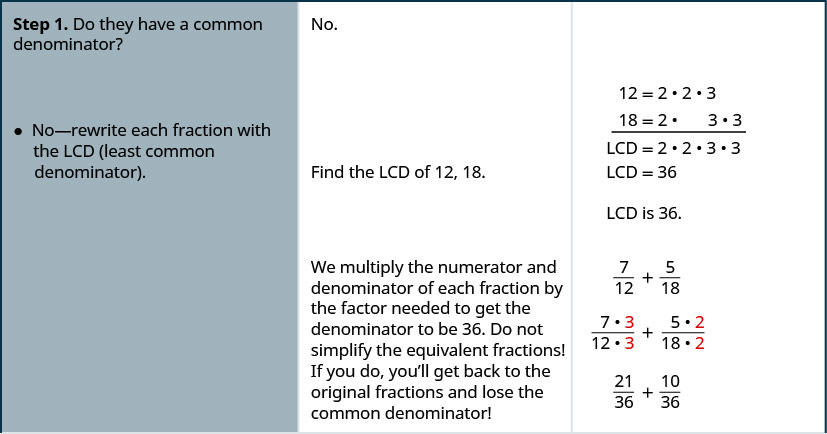


Add: \(\frac{7}{12}+\frac{11}{15}.\)
\(\frac{79}{60}\)
Add: \(\frac{13}{15}+\frac{17}{20}.\)
\(\frac{103}{60}\)
- Do they have a common denominator?
- Yes—go to step 2.
- No—rewrite each fraction with the LCD (least common denominator).
- Find the LCD.
- Change each fraction into an equivalent fraction with the LCD as its denominator.
- Add or subtract the fractions.
- Simplify, if possible.
We now have all four operations for fractions. Table 4 summarizes fraction operations.
| Fraction Multiplication | Fraction Division |
| \(\frac{a}{b}·\frac{c}{d}=\frac{ac}{bd}\) | \(\frac{a}{b}÷\frac{c}{d}=\frac{a}{b}·\frac{d}{c}\) |
| Multiply the numerators and multiply the denominators | Multiply the first fraction by the reciprocal of the second. |
| Fraction Addition | Fraction Subtraction |
| \(\frac{a}{c}+\frac{b}{c}=\frac{a+b}{c}\) | \(\frac{a}{c}-\frac{b}{c}=\frac{a-b}{c}\) |
| Add the numerators and place the sum over the common denominator. | Subtract the numerators and place the difference over the common denominator. |
| To multiply or divide fractions, an LCD is NOT needed. To add or subtract fractions, an LCD is needed. |
When starting an exercise, always identify the operation and then recall the methods needed for that operation.
Simplify: ⓐ \(\frac{5x}{6}-\frac{3}{10}\) ⓑ \(\frac{5x}{6}·\frac{3}{10}.\)
First identify the operation in each part — only subtraction needs a common denominator.
First ask, “What is the operation?” Identifying the operation will determine whether or not we need a common denominator. Remember, we need a common denominator to add or subtract, but not to multiply or divide.
ⓐ
| What is the operation? The operation is subtraction. | |
| Do the fractions have a common denominator? No. | \(\frac{5x}{6}-\frac{3}{10}\) |
| Find the LCD of 6 and 10 | The LCD is 30. |
| \(\,\begin{array}{l}\,6=2·3 \\ \underset{\_\_\_\_\_\_\_\_\_\_\_}{\,10=2·5} \\ \text{LCD}=2·3·5 \\ \text{LCD}=30\end{array}\) | |
| Rewrite each fraction as an equivalent fraction with the LCD. | \(\frac{5x·5}{6·5}-\frac{3·3}{10·3}\) |
| \(\frac{25x}{30}-\frac{9}{30}\) | |
| Subtract the numerators and place the difference over the common denominators. | \(\frac{25x-9}{30}\) |
| Simplify, if possible. There are no common factors. The fraction is simplified. |
ⓑ
| What is the operation? Multiplication. | \(\frac{5x}{6}·\frac{3}{10}\) |
| To multiply fractions, multiply the numerators and multiply the denominators. | \(\frac{5x·3}{6·10}\) |
| Rewrite, showing common factors. Remove common factors. | \(\frac{5x·3}{2·3·2·5}\) |
| Simplify. | \(\frac{x}{4}\) |
| Notice, we needed an LCD to add \(\frac{5x}{6}-\frac{3}{10},\) but not to multiply \(\frac{5x}{6}·\frac{3}{10}.\) |
Simplify: ⓐ \(\frac{3a}{4}-\frac{8}{9}\) ⓑ \(\frac{3a}{4}·\frac{8}{9}.\)
ⓐ \(\frac{27a-32}{36}\) ⓑ \(\frac{2a}{3}\)
Simplify: ⓐ \(\frac{4k}{5}-\frac{1}{6}\) ⓑ \(\frac{4k}{5}·\frac{1}{6}.\)
ⓐ \(\frac{24k-5}{30}\) ⓑ \(\frac{2k}{15}\)
Use the Order of Operations to Simplify Fractions
The fraction bar in a fraction acts as grouping symbol. The order of operations then tells us to simplify the numerator and then the denominator. Then we divide.
- Simplify the expression in the numerator. Simplify the expression in the denominator.
- Simplify the fraction.
Where does the negative sign go in a fraction? Usually the negative sign is in front of the fraction, but you will sometimes see a fraction with a negative numerator, or sometimes with a negative denominator. Remember that fractions represent division. When the numerator and denominator have different signs, the quotient is negative.
\[\frac{-1}{3}=-\frac{1}{3}\,\frac{\text{negative}}{\text{positive}}=\text{negative}\]
\[\frac{1}{-3}=-\frac{1}{3}\,\frac{\text{positive}}{\text{negative}}=\text{negative}\]
For any positive numbers a and b,
\[\frac{\text{-}a}{b}=\frac{a}{\text{-}b}=-\frac{a}{b}\]
Simplify: \(\frac{4(-3)+6(-2)}{-3(2)-2}.\)
Simplify the numerator and the denominator completely before dividing.
The fraction bar acts like a grouping symbol. So completely simplify the numerator and the denominator separately.
| \(\frac{4(-3)+6(-2)}{-3(2)-2}\) | |
| Multiply. | \(\frac{-12+(-12)}{-6-2}\) |
| Simplify. | \(\frac{-24}{-8}\) |
| Divide. | \(3\) |
Simplify: \(\frac{8(-2)+4(-3)}{-5(2)+3}.\)
4
Simplify: \(\frac{7(-1)+9(-3)}{-5(3)-2}.\)
2
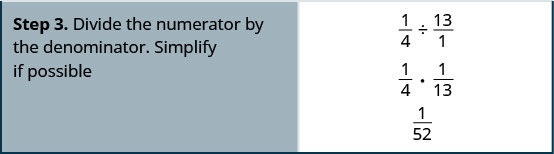
Now we’ll look at complex fractions where the numerator or denominator contains an expression that can be simplified. So we first must completely simplify the numerator and denominator separately using the order of operations. Then we divide the numerator by the denominator as the fraction bar means division.
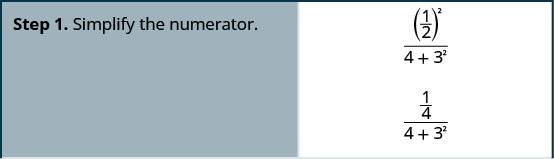
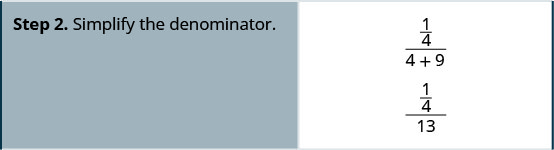
Simplify: \(\frac{{(\frac{1}{2})}^{2}}{4+{3}^{2}}.\)
Simplify the numerator and denominator separately before dividing.
Simplify: \(\frac{{(\frac{1}{3})}^{2}}{{2}^{3}+2}.\)
\(\frac{1}{90}\)
Simplify: \(\frac{1+{4}^{2}}{{(\frac{1}{4})}^{2}}.\)
272
- Simplify the numerator.
- Simplify the denominator.
- Divide the numerator by the denominator. Simplify if possible.
Simplify: \(\frac{\frac{1}{2}+\frac{2}{3}}{\frac{3}{4}-\frac{1}{6}}.\)
Put parentheses around the numerator and denominator, then simplify each using its own LCD.
It may help to put parentheses around the numerator and the denominator.
| \(\frac{(\frac{1}{2}+\frac{2}{3})}{(\frac{3}{4}-\frac{1}{6})}\) | |
| Simplify the numerator (LCD = 6) and simplify the denominator (LCD = 12). | \(\frac{(\frac{3}{6}+\frac{4}{6})}{(\frac{9}{12}-\frac{2}{12})}\) |
| Simplify. | \(\frac{(\frac{7}{6})}{(\frac{7}{12})}\) |
| Divide the numerator by the denominator. | \(\frac{7}{6}÷\frac{7}{12}\) |
| Simplify. | \(\frac{7}{6}\cdot \frac{12}{7}\) |
| Divide out common factors. | \(\frac{7\cdot 6\cdot 2}{6\cdot 7\cdot 1}\) |
| Simplify. | \(2\) |
Simplify: \(\frac{\frac{1}{3}+\frac{1}{2}}{\frac{3}{4}-\frac{1}{3}}.\)
2
Simplify: \(\frac{\frac{2}{3}-\frac{1}{2}}{\frac{1}{4}+\frac{1}{3}}.\)
\(\frac{2}{7}\)
Evaluate Variable Expressions with Fractions
We have evaluated expressions before, but now we can evaluate expressions with fractions. Remember, to evaluate an expression, we substitute the value of the variable into the expression and then simplify.
Evaluate \(2{x}^{2}y\) when \(x=\frac{1}{4}\) and \(y=-\frac{2}{3}.\)
Substitute 1/4 for x and −2/3 for y before simplifying.
Substitute the values into the expression.

| |

| 
|
| Simplify exponents first. | 
|
| Multiply; divide out the common factors. Notice we write 16 as \(2·2·4\) to make it easy to remove common factors. | 
|
| Simplify. | 
|
Evaluate \(3a{b}^{2}\) when \(a=-\frac{2}{3}\) and \(b=-\frac{1}{2}.\)
\(-\frac{1}{2}\)
Evaluate \(4{c}^{3}d\) when \(c=-\frac{1}{2}\) and \(d=-\frac{4}{3}.\)
\(\frac{2}{3}\)
Access this online resource for additional instruction and practice with fractions.
Key Concepts
- Equivalent Fractions Property
If a, b, and c are numbers where \(b\ne 0,c\ne 0,\) then
\(\,\frac{a}{b}=\frac{a·c}{b·c}\,\text{and}\,\frac{a·c}{b·c}=\frac{a}{b}.\) - How to simplify a fraction.
- Rewrite the numerator and denominator to show the common factors.
If needed, factor the numerator and denominator into prime numbers first. - Simplify using the Equivalent Fractions Property by dividing out common factors.
- Multiply any remaining factors. (See Example 1.)
- Rewrite the numerator and denominator to show the common factors.
- Fraction Multiplication
If a, b, c, and d are numbers where \(b\ne 0,\) and \(d\ne 0,\) then
\(\,\frac{a}{b}·\frac{c}{d}=\frac{ac}{bd}.\)
To multiply fractions, multiply the numerators and multiply the denominators. (See Example 2 and Example 6.) - Fraction Division
If a, b, c, and d are numbers where \(b\ne 0,c\ne 0,\) and \(d\ne 0,\) then
\(\,\frac{a}{b}÷\frac{c}{d}=\frac{a}{b}·\frac{d}{c}.\)
To divide fractions, we multiply the first fraction by the reciprocal of the second. (See Example 3.) - Fraction Addition and Subtraction
If a, b, and c are numbers where \(c\ne 0,\) then
\(\,\frac{a}{c}+\frac{b}{c}=\frac{a+b}{c}\,\text{and}\,\frac{a}{c}-\frac{b}{c}=\frac{a-b}{c}.\)
To add or subtract fractions, add or subtract the numerators and place the result over the common denominator. (See Example 5 and Example 6.) - How to add or subtract fractions.
- Do they have a common denominator?
- Yes—go to step 2.
- No—rewrite each fraction with the LCD (least common denominator).
- Find the LCD.
- Change each fraction into an equivalent fraction with the LCD as its denominator.
- Add or subtract the fractions.
- Simplify, if possible. (See Example 5.)
- Do they have a common denominator?
- How to simplify an expression with a fraction bar.
- Simplify the expression in the numerator. Simplify the expression in the denominator.
- Simplify the fraction. (See Example 7.)
- Placement of Negative Sign in a Fraction
For any positive numbers a and b,
\(\,\frac{\text{-}a}{b}=\frac{a}{\text{-}b}=-\frac{a}{b}.\) - How to simplify complex fractions.
Section Exercises
Practice Makes Perfect
Simplify Fractions
In the following exercises, simplify.
\(-\frac{108}{63}\)
\(-\frac{12}{7}\)
\(-\frac{104}{48}\)
\(\frac{120}{252}\)
\(\frac{10}{21}\)
\(\frac{182}{294}\)
\(\frac{14{x}^{2}}{21y}\)
\(\frac{2{x}^{2}}{3y}\)
\(\frac{24a}{32{b}^{2}}\)
\(-\frac{210{a}^{2}}{110{b}^{2}}\)
\(-\frac{21{a}^{2}}{11{b}^{2}}\)
\(-\frac{30{x}^{2}}{105{y}^{2}}\)
Multiply and Divide Fractions
In the following exercises, perform the indicated operation.
\(-\frac{3}{4}(-\frac{4}{9})\)
\(\frac{1}{3}\)
\(-\frac{3}{8}·\frac{4}{15}\)
\((-\frac{14}{15})(\frac{9}{20})\)
\(-\frac{21}{50}\)
\((-\frac{9}{10})(\frac{25}{33})\)
\((-\frac{63}{84})(-\frac{44}{90})\)
\(\frac{11}{30}\)
\((-\frac{33}{60})(-\frac{40}{88})\)
\(\frac{3}{7}·21n\)
\(9n\)
\(\frac{5}{6}·30m\)
\(\frac{3}{4}÷\frac{x}{11}\)
\(\frac{33}{4x}\)
\(\frac{2}{5}÷\frac{y}{9}\)
\(\frac{5}{18}÷(-\frac{15}{24})\)
\(-\frac{4}{9}\)
\(\frac{7}{18}÷(-\frac{14}{27})\)
\(\frac{8u}{15}÷\frac{12v}{25}\)
\(\frac{10u}{9v}\)
\(\frac{12r}{25}÷\frac{18s}{35}\)
\(\frac{3}{4}÷(-12)\)
\(-\frac{1}{16}\)
\(-15÷(-\frac{5}{3})\)
In the following exercises, simplify.
\(\frac{-\frac{8}{21}}{\,\,\,\frac{12}{35}}\)
\(-\frac{10}{9}\)
\(\frac{-\frac{9}{16}}{\,\,\,\frac{33}{40}}\)
\(\frac{-\frac{4}{5}}{\,\,\,2}\)
\(-\frac{2}{5}\)
\(\frac{\frac{5}{3}}{\,\text{10}}\)
\(\frac{\frac{m}{3}}{\frac{n}{2}}\)
\(\frac{2m}{3n}\)
\(\frac{-\frac{3}{8}}{-\frac{y}{12}}\)
Add and Subtract Fractions
In the following exercises, add or subtract.
\(\frac{7}{12}+\frac{5}{8}\)
\(\frac{29}{24}\)
\(\frac{5}{12}+\frac{3}{8}\)
\(\frac{7}{12}-\frac{9}{16}\)
\(\frac{1}{48}\)
\(\frac{7}{16}-\frac{5}{12}\)
\(-\frac{13}{30}+\frac{25}{42}\)
\(\frac{17}{105}\)
\(-\frac{23}{30}+\frac{5}{48}\)
\(-\frac{39}{56}-\frac{22}{35}\)
\(-\frac{53}{40}\)
\(-\frac{33}{49}-\frac{18}{35}\)
\(-\frac{2}{3}-(-\frac{3}{4})\)
\(\frac{1}{12}\)
\(-\frac{3}{4}-(-\frac{4}{5})\)
\(\frac{x}{3}+\frac{1}{4}\)
\(\frac{4x+3}{12}\)
\(\frac{x}{5}-\frac{1}{4}\)
ⓐ \(\frac{2}{3}+\frac{1}{6}\)
ⓑ \(\frac{2}{3}÷\frac{1}{6}\)
ⓐ \(\frac{5}{6}\) ⓑ \(4\)
ⓐ \(-\frac{2}{5}-\frac{1}{8}\)
ⓑ \(-\frac{2}{5}·\frac{1}{8}\)
ⓐ \(\frac{5n}{6}÷\frac{8}{15}\)
ⓑ \(\frac{5n}{6}-\frac{8}{15}\)
ⓐ \(\frac{25n}{16}\) ⓑ \(\frac{25n-16}{30}\)
ⓐ \(\frac{3a}{8}÷\frac{7}{12}\)
ⓑ \(\frac{3a}{8}-\frac{7}{12}\)
ⓐ \(-\frac{4x}{9}-\frac{5}{6}\)
ⓑ \(-\frac{4k}{9}·\frac{5}{6}\)
ⓐ \(\frac{-8x-15}{18}\) ⓑ \(-\frac{10k}{27}\)
ⓐ \(-\frac{3y}{8}-\frac{4}{3}\)
ⓑ \(-\frac{3y}{8}·\frac{4}{3}\)
ⓐ \(-\frac{5a}{3}+(-\frac{10}{6})\)
ⓑ \(-\frac{5a}{3}÷(-\frac{10}{6})\)
ⓐ \(\frac{-5(a+1)}{3}\) ⓑ \(a\)
ⓐ \(\frac{2b}{5}+\frac{8}{15}\)
ⓑ \(\frac{2b}{5}÷\frac{8}{15}\)
Use the Order of Operations to Simplify Fractions
In the following exercises, simplify.
\(\frac{5·6-3·4}{4·5-2·3}\)
\(\frac{9}{7}\)
\(\frac{8·9-7·6}{5·6-9·2}\)
\(\frac{{5}^{2}-{3}^{2}}{3-5}\)
\(-8\)
\(\frac{{6}^{2}-{4}^{2}}{4-6}\)
\(\frac{7·4-2(8-5)}{9·3-3·5}\)
\(\frac{11}{6}\)
\(\frac{9·7-3(12-8)}{8·7-6·6}\)
\(\frac{9(8-2)-3(15-7)}{6(7-1)-3(17-9)}\)
\(\frac{5}{2}\)
\(\frac{8(9-2)-4(14-9)}{7(8-3)-3(16-9)}\)
\(\frac{{2}^{3}+{4}^{2}}{{(\frac{2}{3})}^{2}}\)
\(54\)
\(\frac{{3}^{3}-{3}^{2}}{{(\frac{3}{4})}^{2}}\)
\(\frac{{(\frac{3}{5})}^{2}}{{(\frac{3}{7})}^{2}}\)
\(\frac{49}{25}\)
\(\frac{{(\frac{3}{4})}^{2}}{{(\frac{5}{8})}^{2}}\)
\(\frac{2}{\frac{1}{3}+\frac{1}{5}}\)
\(\frac{15}{4}\)
\(\frac{5}{\frac{1}{4}+\frac{1}{3}}\)
\(\frac{\frac{7}{8}-\frac{2}{3}}{\frac{1}{2}+\frac{3}{8}}\)
\(\frac{5}{21}\)
\(\frac{\frac{3}{4}-\frac{3}{5}}{\frac{1}{4}+\frac{2}{5}}\)
Mixed Practice
In the following exercises, simplify.
\(-\frac{3}{8}÷(-\frac{3}{10})\)
\(\frac{5}{4}\)
\(-\frac{3}{12}÷(-\frac{5}{9})\)
\(-\frac{3}{8}+\frac{5}{12}\)
\(\frac{1}{24}\)
\(-\frac{1}{8}+\frac{7}{12}\)
\(-\frac{7}{15}-\frac{y}{4}\)
\(\frac{-28-15y}{60}\)
\(-\frac{3}{8}-\frac{x}{11}\)
\(\frac{11}{12a}·\frac{9a}{16}\)
\(\frac{33}{64}\)
\(\frac{10y}{13}·\frac{8}{15y}\)
\(\frac{1}{2}+\frac{2}{3}·\frac{5}{12}\)
\(\frac{7}{9}\)
\(\frac{1}{3}+\frac{2}{5}·\frac{3}{4}\)
\(1-\frac{3}{5}÷\frac{1}{10}\)
\(-5\)
\(1-\frac{5}{6}÷\frac{1}{12}\)
\(\frac{3}{8}-\frac{1}{6}+\frac{3}{4}\)
\(\frac{23}{24}\)
\(\frac{2}{5}+\frac{5}{8}-\frac{3}{4}\)
\(12(\frac{9}{20}-\frac{4}{15})\)
\(\frac{11}{5}\)
\(8(\frac{15}{16}-\frac{5}{6})\)
\(\frac{\frac{5}{8}+\frac{1}{6}}{\frac{19}{24}}\)
\(1\)
\(\frac{\frac{1}{6}+\frac{3}{10}}{\frac{14}{30}}\)
\((\frac{5}{9}+\frac{1}{6})÷(\frac{2}{3}-\frac{1}{2})\)
\(\frac{13}{3}\)
\((\frac{3}{4}+\frac{1}{6})÷(\frac{5}{8}-\frac{1}{3})\)
Evaluate Variable Expressions with Fractions
In the following exercises, evaluate.
\(\frac{7}{10}-w\) when
ⓐ \(w=\frac{1}{2}\) ⓑ \(w=-\frac{1}{2}\)
ⓐ \(\frac{1}{5}\) ⓑ \(\frac{6}{5}\)
\(\frac{5}{12}-w\) when
ⓐ \(w=\frac{1}{4}\) ⓑ \(w=-\frac{1}{4}\)
\(2{x}^{2}{y}^{3}\) when
\(x=-\frac{2}{3}\) and \(y=-\frac{1}{2}\)
\(-\frac{1}{9}\)
\(8{u}^{2}{v}^{3}\) when
\(u=-\frac{3}{4}\) and \(v=-\frac{1}{2}\)
\(\frac{a+b}{a-b}\) when
\(a=-3,b=8\)
\(-\frac{5}{11}\)
\(\frac{r-s}{r+s}\) when
\(r=10,s=-5\)
Writing Exercises
Why do you need a common denominator to add or subtract fractions? Explain.
Answers will vary.
How do you find the LCD of 2 fractions?
Explain how you find the reciprocal of a fraction.
Answers will vary.
Explain how you find the reciprocal of a negative number.
Self Check
ⓐ After completing the exercises, use this checklist to evaluate your mastery of the objectives of this section.
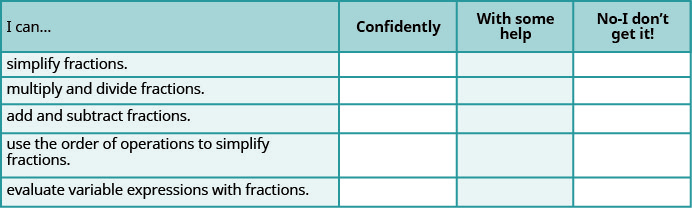
ⓑ What does this checklist tell you about your mastery of this section? What steps will you take to improve?
Glossary
- complex fraction
- A fraction in which the numerator or the denominator is a fraction is called a complex fraction.
- denominator
- In a fraction, written \(\frac{a}{b},\) where \(b\ne 0,\) the denominator b is the number of equal parts the whole has been divided into.
- equivalent fractions
- Equivalent fractions are fractions that have the same value.
- fraction
- A fraction is written \(\frac{a}{b},\) where \(b\ne 0,\) and a is the numerator and b is the denominator. A fraction represents parts of a whole.
- least common denominator
- The least common denominator (LCD) of two fractions is the least common multiple (LCM) of their denominators.
- numerator
- In a fraction, written \(\frac{a}{b},\) where \(b\ne 0,\) the numerator a indicates how many parts are included.
- reciprocal
- The reciprocal of a fraction is found by inverting the fraction, placing the numerator in the denominator and the denominator in the numerator.