Section 4.5The Chain Rule
In single-variable calculus, we found that one of the most useful differentiation rules is the chain rule, which allows us to find the derivative of the composition of two functions. The same thing is true for multivariable calculus, but this time we have to deal with more than one form of the chain rule. In this section, we study extensions of the chain rule and learn how to take derivatives of compositions of functions of more than one variable.
Chain Rules for One or Two Independent Variables
Recall that the chain rule for the derivative of a composite of two functions can be written in the form
\[\frac{d}{dx}(f(g(x)))=f\prime (g(x))g\prime (x).\]
In this equation, both \(f(x)\) and \(g(x)\) are functions of one variable. Now suppose that \(f\) is a function of two variables and \(g\) is a function of one variable. Or perhaps they are both functions of two variables, or even more. How would we calculate the derivative in these cases? The following theorem gives us the answer for the case of one independent variable.
Suppose that \(x=g(t)\) and \(y=h(t)\) are differentiable functions of \(t\) and \(z=f(x,y)\) is a differentiable function of \(x\,\text{and}\,y.\) Then \(z=f(x(t),y(t))\) is a differentiable function of \(t\) and
\[\frac{dz}{dt}=\frac{∂z}{∂x}·\frac{dx}{dt}+\frac{∂z}{∂y}·\frac{dy}{dt},\]
where the ordinary derivatives are evaluated at \(t\) and the partial derivatives are evaluated at \((x,y).\)
Proof
The proof of this theorem uses the definition of differentiability of a function of two variables. Suppose that f is differentiable at the point \(P({x}_{0},{y}_{0}),\) where \({x}_{0}=g({t}_{0})\) and \({y}_{0}=h({t}_{0})\) for a fixed value of \({t}_{0}.\) We wish to prove that \(z=f(x(t),y(t))\) is differentiable at \(t={t}_{0}\) and that Equation 2 holds at that point as well.
Since \(f\) is differentiable at \(P,\) we know that
\[z(t)=f(x,y)=f({x}_{0},{y}_{0})+{f}_{x}({x}_{0},{y}_{0})(x-{x}_{0})+{f}_{y}({x}_{0},{y}_{0})(y-{y}_{0})+E(x,y),\]
where \(\underset{(x,y)\to ({x}_{0},{y}_{0})}{\text{lim}}\frac{E(x,y)}{\sqrt{{(x-{x}_{0})}^{2}+{(y-{y}_{0})}^{2}}}=0.\) We then subtract \({z}_{0}=f({x}_{0},{y}_{0})\) from both sides of this equation:
\[\begin{array}{ll}z(t)-z({t}_{0}) & =f(x(t),y(t))-f(x({t}_{0}),y({t}_{0})) \\ & ={f}_{x}({x}_{0},{y}_{0})(x(t)-x({t}_{0}))+{f}_{y}({x}_{0},{y}_{0})(y(t)-y({t}_{0}))+E(x(t),y(t)).\end{array}\]
Next, we divide both sides by \(t-{t}_{0}\text{:}\)
\[\frac{z(t)-z({t}_{0})}{t-{t}_{0}}={f}_{x}({x}_{0},{y}_{0})(\frac{x(t)-x({t}_{0})}{t-{t}_{0}})+{f}_{y}({x}_{0},{y}_{0})(\frac{y(t)-y({t}_{0})}{t-{t}_{0}})+\frac{E(x(t),y(t))}{t-{t}_{0}}.\]
Then we take the limit as \(t\) approaches \({t}_{0}\text{:}\)
\[\begin{array}{ll}\underset{t\to {t}_{0}}{\text{lim}}\frac{z(t)-z({t}_{0})}{t-{t}_{0}} & ={f}_{x}({x}_{0},{y}_{0})\underset{t\to {t}_{0}}{\text{lim}}(\frac{x(t)-x({t}_{0})}{t-{t}_{0}})+{f}_{y}({x}_{0},{y}_{0})\underset{t\to {t}_{0}}{\text{lim}}(\frac{y(t)-y({t}_{0})}{t-{t}_{0}}) \\ & \,+\underset{t\to {t}_{0}}{\text{lim}}\frac{E(x(t),y(t))}{t-{t}_{0}}.\end{array}\]
The left-hand side of this equation is equal to \(dz\text{/}dt,\) which leads to
\[\frac{dz}{dt}={f}_{x}({x}_{0},{y}_{0})\frac{dx}{dt}+{f}_{y}({x}_{0},{y}_{0})\frac{dy}{dt}+\underset{t\to {t}_{0}}{\text{lim}}\frac{E(x(t),y(t))}{t-{t}_{0}}.\]
The last term can be rewritten as
\[\begin{array}{ll}\underset{t\to {t}_{0}}{\text{lim}}\frac{E(x(t),y(t))}{t-{t}_{0}} & =\underset{t\to {t}_{0}}{\text{lim}}(\frac{E(x,y)}{\sqrt{{(x-{x}_{0})}^{2}+{(y-{y}_{0})}^{2}}}\,\frac{\sqrt{{(x-{x}_{0})}^{2}+{(y-{y}_{0})}^{2}}}{t-{t}_{0}}) \\ & =\underset{t\to {t}_{0}}{\text{lim}}(\frac{E(x,y)}{\sqrt{{(x-{x}_{0})}^{2}+{(y-{y}_{0})}^{2}}})\underset{t\to {t}_{0}}{\text{lim}}(\frac{\sqrt{{(x-{x}_{0})}^{2}+{(y-{y}_{0})}^{2}}}{t-{t}_{0}}).\end{array}\]
As \(t\) approaches \({t}_{0},\) \((x(t),y(t))\) approaches \((x({t}_{0}),y({t}_{0})),\) so we can rewrite the last product as
\[\underset{(x,y)\to ({x}_{0},{y}_{0})}{\text{lim}}(\frac{E(x,y)}{\sqrt{{(x-{x}_{0})}^{2}+{(y-{y}_{0})}^{2}}})\underset{(x,y)\to ({x}_{0},{y}_{0})}{\text{lim}}(\frac{\sqrt{{(x-{x}_{0})}^{2}+{(y-{y}_{0})}^{2}}}{t-{t}_{0}}).\]
Since the first limit is equal to zero, we need only show that the second limit is finite:
\[\begin{array}{ll}\underset{(x,y)\to ({x}_{0},{y}_{0})}{\text{lim}}(\frac{\sqrt{{(x-{x}_{0})}^{2}+{(y-{y}_{0})}^{2}}}{t-{t}_{0}}) & =\underset{(x,y)\to ({x}_{0},{y}_{0})}{\text{lim}}(\sqrt{\frac{{(x-{x}_{0})}^{2}+{(y-{y}_{0})}^{2}}{{(t-{t}_{0})}^{2}}}) \\ & =\underset{(x,y)\to ({x}_{0},{y}_{0})}{\text{lim}}(\sqrt{{(\frac{x-{x}_{0}}{t-{t}_{0}})}^{2}+{(\frac{y-{y}_{0}}{t-{t}_{0}})}^{2}}) \\ & =\sqrt{{(\underset{(x,y)\to ({x}_{0},{y}_{0})}{\text{lim}}(\frac{x-{x}_{0}}{t-{t}_{0}}))}^{2}+{(\underset{(x,y)\to ({x}_{0},{y}_{0})}{\text{lim}}(\frac{y-{y}_{0}}{t-{t}_{0}}))}^{2}}.\end{array}\]
Since \(x(t)\) and \(y(t)\) are both differentiable functions of \(t,\) both limits inside the last radical exist. Therefore, this value is finite. This proves the chain rule at \(t={t}_{0};\) the rest of the theorem follows from the assumption that all functions are differentiable over their entire domains.
□
Closer examination of Equation 2 reveals an interesting pattern. The first term in the equation is \(\frac{∂f}{∂x}·\frac{dx}{dt}\) and the second term is \(\frac{∂f}{∂y}·\frac{dy}{dt}.\) Recall that when multiplying fractions, cancelation can be used. If we treat these derivatives as fractions, then each product “simplifies” to something resembling \(∂f\text{/}dt.\) The variables \(x\,\text{and}\,y\) that disappear in this simplification are often called intermediate variables: they are independent variables for the function \(f,\) but are dependent variables for the variable \(t.\) Two terms appear on the right-hand side of the formula, and \(f\) is a function of two variables. This pattern works with functions of more than two variables as well, as we see later in this section.
Calculate \(dz\text{/}dt\) for each of the following functions:
- \(z=f(x,y)=4{x}^{2}+3{y}^{2},x=x(t)=\text{sin}\,t,y=y(t)=\text{cos}\,t\)
- \(z=f(x,y)=\sqrt{{x}^{2}-{y}^{2}},x=x(t)={e}^{2t},y=y(t)={e}^{\text{-}t}\)
Compute the four building-block derivatives \(∂z\text{/}∂x,∂z\text{/}∂y,dx\text{/}dt,\) and \(dy\text{/}dt,\) then combine them with the one-variable chain rule formula.
- To use the chain rule, we need four quantities— \(∂z\text{/}∂x,∂z\text{/}∂y,dx\text{/}dt,\) and \(dy\text{/}dt\text{:}\)
Now, we substitute each of these into Equation 2:
This answer has three variables in it. To reduce it to one variable, use the fact that \(x(t)=\text{sin}\,t\,\text{and}\,y(t)=\text{cos}\,t.\) We obtain
This derivative can also be calculated by first substituting \(x(t)\) and \(y(t)\) into \(f(x,y),\) then differentiating with respect to \(t\text{:}\)
Then
which is the same solution. However, it may not always be this easy to differentiate in this form.\[\begin{array}{llll}\frac{∂z}{∂x}=8x & & & \frac{∂z}{∂y}=6y \\ \frac{dx}{dt}=\text{cos}\,t & & & \frac{dy}{dt}=\text{-}\text{sin}\,t\end{array}\]
\[\begin{array}{ll}\frac{dz}{dt} & =\frac{∂z}{∂x}·\frac{dx}{dt}+\frac{∂z}{∂y}·\frac{dy}{dt} \\ & =(8x)(\text{cos}\,t)+(6y)(\text{-}\text{sin}\,t) \\ & =8x\,\text{cos}\,t-6y\,\text{sin}\,t.\end{array}\]
\[\begin{array}{ll}\frac{dz}{dt} & =8x\,\text{cos}\,t-6y\,\text{sin}\,t \\ & =8(\text{sin}\,t)\text{cos}\,t-6(\text{cos}\,t)\text{sin}\,t \\ & =2\,\text{sin}\,t\,\text{cos}\,t.\end{array}\]
\[\begin{array}{ll}z & =f(x,y) \\ & =f(x(t),y(t)) \\ & =4{(x(t))}^{2}+3{(y(t))}^{2} \\ & =4{\text{sin}}^{2}t+3{\text{cos}}^{2}t.\end{array}\]
\[\begin{array}{ll}\frac{dz}{dt} & =2(4\,\text{sin}\,t)(\text{cos}\,t)+2(3\,\text{cos}\,t)(\text{-}\text{sin}\,t) \\ & =8\,\text{sin}\,t\,\text{cos}\,t-6\,\text{sin}\,t\,\text{cos}\,t \\ & =2\,\text{sin}\,t\,\text{cos}\,t,\end{array}\]
- To use the chain rule, we again need four quantities— \(∂z\text{/}∂x,∂z\text{/}dy,dx\text{/}dt,\) and \(dy\text{/}dt\text{:}\)
We substitute each of these into Equation 2:
To reduce this to one variable, we use the fact that \(x(t)={e}^{2t}\) and \(y(t)={e}^{\text{-}t}.\) Therefore,
To eliminate negative exponents, we multiply the top by \({e}^{2t}\) and the bottom by \(\sqrt{{e}^{4t}}\text{:}\)
Again, this derivative can also be calculated by first substituting \(x(t)\) and \(y(t)\) into \(f(x,y),\) then differentiating with respect to \(t\text{:}\)
Then
This is the same solution.\[\begin{array}{llll}\frac{∂z}{∂x}=\frac{x}{\sqrt{{x}^{2}-{y}^{2}}} & & & \frac{∂z}{∂y}=\frac{\text{-}y}{\sqrt{{x}^{2}-{y}^{2}}} \\ \frac{dx}{dt}=2{e}^{2t} & & & \frac{dy}{dt}=\text{-}{e}^{\text{-}t}.\end{array}\]
\[\begin{array}{ll}\frac{dz}{dt} & =\frac{∂z}{∂x}·\frac{dx}{dt}+\frac{∂z}{∂y}·\frac{dy}{dt} \\ & =(\frac{x}{\sqrt{{x}^{2}-{y}^{2}}})(2{e}^{2t})+(\frac{\text{-}y}{\sqrt{{x}^{2}-{y}^{2}}})(\text{-}{e}^{\text{-}t}) \\ & =\frac{2x{e}^{2t}+y{e}^{\text{-}t}}{\sqrt{{x}^{2}-{y}^{2}}}.\end{array}\]
\[\begin{array}{ll}\frac{dz}{dt} & =\frac{2x{e}^{2t}+y{e}^{\text{-}t}}{\sqrt{{x}^{2}-{y}^{2}}} \\ & =\frac{2({e}^{2t}){e}^{2t}+({e}^{\text{-}t}){e}^{\text{-}t}}{\sqrt{{e}^{4t}-{e}^{-2t}}} \\ & =\frac{2{e}^{4t}+{e}^{-2t}}{\sqrt{{e}^{4t}-{e}^{-2t}}}.\end{array}\]
\[\begin{array}{ll}\frac{dz}{dt} & =\frac{2{e}^{4t}+{e}^{-2t}}{\sqrt{{e}^{4t}-{e}^{-2t}}}·\frac{{e}^{2t}}{\sqrt{{e}^{4t}}} \\ & =\frac{2{e}^{6t}+1}{\sqrt{{e}^{8t}-{e}^{2t}}} \\ & =\frac{2{e}^{6t}+1}{\sqrt{{e}^{2t}({e}^{6t}-1)}} \\ & =\frac{2{e}^{6t}+1}{{e}^{t}\sqrt{{e}^{6t}-1}}.\end{array}\]
\[\begin{array}{ll}z & =f(x,y) \\ & =f(x(t),y(t)) \\ & =\sqrt{{(x(t))}^{2}-{(y(t))}^{2}} \\ & =\sqrt{{e}^{4t}-{e}^{-2t}} \\ & ={({e}^{4t}-{e}^{-2t})}^{1\text{/}2}.\end{array}\]
\[\begin{array}{ll}\frac{dz}{dt} & =\frac{1}{2}{({e}^{4t}-{e}^{-2t})}^{\text{-}1\text{/}2}(4{e}^{4t}+2{e}^{-2t}) \\ & =\frac{2{e}^{4t}+{e}^{-2t}}{\sqrt{{e}^{4t}-{e}^{-2t}}}.\end{array}\]
Calculate \(dz\text{/}dt\) given the following functions. Express the final answer in terms of \(t.\)
\[z=f(x,y)={x}^{2}-3xy+2{y}^{2},x=x(t)=3\,\text{sin}\,2t,y=y(t)=4\,\text{cos}\,2t\]
\(\begin{array}{ll}\frac{dz}{dt} & =\frac{∂f}{∂x}\,\frac{dx}{dt}+\frac{∂f}{∂y}\,\frac{dy}{dt} \\ & =(2x-3y)(6\,\text{cos}\,2t)+(-3x+4y)(-8\,\text{sin}\,2t) \\ & =-92\,\text{sin}\,2t\,\text{cos}\,2t-72({\text{cos}}^{2}2t-{\text{sin}}^{2}2t) \\ & =-46\,\text{sin}\,4t-72\,\text{cos}\,4t.\end{array}\)
It is often useful to create a visual representation of Equation 2 for the chain rule. This is called a tree diagram for the chain rule for functions of one variable and it provides a way to remember the formula (Figure 1). This diagram can be expanded for functions of more than one variable, as we shall see very shortly.
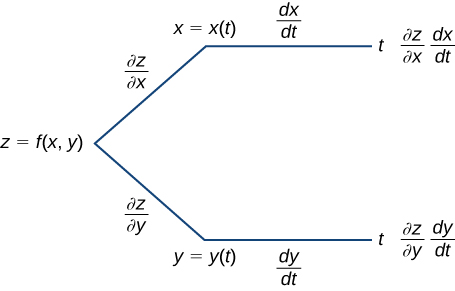
In this diagram, the leftmost corner corresponds to \(z=f(x,y).\) Since \(f\) has two independent variables, there are two lines coming from this corner. The upper branch corresponds to the variable \(x\) and the lower branch corresponds to the variable \(y.\) Since each of these variables is then dependent on one variable \(t,\) one branch then comes from \(x\) and one branch comes from \(y.\) Last, each of the branches on the far right has a label that represents the path traveled to reach that branch. The top branch is reached by following the \(x\) branch, then the \(t\) branch; therefore, it is labeled \((∂z\text{/}∂x)\,\times \,(dx\text{/}dt).\) The bottom branch is similar: first the \(y\) branch, then the \(t\) branch. This branch is labeled \((∂z\text{/}∂y)\,\times \,(dy\text{/}dt).\) To get the formula for \(dz\text{/}dt,\) add all the terms that appear on the rightmost side of the diagram. This gives us Equation 2.
In Chain Rule for Two Independent Variables, \(z=f(x,y)\) is a function of \(x\,\text{and}\,y,\) and both \(x=g(u,v)\) and \(y=h(u,v)\) are functions of the independent variables \(u\,\text{and}\,v.\)
Suppose \(x=g(u,v)\) and \(y=h(u,v)\) are differentiable functions of \(u\) and \(v,\) and \(z=f(x,y)\) is a differentiable function of \(x\,\text{and}\,y.\) Then, \(z=f(g(u,v),h(u,v))\) is a differentiable function of \(u\,\text{and}\,v,\) and
\[\frac{∂z}{∂u}=\frac{∂z}{∂x}\,\frac{∂x}{∂u}+\frac{∂z}{∂y}\,\frac{∂y}{∂u}\]
and
\[\frac{∂z}{∂v}=\frac{∂z}{∂x}\,\frac{∂x}{∂v}+\frac{∂z}{∂y}\,\frac{∂y}{∂v}.\]
We can draw a tree diagram for each of these formulas as well as follows.
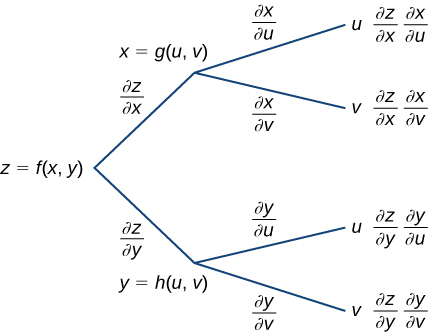
To derive the formula for \(∂z\text{/}∂u,\) start from the left side of the diagram, then follow only the branches that end with \(u\) and add the terms that appear at the end of those branches. For the formula for \(∂z\text{/}∂v,\) follow only the branches that end with \(v\) and add the terms that appear at the end of those branches.
There is an important difference between these two chain rule theorems. In Chain Rule for One Independent Variable, the left-hand side of the formula for the derivative is not a partial derivative, but in Chain Rule for Two Independent Variables it is. The reason is that, in Chain Rule for One Independent Variable, \(z\) is ultimately a function of \(t\) alone, whereas in Chain Rule for Two Independent Variables, \(z\) is a function of both \(u\,\text{and}\,v.\)
Calculate \(∂z\text{/}∂u\) and \(∂z\text{/}∂v\) using the following functions:
\[z=f(x,y)=3{x}^{2}-2xy+{y}^{2},x=x(u,v)=3u+2v,y=y(u,v)=4u-v.\]
List the six partial derivatives \(∂z\text{/}∂x,∂z\text{/}∂y,∂x\text{/}∂u,∂x\text{/}∂v,∂y\text{/}∂u,\) and \(∂y\text{/}∂v,\) then combine them with the two-independent-variable chain rule formulas.
To implement the chain rule for two variables, we need six partial derivatives— \(∂z\text{/}∂x,∂z\text{/}∂y,∂x\text{/}∂u,∂x\text{/}∂v,∂y\text{/}∂u,\) and \(∂y\text{/}∂v\text{:}\)
\[\begin{array}{llll}\frac{∂z}{∂x}=6x-2y & & & \frac{∂z}{∂y}=-2x+2y \\ \frac{∂x}{∂u}=3 & & & \frac{∂x}{∂v}=2 \\ \frac{∂y}{∂u}=4 & & & \frac{∂y}{∂v}=-1.\end{array}\]
To find \(∂z\text{/}∂u,\) we use Equation 23:
\[\begin{array}{ll}\frac{∂z}{∂u} & =\frac{∂z}{∂x}\frac{∂x}{∂u}+\frac{∂z}{∂y}\frac{∂y}{∂u} \\ & =3(6x-2y)+4(-2x+2y) \\ & =10x+2y.\end{array}\]
Next, we substitute \(x(u,v)=3u+2v\) and \(y(u,v)=4u-v\text{:}\)
\[\begin{array}{ll}\frac{∂z}{∂u} & =10x+2y \\ & =10(3u+2v)+2(4u-v) \\ & =38u+18v.\end{array}\]
To find \(∂z\text{/}∂v,\) we use Equation 24:
\[\begin{array}{ll}\frac{∂z}{∂v} & =\frac{∂z}{∂x}\,\frac{∂x}{∂v}+\frac{∂z}{∂y}\,\frac{∂y}{∂v} \\ & =2(6x-2y)+(-1)(-2x+2y) \\ & =14x-6y.\end{array}\]
Then we substitute \(x(u,v)=3u+2v\) and \(y(u,v)=4u-v\text{:}\)
\[\begin{array}{ll}\frac{∂z}{∂v} & =14x-6y \\ & =14(3u+2v)-6(4u-v) \\ & =18u+34v.\end{array}\]
Calculate \(∂z\text{/}∂u\) and \(∂z\text{/}∂v\) given the following functions:
\[z=f(x,y)=\frac{2x-y}{x+3y},x(u,v)={e}^{2u}\text{cos}\,3v,y(u,v)={e}^{2u}\text{sin}\,3v.\]
\(\frac{∂z}{∂u}=0,\,\frac{∂z}{∂v}=\frac{-21}{{(3\,\text{sin}\,3v+\text{cos}\,3v)}^{2}}\)
The Generalized Chain Rule
Now that we’ve see how to extend the original chain rule to functions of two variables, it is natural to ask: Can we extend the rule to more than two variables? The answer is yes, as the generalized chain rule states.
Let \(w=f({x}_{1},{x}_{2}\text{,…,}\,{x}_{m})\) be a differentiable function of \(m\) independent variables, and for each \(i\in \{1\text{,…,}\,m\},\) let \({x}_{i}={x}_{i}({t}_{1},{t}_{2}\text{,…,}\,{t}_{n})\) be a differentiable function of \(n\) independent variables. Then
\[\frac{∂w}{∂{t}_{j}}=\frac{∂w}{∂{x}_{1}}\,\frac{∂{x}_{1}}{∂{t}_{j}}+\frac{∂w}{∂{x}_{2}}\,\frac{∂{x}_{2}}{∂{t}_{j}}+\cdots +\frac{∂w}{∂{x}_{m}}\,\frac{∂{x}_{m}}{∂{t}_{j}}\]
for any \(j\in \{1,2\text{,…,}\,n\}.\)
In the next example we calculate the derivative of a function of three independent variables in which each of the three variables is dependent on two other variables.
Calculate \(∂w\text{/}∂u\) and \(∂w\text{/}∂v\) using the following functions:
\[\begin{array}{lll} \\ w & = & f(x,y,z)=3{x}^{2}-2xy+4{z}^{2} \\ x & = & x(u,v)={e}^{u}\text{sin}\,v \\ y & = & y(u,v)={e}^{u}\text{cos}\,v \\ z & = & z(u,v)={e}^{u}.\end{array}\]
List all nine partial derivatives you need — three of \(w\) with respect to \(x,y,z,\) and six of \(x,y,z\) with respect to \(u,v\) — then combine them with the generalized chain rule.
The formulas for \(∂w\text{/}∂u\) and \(∂w\text{/}∂v\) are
\[\begin{array}{l}\frac{∂w}{∂u}=\frac{∂w}{∂x}·\frac{∂x}{∂u}+\frac{∂w}{∂y}·\frac{∂y}{∂u}+\frac{∂w}{∂z}·\frac{∂z}{∂u} \\ \frac{∂w}{∂v}=\frac{∂w}{∂x}·\frac{∂x}{∂v}+\frac{∂w}{∂y}·\frac{∂y}{∂v}+\frac{∂w}{∂z}·\frac{∂z}{∂v}.\end{array}\]
Therefore, there are nine different partial derivatives that need to be calculated and substituted. We need to calculate each of them:
\[\begin{array}{lllllllllllll}\frac{∂w}{∂x} & = & 6x-2y & & & \frac{∂w}{∂y} & = & -2x & & & \frac{∂w}{∂z} & = & 8z \\ \frac{∂x}{∂u} & = & {e}^{u}\text{sin}\,v & & & \frac{∂y}{∂u} & = & {e}^{u}\text{cos}\,v & & & \frac{∂z}{∂u} & = & {e}^{u} \\ \frac{∂x}{∂v} & = & {e}^{u}\text{cos}\,v & & & \frac{∂y}{∂v} & = & \text{-}{e}^{u}\text{sin}\,v & & & \frac{∂z}{∂v} & = & 0.\end{array}\]
Now, we substitute each of them into the first formula to calculate \(∂w\text{/}∂u\text{:}\)
\[\begin{array}{ll}\frac{∂w}{∂u} & =\frac{∂w}{∂x}·\frac{∂x}{∂u}+\frac{∂w}{∂y}·\frac{∂y}{∂u}+\frac{∂w}{∂z}·\frac{∂z}{∂u} \\ & =(6x-2y){e}^{u}\text{sin}\,v-2x{e}^{u}\text{cos}\,v+8z{e}^{u},\end{array}\]
then substitute \(x(u,v)={e}^{u}\text{sin}\,v,y(u,v)={e}^{u}\text{cos}\,v,\) and \(z(u,v)={e}^{u}\) into this equation:
\[\begin{array}{ll}\frac{∂w}{∂u} & =(6x-2y){e}^{u}\text{sin}\,v-2x{e}^{u}\text{cos}\,v+8z{e}^{u} \\ & =(6{e}^{u}\text{sin}\,v-2{e}^{u}\text{cos}\,v){e}^{u}\text{sin}\,v-2({e}^{u}\text{sin}\,v){e}^{u}\text{cos}\,v+8{e}^{2u} \\ & =6{e}^{2u}{\text{sin}}^{2}v-4{e}^{2u}\text{sin}\,v\,\text{cos}\,v+8{e}^{2u} \\ & =2{e}^{2u}(3\,{\text{sin}}^{2}v-2\,\text{sin}\,v\,\text{cos}\,v+4).\end{array}\]
Next, we calculate \(∂w\text{/}∂v\text{:}\)
\[\begin{array}{ll}\frac{∂w}{∂v} & =\frac{∂w}{∂x}·\frac{∂x}{∂v}+\frac{∂w}{∂y}·\frac{∂y}{∂v}+\frac{∂w}{∂z}·\frac{∂z}{∂v} \\ & =(6x-2y){e}^{u}\text{cos}\,v-2x(\text{-}{e}^{u}\text{sin}\,v)+8z(0),\end{array}\]
then we substitute \(x(u,v)={e}^{u}\text{sin}\,v,y(u,v)={e}^{u}\text{cos}\,v,\) and \(z(u,v)={e}^{u}\) into this equation:
\[\begin{array}{ll}\frac{∂w}{∂v} & =(6x-2y){e}^{u}\text{cos}\,v-2x(\text{-}{e}^{u}\text{sin}\,v) \\ & =(6{e}^{u}\text{sin}\,v-2{e}^{u}\text{cos}\,v){e}^{u}\text{cos}\,v+2({e}^{u}\text{sin}\,v)({e}^{u}\text{sin}\,v) \\ & =2{e}^{2u}{\text{sin}}^{2}v+6{e}^{2u}\text{sin}\,v\,\text{cos}\,v-2{e}^{2u}{\text{cos}}^{2}v \\ & =2{e}^{2u}(v+3\text{sin} \text{sin }v \text{cos} \text{cos }v-v).\end{array}\]
Calculate \(∂w\text{/}∂u\) and \(∂w\text{/}∂v\) given the following functions:
\[\begin{array}{lll} \\ \\ w & = & f(x,y,z)=\frac{x+2y-4z}{2x-y+3z} \\ x & = & x(u,v)={e}^{2u}\text{cos}\,3v \\ y & = & y(u,v)={e}^{2u}\text{sin}\,3v \\ z & = & z(u,v)={e}^{2u}.\end{array}\]
\(\begin{array}{l}\frac{∂w}{∂u}=0 \\ \frac{∂w}{∂v}=\frac{15-33\,\text{sin}\,3v+6\,\text{cos}\,3v}{{(3+2\,\text{cos}\,3v-\text{sin}\,3v)}^{2}}\end{array}\)
Create a tree diagram for the case when
\[w=f(x,y,z),x=x(t,u,v),y=y(t,u,v),z=z(t,u,v)\]
and write out the formulas for the three partial derivatives of \(w.\)
Draw one branch out of \(w\) for each of \(x,y,z,\) then three sub-branches from each of those for \(t,u,v,\) and read each chain-rule term off the path from \(w\) to the far-right variable.
Starting from the left, the function \(f\) has three independent variables: \(x,y,\text{and}\,z.\) Therefore, three branches must be emanating from the first node. Each of these three branches also has three branches, for each of the variables \(t,u,\,\text{and}\,v.\)
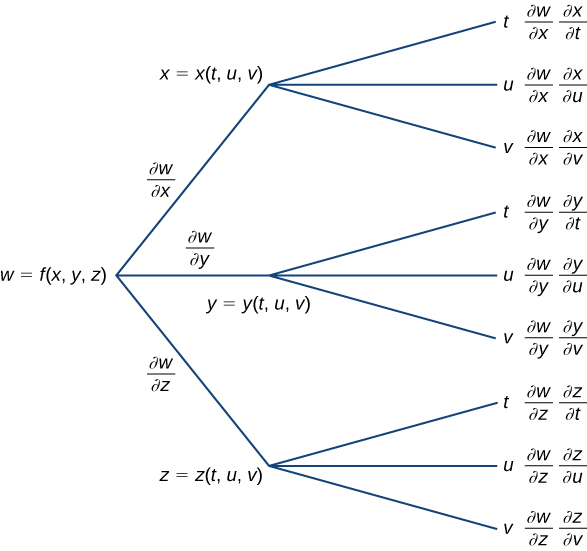
The three formulas are
\[\begin{array}{l}\frac{∂w}{∂t}=\frac{∂w}{∂x}\,\frac{∂x}{∂t}+\frac{∂w}{∂y}\,\frac{∂y}{∂t}+\frac{∂w}{∂z}\,\frac{∂z}{∂t} \\ \frac{∂w}{∂u}=\frac{∂w}{∂x}\,\frac{∂x}{∂u}+\frac{∂w}{∂y}\,\frac{∂y}{∂u}+\frac{∂w}{∂z}\,\frac{∂z}{∂u} \\ \frac{∂w}{∂v}=\frac{∂w}{∂x}\,\frac{∂x}{∂v}+\frac{∂w}{∂y}\,\frac{∂y}{∂v}+\frac{∂w}{∂z}\,\frac{∂z}{∂v}.\end{array}\]
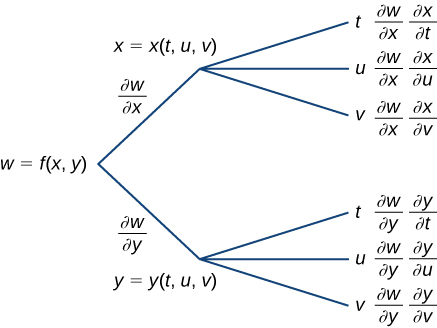
Create a tree diagram for the case when
\[w=f(x,y),x=x(t,u,v),y=y(t,u,v)\]
and write out the formulas for the three partial derivatives of \(w.\)
\(\begin{array}{l}\frac{∂w}{∂t}=\frac{∂w}{∂x}\,\frac{∂x}{∂t}+\frac{∂w}{∂y}\,\frac{∂y}{∂t} \\ \frac{∂w}{∂u}=\frac{∂w}{∂x}\,\frac{∂x}{∂u}+\frac{∂w}{∂y}\,\frac{∂y}{∂u} \\ \frac{∂w}{∂v}=\frac{∂w}{∂x}\,\frac{∂x}{∂v}+\frac{∂w}{∂y}\,\frac{∂y}{∂v}\end{array}\)
Implicit Differentiation
Recall from Implicit Differentiation that implicit differentiation provides a method for finding \(dy\text{/}dx\) when \(y\) is defined implicitly as a function of \(x.\) The method involves differentiating both sides of the equation defining the function with respect to \(x,\) then solving for \(dy\text{/}dx.\) Partial derivatives provide an alternative to this method.
Consider the ellipse defined by the equation \({x}^{2}+3{y}^{2}+4y-4=0\) as follows.
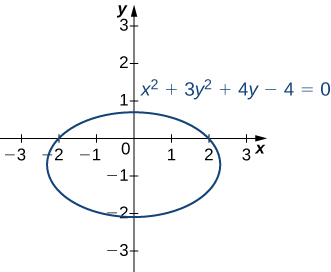
This equation implicitly defines \(y\) as a function of \(x.\) As such, we can find the derivative \(dy\text{/}dx\) using the method of implicit differentiation:
\[\begin{array}{lll}\frac{d}{dx}({x}^{2}+3{y}^{2}+4y-4) & = & \frac{d}{dx}(0) \\ 2x+6y\frac{dy}{dx}+4\frac{dy}{dx} & = & 0 \\ (6y+4)\frac{dy}{dx} & = & -2x \\ \frac{dy}{dx} & = & -\frac{x}{3y+2}.\end{array}\]
We can also define a function \(z=f(x,y)\) by using the left-hand side of the equation defining the ellipse. Then \(f(x,y)={x}^{2}+3{y}^{2}+4y-4.\) The ellipse \({x}^{2}+3{y}^{2}+4y-4=0\) can then be described by the equation \(f(x,y)=0.\) Using this function and the following theorem gives us an alternative approach to calculating \(dy\text{/}dx.\)
Suppose the function \(z=f(x,y)\) defines \(y\) implicitly as a function \(y=g(x)\) of \(x\) via the equation \(f(x,y)=0.\) Then
\[\frac{dy}{dx}=-\frac{∂f\text{/}∂x}{∂f\text{/}∂y}\]
provided \({f}_{y}(x,y)\ne 0.\)
If the equation \(f(x,y,z)=0\) defines \(z\) implicitly as a differentiable function of \(x\,\text{and}\,y,\) then
\[\frac{∂z}{∂x}=-\frac{∂f\text{/}∂x}{∂f\text{/}∂z}\,\text{and}\,\frac{∂z}{∂y}=-\frac{∂f\text{/}∂y}{∂f\text{/}∂z}\]
as long as \({f}_{z}(x,y,z)\ne 0.\)
Equation 45 is a direct consequence of Equation 23. In particular, if we assume that \(y\) is defined implicitly as a function of \(x\) via the equation \(f(x,y)=0,\) we can apply the chain rule to find \(dy\text{/}dx\text{:}\)
\[\begin{array}{lll}\frac{d}{dx}f(x,y) & = & \frac{d}{dx}(0) \\ \frac{∂f}{∂x}·\frac{dx}{dx}+\frac{∂f}{∂y}·\frac{dy}{dx} & = & 0 \\ \frac{∂f}{∂x}+\frac{∂f}{∂y}·\frac{dy}{dx} & = & 0.\end{array}\]
Solving this equation for \(dy\text{/}dx\) gives Equation 45. Equation 46 can be derived in a similar fashion.
Let’s now return to the problem that we started before the previous theorem. Using Implicit Differentiation of a Function of Two or More Variables and the function \(f(x,y)={x}^{2}+3{y}^{2}+4y-4,\) we obtain
\[\begin{array}{l}\frac{∂f}{∂x}=2x \\ \frac{∂f}{∂y}=6y+4.\end{array}\]
Then Equation 45 gives
\[\frac{dy}{dx}=-\frac{∂f\text{/}∂x}{∂f\text{/}∂y}=-\frac{2x}{6y+4}=-\frac{x}{3y+2},\]
which is the same result obtained by the earlier use of implicit differentiation.
- Calculate \(dy\text{/}dx\) if \(y\) is defined implicitly as a function of \(x\) via the equation \(3{x}^{2}-2xy+{y}^{2}+4x-6y-11=0.\) What is the equation of the tangent line to the graph of this curve at point \((2,1)?\)
- Calculate \(∂z\text{/}∂x\) and \(∂z\text{/}∂y,\) given \({x}^{2}{e}^{y}-yz{e}^{x}=0.\)
Set \(f\) equal to the left-hand side of the equation (so \(f=0\) describes the curve or surface), compute the needed partials of \(f,\) then apply the implicit-differentiation formula \(dy\text{/}dx=-{f}_{x}\text{/}{f}_{y}\) (or its \(z\) analogue).
- Set \(f(x,y)=3{x}^{2}-2xy+{y}^{2}+4x-6y-11=0,\) then calculate \({f}_{x}\) and \({f}_{y}\text{:}\) \(\begin{array}{l}{f}_{x}=6x-2y+4 \\ {f}_{y}=-2x+2y-6.\end{array}\)
The derivative is given by
The slope of the tangent line at point \((2,1)\) is given by
To find an equation of the tangent line, we use the point-slope form (Figure 5):
\[\frac{dy}{dx}=-\frac{∂f\text{/}∂x}{∂f\text{/}∂y}=-\frac{6x-2y+4}{-2x+2y-6}=\frac{3x-y+2}{x-y+3}.\]
\[{\frac{dy}{dx}|}_{(x,y)=(2,1)}=\frac{3(2)-1+2}{2-1+3}=\frac{7}{4}.\]
\[\begin{array}{lll}y-{y}_{0} & = & m(x-{x}_{0}) \\ y-1 & = & \frac{7}{4}(x-2) \\ y & = & \frac{7}{4}x-\frac{7}{2}+1 \\ y & = & \frac{7}{4}x-\frac{5}{2}.\end{array}\]
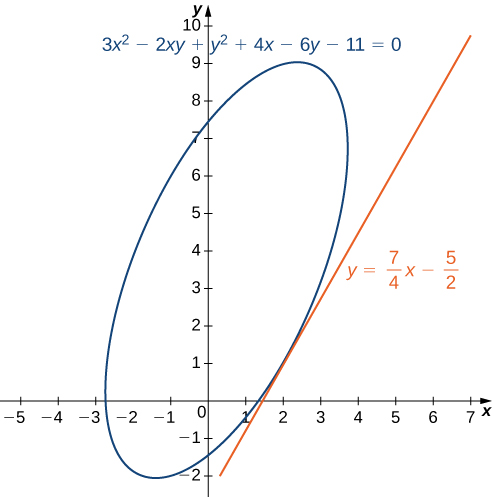
Figure 5 — Graph of the rotated ellipse defined by \(3{x}^{2}-2xy+{y}^{2}+4x-6y-11=0.\) - We have \(f(x,y,z)={x}^{2}{e}^{y}-yz{e}^{x}.\) Therefore,
Using Equation 46,\[\begin{array}{l}\frac{∂f}{∂x}=2x{e}^{y}-yz{e}^{x} \\ \frac{∂f}{∂y}={x}^{2}{e}^{y}-z{e}^{x} \\ \frac{∂f}{∂z}=\text{-}y{e}^{x}.\end{array}\]
\[\begin{array}{lllllll}\begin{array}{ll}\frac{∂z}{∂x} & =-\frac{∂f\text{/}∂x}{∂f\text{/}∂z} \\ & =-\frac{2x{e}^{y}-yz{e}^{x}}{\text{-}y{e}^{x}} \\ & =\frac{2x{e}^{y}-yz{e}^{x}}{y{e}^{x}}\end{array} & & & \text{and} & & & \begin{array}{ll}\frac{∂z}{∂y} & =-\frac{∂f\text{/}∂y}{∂f\text{/}∂z} \\ & =-\frac{{x}^{2}{e}^{y}-z{e}^{x}}{\text{-}y{e}^{x}} \\ & =\frac{{x}^{2}{e}^{y}-z{e}^{x}}{y{e}^{x}}.\end{array}\end{array}\]
Find \(dy\text{/}dx\) if \(y\) is defined implicitly as a function of \(x\) by the equation \({x}^{2}+xy-{y}^{2}+7x-3y-26=0.\) What is the equation of the tangent line to the graph of this curve at point \((3,-2)?\)
\(\frac{dy}{dx}={\frac{2x+y+7}{2y-x+3}|}_{(3,-2)}=\frac{2(3)+(-2)+7}{2(-2)-(3)+3}=-\frac{11}{4}\)
Equation of the tangent line: \(y=-\frac{11}{4}x+\frac{25}{4}\)
Key Concepts
- The chain rule for functions of more than one variable involves the partial derivatives with respect to all the independent variables. (See Example 1, Example 2, and Example 3.)
- Tree diagrams are useful for deriving formulas for the chain rule for functions of more than one variable, where each independent variable also depends on other variables. (See Example 4.)
Key Equations
| Chain rule, one independent variable | \(\frac{dz}{dt}=\frac{∂z}{∂x}·\frac{dx}{dt}+\frac{∂z}{∂y}·\frac{dy}{dt}\) |
| Chain rule, two independent variables | \(\frac{dz}{du}=\frac{∂z}{∂x}\frac{∂x}{∂u}+\frac{∂z}{∂y}\frac{∂x}{∂u}\) \(\frac{dz}{dv}=\frac{∂z}{∂x}\frac{∂x}{∂v}+\frac{∂z}{∂y}\frac{∂y}{∂v}\) |
| Generalized chain rule | \(\frac{∂w}{∂{t}_{j}}=\frac{∂w}{∂{x}_{1}}\,\frac{∂{x}_{1}}{∂{t}_{j}}+\frac{∂w}{∂{x}_{2}}\,\frac{∂{x}_{1}}{∂{t}_{j}}+\cdots +\frac{∂w}{∂{x}_{m}}\,\frac{∂{x}_{m}}{∂{t}_{j}}\) |
Section Exercises
For the following exercises, use the information provided to solve the problem.
Let \(w(x,y,z)=xy\,\text{cos}\,z,\) where \(x=t,y={t}^{2},\) and \(z=\text{arcsin}\,t.\) Find \(\frac{dw}{dt}.\)
\(\frac{dw}{dt}=\frac{3{t}^{2}-4{t}^{2}}{\sqrt{1-{t}^{2}}}\)
Let \(w(t,v)={e}^{tv}\) where \(t=r+s\) and \(v=rs.\) Find \(\frac{∂w}{∂r}\) and \(\frac{∂w}{∂s}.\)
If \(w=5{x}^{2}+2{y}^{2},x=-3s+t,\) and \(y=s-4t,\) find \(\frac{∂w}{∂s}\) and \(\frac{∂w}{∂t}.\)
\(\frac{∂w}{∂s}=94s-46t,\) \(\frac{∂w}{∂t}=-46s+74t\)
If \(w=x{y}^{2},x=5\,\text{cos}(2t),\) and \(y=5\,\text{sin}(2t),\) find \(\frac{dw}{dt}.\)
If \(f(x,y)=xy,x=r\,\text{cos}\,θ,\) and \(y=r\,\text{sin}\,θ,\) find \(\frac{∂f}{∂r}\) and express the answer in terms of \(r\) and \(θ.\)
\(\frac{∂f}{∂r}=r\,\text{sin}(2θ)\)
Suppose \(f(x,y)=x+y,\) where \(x=r\,\text{cos}\,θ\) and \(y=r\,\text{sin}\,θ.\) Find \(\frac{∂f}{∂θ}.\)
For the following exercises, find \(\frac{df}{dt}\) using the chain rule and direct substitution.
\(f(x,y)={x}^{2}+{y}^{2},\) \(x=t,y={t}^{2}\)
\(\frac{df}{dt}=2t+4{t}^{3}\)
\(f(x,y)=\sqrt{{x}^{2}+{y}^{2}},y={t}^{2},x=t\)
\(f(x,y)=xy,x=1-\sqrt{t},y=1+\sqrt{t}\)
\(\frac{df}{dt}=-1\)
\(f(x,y)=\frac{x}{y},x={e}^{t},y=2{e}^{t}\)
\(f(x,y)=\text{ln}(x+y),\) \(x={e}^{t},y={e}^{t}\)
\(\frac{df}{dt}=1\)
\(f(x,y)={x}^{4},\) \(x=t,y=t\)
Let \(w(x,y,z)={x}^{2}+{y}^{2}+{z}^{2},\) \(x=\text{cos}\,t,y=\text{sin}\,t,\) and \(z={e}^{t}.\) Express \(w\) as a function of \(t\) and find \(\frac{dw}{dt}\) directly. Then, find \(\frac{dw}{dt}\) using the chain rule.
\(\frac{dw}{dt}=2{e}^{2t}\) in both cases
Let \(z={x}^{2}y,\) where \(x={t}^{2}\) and \(y={t}^{3}.\) Find \(\frac{dz}{dt}.\)
Let \(u={e}^{x}\text{sin}\,y,\) where \(x=-ln2t\) and \(y=\pi t.\) Find \(\frac{du}{dt}\) when \(x=\text{ln}\,2\) and \(y=\frac{\pi }{4}.\)
\(\frac{du}{dt}=\sqrt{2}(\pi -4)\)
For the following exercises, find \(\frac{dy}{dx}\) using partial derivatives.
\(\text{sin}(6x)+\text{tan}(8y)+5=0\)
\({x}^{3}+{y}^{2}x-3=0\)
\(\frac{dy}{dx}=-\frac{3{x}^{2}+{y}^{2}}{2xy}\)
\(\text{sin}(x+y)+\text{cos}(x-y)=4\)
\({x}^{2}-2xy+{y}^{4}=4\)
\(\frac{dy}{dx}=\frac{y-x}{\text{-}x+2{y}^{3}}\)
\(x{e}^{y}+y{e}^{x}-2{x}^{2}y=0\)
\({x}^{2\text{/}3}+{y}^{2\text{/}3}={a}^{2\text{/}3}\)
\(\frac{dy}{dx}=\text{-}\sqrt[3]{\frac{y}{x}}\)
\(x\,\text{cos}(xy)+y\,\text{cos}\,x=2\)
\({e}^{xy}+y{e}^{y}=1\)
\(\frac{dy}{dx}=-\frac{y{e}^{xy}}{x{e}^{xy}+{e}^{y}(1+y)}\)
\({x}^{2}{y}^{3}+\text{cos}\,y=0\)
Find \(\frac{dz}{dt}\) using the chain rule where \(z=3{x}^{2}{y}^{3},x={t}^{4},\) and \(y={t}^{2}.\)
\(\frac{dz}{dt}=42{t}^{13}\)
Let \(z=3\,\text{cos}\,x-\text{sin}(xy),x=\frac{1}{t},\) and \(y=3t.\) Find \(\frac{dz}{dt}.\)
Let \(z={e}^{1-xy},x={t}^{1\text{/}3},\) and \(y={t}^{3}.\) Find \(\frac{dz}{dt}.\)
\(\frac{dz}{dt}=-\frac{10}{3}{t}^{7\text{/}3}\,\times \,{e}^{1-{t}^{10\text{/}3}}\)
Find \(\frac{dz}{dt}\) by the chain rule where \(z={\text{cosh}}^{2}(xy),x=\frac{1}{2}t,\) and \(y={e}^{t}.\)
Let \(z=\frac{x}{y},x=2\,\text{cos}\,u,\) and \(y=3\,\text{sin}\,v.\) Find \(\frac{∂z}{∂u}\) and \(\frac{∂z}{∂v}.\)
\(\frac{∂z}{∂u}=\frac{-2\,\text{sin}\,u}{3\,\text{sin}\,v}\) and \(\frac{∂z}{∂v}=\frac{-2\,\text{cos}\,u\,\text{cos}\,v}{3\,{\text{sin}}^{2}v}\)
Let \(z={e}^{{x}^{2}y},\) where \(x=\sqrt{uv}\) and \(y=\frac{1}{v}.\) Find \(\frac{∂z}{∂u}\) and \(\frac{∂z}{∂v}.\)
If \(z=xy{e}^{x\text{/}y},\) \(x=r\,\text{cos}\,θ,\) and \(y=r\,\text{sin}\,θ,\) find \(\frac{∂z}{∂r}\) and \(\frac{∂z}{∂θ}\) when \(r=2\) and \(θ=\frac{\pi }{6}.\)
\(\frac{∂z}{∂r}=\sqrt{3}{e}^{\sqrt{3}},\) \(\frac{∂z}{∂θ}=(2-4\sqrt{3}){e}^{\sqrt{3}}\)
Find \(\frac{∂w}{∂s}\) if \(w=4x+{y}^{2}+{z}^{3},x={e}^{r{s}^{2}},y=\text{ln}(\frac{r+s}{t}),\) and \(z=rs{t}^{2}.\)
If \(w=\text{sin}(xyz),x=1-3t,y={e}^{1-t},\) and \(z=4t,\) find \(\frac{∂w}{∂t}.\)
\(\frac{∂w}{∂t}=\left(-12t{e}^{1-t}cos\left((1-3t){e}^{1-t}(-4t)\right)+4t(1-3t){e}^{1-t}cos\left((1-3t){e}^{1-t}(-4t)\right)-4(1-3t){e}^{1-t}cos\left((1-3t){e}^{1-t}(-4t)\right)\right)\)
For the following exercises, use this information: A function \(f(x,y)\) is said to be homogeneous of degree \(n\) if \(f(tx,ty)={t}^{n}f(x,y).\) For all homogeneous functions of degree \(n,\) the following equation is true: \(x\frac{∂f}{∂x}+y\frac{∂f}{∂y}=nf(x,y).\) Show that the given function is homogeneous and verify that \(x\frac{∂f}{∂x}+y\frac{∂f}{∂y}=nf(x,y).\)
\(f(x,y)=3{x}^{2}+{y}^{2}\)
\(f(x,y)=\sqrt{{x}^{2}+{y}^{2}}\)
\(f(tx,ty)=\sqrt{{t}^{2}{x}^{2}+{t}^{2}{y}^{2}}={t}^{1}f(x,y),\) \(\frac{∂f}{∂y}=x\frac{1}{2}{({x}^{2}+{y}^{2})}^{\text{-}1\text{/}2}\,\times \,2x+y\frac{1}{2}{({x}^{2}+{y}^{2})}^{\text{-}1\text{/}2}\,\times \,2y=1f(x,y)\)
\(f(x,y)={x}^{2}y-2{y}^{3}\)
The volume of a right circular cylinder is given by \(V(x,y)=\pi {x}^{2}y,\) where \(x\) is the radius of the cylinder and y is the cylinder height. Suppose \(x\) and \(y\) are functions of \(t\) given by \(x=\frac{1}{2}t\) and \(y=\frac{1}{3}t\) so that \(x\,\text{and}\,y\) are both increasing with time. How fast is the volume increasing when \(x=2\) and \(y=\frac{4}{3}?\)
\(V'=4\pi\)
The pressure \(P\) of a gas is related to the volume and temperature by the formula \(PV=kT,\) where temperature is expressed in kelvins. Express the pressure of the gas as a function of both \(V\) and \(T.\) Find \(\frac{dP}{dt}\) when \(k=1,\) \(\frac{dV}{dt}=2\) cm3/min, \(\frac{dT}{dt}=\frac{1}{2}\) K/min, \(V=20\) cm3, and \(T=20\text{°}\text{F}.\)
The radius of a right circular cone is increasing at \(3\) cm/min whereas the height of the cone is decreasing at \(2\) cm/min. Find the rate of change of the volume of the cone when the radius is \(13\) cm and the height is \(18\) cm.
\(\frac{dV}{dt}=\frac{1066\pi }{3}{\text{cm}}^{3}\text{/}\text{min}\)
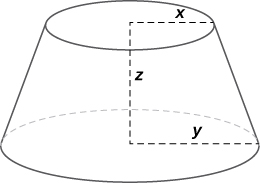
The volume of a frustum of a cone is given by the formula \(V=\frac{1}{3}\pi z({x}^{2}+{y}^{2}+xy),\) where \(x\) is the radius of the smaller circle, \(y\) is the radius of the larger circle, and \(z\) is the height of the frustum (see figure). Find the rate of change of the volume of this frustum when \(x=10\,\text{in}\text{.,}\,y=12\,\text{in.,}\,\text{and}\,z=18\,\text{in}.\) if \(\frac{dz}{dt}=-5,\frac{dx}{dt}=1,\frac{dy}{dt}=1\) (all in/min).
A closed box is in the shape of a rectangular solid with dimensions \(x,y,\,\text{and}\,z.\) (Dimensions are in inches.) Suppose each dimension is changing at the rate of \(0.5\) in./min. Find the rate of change of the total surface area of the box when \(x=2\,\text{in}\text{.,}\,y=3\,\text{in.,}\,\text{and}\,z=1\,\text{in}.\)
\(\frac{dA}{dt}=12\,\text{in}{.}^{2}\text{/}\text{min}\)
The total resistance in a circuit that has three individual resistances represented by \(x,y,\) and \(z\) is given by the formula \(R(x,y,z)=\frac{xyz}{yz+xz+xy}.\) Suppose at a given time the \(x\) resistance is \(100\Omega ,\) the y resistance is \(200\Omega ,\) and the \(z\) resistance is \(300\Omega .\) Also, suppose the \(x\) resistance is changing at a rate of \(2\Omega \text{/}\text{min},\) the \(y\) resistance is changing at the rate of \(1\Omega \text{/}\text{min},\) and the \(z\) resistance has no change. Find the rate of change of the total resistance in this circuit at this time.
The temperature \(T\) at a point \((x,y)\) is \(T(x,y)\) and is measured using the Celsius scale. A fly crawls so that its position after \(t\) seconds is given by \(x=\sqrt{1+t}\) and \(y=2+\frac{1}{3}t,\) where \(x\,\text{and}\,y\) are measured in centimeters. The temperature function satisfies \({T}_{x}(2,3)=4\) and \({T}_{y}(2,3)=3.\) How fast is the temperature increasing on the fly’s path after \(3\) sec?
\(2\text{°}\text{C/sec}\)
The \(x\,\text{and}\,y\) components of a fluid moving in two dimensions are given by the following functions: \(u(x,y)=2y\) and \(v(x,y)=-2x;\) \(x\ge 0;y\ge 0.\) The speed of the fluid at the point \((x,y)\) is \(s(x,y)=\sqrt{u{(x,y)}^{2}+v{(x,y)}^{2}}.\) Find \(\frac{∂s}{∂x}\) and \(\frac{∂s}{∂y}\) using the chain rule.
Let \(u=u(x,y,z),\) where \(x=x(w,t),y=y(w,t),z=z(w,t),w=w(r,s),\text{and}\,t=t(r,s).\) Use a tree diagram and the chain rule to find an expression for \(\frac{∂u}{∂r}.\)
\(\begin{array}{ll}\frac{∂u}{∂r} & =\frac{∂u}{∂x}(\frac{∂x}{∂w}\,\frac{∂w}{∂r}+\frac{∂x}{∂t}\,\frac{∂t}{∂r})+\frac{∂u}{∂y}(\frac{∂y}{∂w}\,\frac{∂w}{∂r}+\frac{∂y}{∂t}\,\frac{∂t}{∂r}) \\ & \,+\frac{∂u}{∂z}(\frac{∂z}{∂w}\,\frac{∂w}{∂r}+\frac{∂z}{∂t}\,\frac{∂t}{∂r})\end{array}\)
Glossary
- generalized chain rule
- the chain rule extended to functions of more than one independent variable, in which each independent variable may depend on one or more other variables
- intermediate variable
- given a composition of functions (e.g., \(f(x(t),y(t))),\) the intermediate variables are the variables that are independent in the outer function but dependent on other variables as well; in the function \(f(x(t),y(t)),\) the variables \(x\,\text{and}\,y\) are examples of intermediate variables
- tree diagram
- illustrates and derives formulas for the generalized chain rule, in which each independent variable is accounted for